


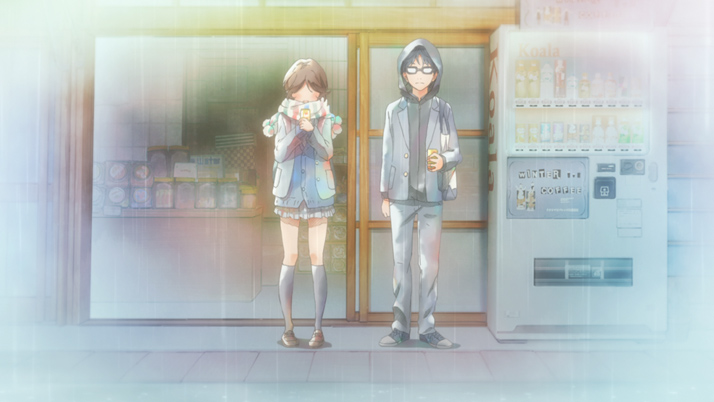
The visual of a pair of hands can evoke a great many emotions; they can mean a lot of things – steadiness, strength, warmth. In Your Lie in April, they certainly reveal ability and talent, but in episode 20, the imagery of hands means so much more -they represent both power and powerlessness, the ability to create and the inability to aid.
The episode continues to develop Tsubaki’s storyline and she kinda confesses to Kousei in her tomboyish way. But as is usual, the plot returns to Kousei, who continues to grow, overcoming his discomfort of visiting Kaori with Watari and deciding to go along with him (and even further, telling his friend that he likes his girlfriend). When they arrive at her room, however, they find Kaori convulsing and in need of dire attention from medical staff, as Kousei fixates on her hand, which at first grips onto the railing of her bed before falling away.
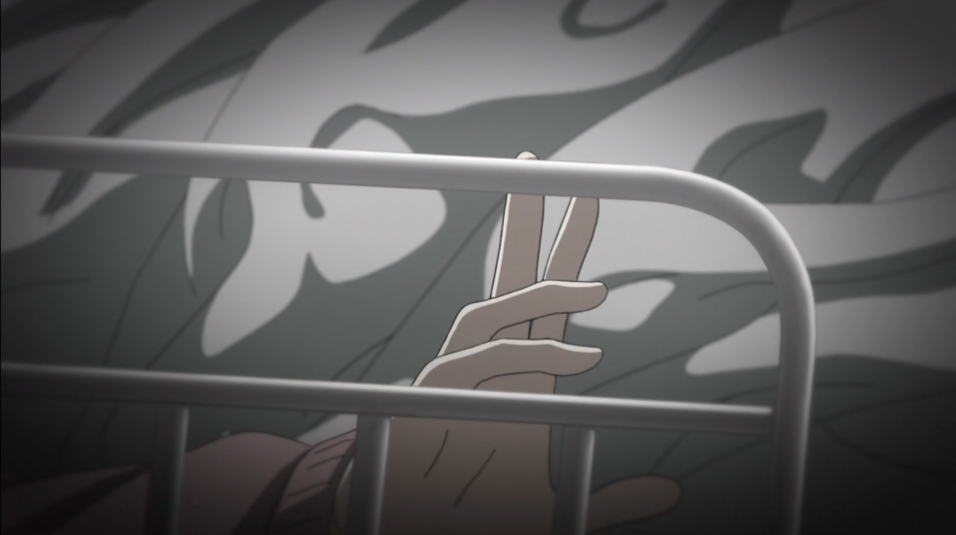
Hands are so meaningful in music. They, of course, are vital tools for the musician – injury or disease to them can destroy a musician’s career. As Kaori loses control of her hands, Kousei still has his, and with his dexterous fingertips he creates beautiful music.
But even with that ability, a realization hits Kousei in this episode – his hands are useless to help Kaori. There’s nothing he can do to help her during her episode, and in fact, he’s in the way, as a hospital staffer declares.
Even worse, not only can Kousei do nothing to help Kaori this very minute, there’s nothing he can do to stop her impending death. This is demonstrated through his attempt to save the black cat; a metaphor for Kaori and reminiscent of Chelsea, Kousei feels that he is again unable to save someone dear to him, and as he stares down at blood-covered hands, he further thinks because he lacks this power, it’s his fault.
The blood on his hands is as obvious an image as can be – death is coming to Kaori, and there’s nothing he can do.
We might be able to relate to Kousei, because even though we may not have felt the same inability to help a loved one that he does, we do all have this is common – we have blood on our hands.
Always used in negative fashion, and often used in a hateful sense, the phrase “blood on your hands” refers to the responsibility one has in someone’s death or another wrong-doing. We may not have been involved in some person’s murder (I certainly hope not!), but we did have a direct role in an execution. Our sins are why we are doomed to die; and God’s love is the reason Jesus came and paid our penalty. His blood is on our hands.
And with this knowledge, it might be easy to become like Kousei is – dejected and guilt-ridden. But blood on another’s hands shows us different. A reversal has occurred. Christ’s nail-driven hands (or wrists) reveal that the blood is not on us, but on him instead. He’s taken the sacrifice and he has bled for us. He chose to go to the cross out of obedience, and through his blood we are saved.
Our hands can help others. They can create, build, and play. But they are ultimately powerless when it comes to life eternal.
Thankfully, a stronger pair of hands takes care of that.


- First Impression: An Observation Log of My Fiancée Who Calls Herself a Villainess - 04.04.2026
- First Impression: Killed again, Mr. Detective. - 04.04.2026
- First Impression: SNOWBALL EARTH - 04.03.2026