We’re so excited to bring you such a variety of manga and reviews this week, including the latest volumes of tried and true series, volume three of both the manga and LN versions of that hammer-wielding, overtime-dreading guild receptionist’s story, and premieres to two new horror-tinged series. Drop down below to read our thoughts and comment with your own!
Akane-banashi (Vol. 6) • Apocalypse Bringer Mynoghra (Vol. 1) • Chitose Is in the Ramune Bottle (Vol. 6) • Fool Night (Vol. 1) • I May Be a Guild Receptionist, but I’ll Solo Any Boss to Clock Out on Time (LN, Vol. 3) • I May Be a Guild Receptionist, but I’ll Solo Any Boss to Clock Out on Time (Manga, Vol. 3) • Issak (Vol. 8) • Tokyo These Days (Vol. 2)
I May Be a Guild Receptionist, but I’ll Solo Any Boss to Clock Out on Time, Light Novel Vol. 3

Please Mr. LN Editor, allow author Mato Kousaka a few more pages to write his story. I assume that must be the issue here, because volume three of I May Be a Guild Receptionist, while overall an excellent work, features an oddly short flashback scene that desperately needed to be developed further to really land the climax; but doing so would have put it over the traditional 180-some pages of content. It’s a real shame, because this entire series, about an OP guild receptionist who desperately wants to do her job without having to work the requisite overtime, but who finds herself wrapped up in a conspiracy involving the resurrection of dark gods, is addicting, is structured well, and keeps us on our toes (until the ending of this volume!). Kousaka sensei masterfully weaves the silliness of Alina’s griping and her budding relationship with Silver Sword guild party leader Jade with exciting action scenes and ever-deepening mythos. Also receiving wonderful treatment in this volume is Jade himself; the author does a terrific job of drawing him and Alina together in a way that’s reasonable, makes sense for their relationship, and strikes the right gooey, rousing, and romantic tones for the reader. I would go as far as to say that Jade’s characterization is the heart of this volume, although the action doesn’t center on him. The antagonist is instead the character whom we’re supposed to be drawn towards, but his treatment is too superficial and obvious; meanwhile, Alina’s past, which comes into play here as well, isn’t given a mention in the volume before the climactic scenes as it probably should, so it doesn’t hit as strongly either as it should either. These lacking elements are disappointing, because I May Be a Guild Receptionist is otherwise so well-written that it rises above simple fun (although it is a fun read!) and more toward the territory of a great LN work. However, it’s not quite there. So I’ll end with that plea once again—Mr. LN Editor, give Kousaka-sensei a few more pages to work with, as I’m sure he’ll figure out how to weave everything together even more tightly and lovingly. And I know this—he’s shown that he’s earned it. ~ Twwk
I May Be a Guild Receptionist, but I’ll Solo Any Boss to Clock Out on Time is published by Yen Press.
READ Reviews of I May Be a Guild Receptionist, but I’ll Solo Any Boss to Clock Out on Time: Vol. 1 // Vol. 2
Akane-banashi, Manga Vol. 6

When Akane tweaked a classic rakugo skit to thumb her nose at a self-important Senior Apprentice, she did it subtly enough that the audience never caught on. But backstage her message was all too obvious. In one fell swoop she burned quite a few bridges, and at the worst possible time to boot. Akane has reached a point in her career where she needs to branch out and learn from other Masters, but because of her newfound ‘reputation’ no Master is willing to teach her—except for Master Urara of the Ransaika School. She’s a living legend who appreciates people with a combative streak, but who also believes that if you can’t back that attitude up, you’re just a punk. To prove her skill, Akane will need to quickly learn a high-level story called “Fetching Tea.” It’s long and complex, and the main character is a wily seductress. That last part is going to be a particular problem, as brash tomboy Akane will need to find a way to play completely against type… In life, many strengths can become weaknesses if you don’t handle them wisely. But by the same token, wisdom can turn many weaknesses into strengths. That’s the overarching theme of this volume as Akane finds herself trying to find a way to portray a character whose personality starkly contradicts her own. And this learning process is the core of what makes Akane such a lovable character. Her experiments with new approaches when her usual plan of attack doesn’t work, and her observations that provide rakugo lessons drawn from everyday life, both give a lot of entertaining twists to such an otherwise straightforward character. In both premise and vibe, Akane-banashi is the Gen Z iteration of Bakuman. And while I think the criticisms which are sometimes raised against the older series’ female characters are inflated, Akane-banashi shows how you can refine and elevate the concept when the writing for your leading ladies levels up from “serviceable” to “really good.” ~ WacOtaku
Akane-banashi is published by VIZ Media.
READ Reviews of Akane-banashi: Vol. 1 // Vol.2 // Vol.3 // Vol.4 // Vol.5
I May Be a Guild Receptionist, but I’ll Solo Any Boss to Clock Out on Time, Manga Vol. 3

If the first two volumes of I May Be a Guild Receptionist were the setup—introducing readers to the overtime-hating, uber-powerful receptionist, Alina; building our fondness for the Silver Sword guild, and especially their tank, Jade; and introducing an obviously villainous character in Rufus, who is likely to lead the entire group into a precarious predicament—volume three is the payoff, and it was worth the wait. Rufus does indeed put everyone in a bind, pushing his way into Silver Sword by threatening to expose Alina; however, he proves to be even more treacherous than imagined because of who it is he leads them to. The real enemy, pictured on the cover of this volume, is both impossibly powerful and at the center of the series’ mythology. Because he’s so much stronger than the party, the tension isn’t in the fight—it’s in wondering if and when Alina will join. And indeed, there’s a lot of drama drawn out in the story taking place away from the dungeon, from Alina’s past coming to light to the final couple of dozen pages which are as exciting as anything in this volume, even though they barely touch on a one-on-one battle. And even though I’m not high on the antagonist’s boorish character design, nor particularly impressed by how the gaming mechanics and other trope elements set themselves apart from other fantasy series, I am happy that the manga proves that it can be exciting and action-packed; it’s not just a humorous story about overwork. As an adaptation, I would say that it does a fair job, too, of capturing all the wonderful plot elements of the original work. I would lean toward the light novel first, but if you’re a manga reader, the first three volumes of I May Be a Guild Receptionist, but I’ll Solo Any Boss to Clock Out on Time have now shown this to be a strong adaptation. ~ Twwk
I May Be a Guild Receptionist, but I’ll Solo Any Boss to Clock Out on Time is published by Yen Press.
READ Reviews of I May Be a Guild Receptionist, but I’ll Solo Any Boss to Clock Out on Time: Vol. 1 // Vol. 2
Tokyo These Days, Manga Vol. 2
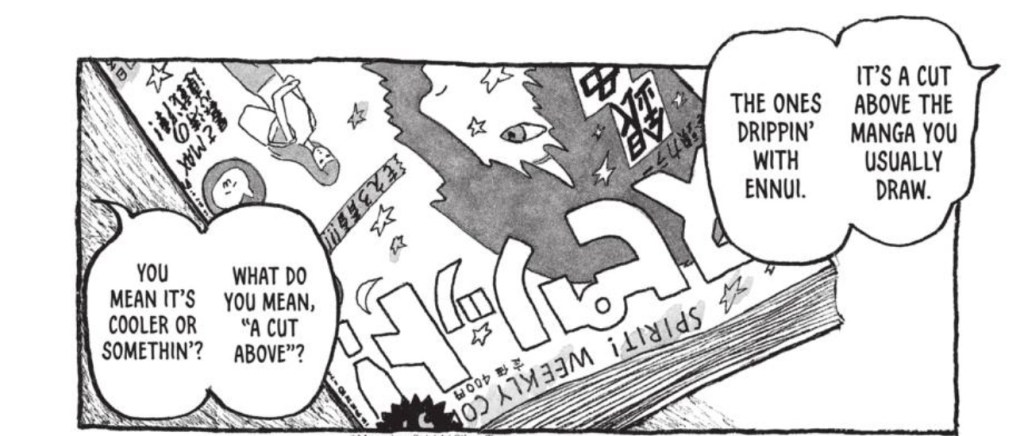
I called volume one of Tokyo These Days a “thoughtful, remarkable work.” Volume two, expanding on the everyday lives and struggles of mangaka and manga editors, is all the more so. The mangaka, Taiyo Matsumoto, engages us with people and scenes that are just a little beyond reality—the bombastic Chosaku, the depressed mega-talent Aoki, the magic realism featuring unicorns and talking birds that are probably (maybe?) just in the characters’ heads—alongside real-life scenarios that hit us right in our hearts. For instance, when Chosaku spends time with his ex-wife and daughter Luna, we as readers wonder if a reunion could be in the works. Could this be what once again inspires Chosaku to create another great manga? Could this help him revitalize his life? But there are hints from the beginning of this story (primarily that Luna has all the same foibles as her dad) that this won’t end tidily and happily. And yet, Chosaku is not going quit making manga. He’s not going to kill himself. And Shiozawa, the main character, will not stop with his all-star manga project, even when faced with old friends who reject him and bookstores unwilling to carry his new work. And Aoki—Aoki!—the character we most worry about because of his depression and the likelihood that he will lose the opportunity he’s created through his massive talent, isn’t easily written off either. The story involving him and his editor, Hayashi, who is coming off the heavy rejection of her kindness toward Shiozawa, expresses the series’ optimism in the face of unrelenting reality. The theme is this: while it may be messy, it may be hidden, and it may be hard to find, hope does exist. It, too, is unrelenting. You can move forward, even moving forward means sometimes going backward, in zigzags, and in circles first. Tokyo These Days is dripping with harsh reality, but because of that, it makes optimistic conclusions and small victories all the more authentic and meaningful. Unfortunately, there’s one more harsh reality involving this series: the story is just getting started, yet only one volume remains. Somehow, though, that seems fitting for this beautiful and complicated tale. ~ Twwk
Tokyo These Days is published by VIZ Media.
Read: Tokyo These Days Vol. 1 Review
Issak, Manga Vol. 8
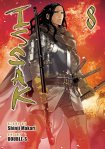
Issak and Heinrich have beaten long odds plenty of times by finding their enemy’s critical weakness and exploiting it. But in their fight against the ruthless and brilliant General Wallenstein, there were no weaknesses to exploit. Their opponent laid his trap carefully, skillfully using his advantages in numbers and firepower to their fullest. Our heroes lost the battle before the first shot was fired, and now the fellowship is broken. Zetta finds herself shepherding the Prince-Elector Frederick V to safety among crowds of Protestant refugees—no easy task considering that he sticks out like a sore thumb among the common people and is currently the most wanted man in the Holy Roman Empire. Issak cut his way out of Wallenstein’s trap, but now he and Lorenzo are locked a deadly game of cat-and-mouse played across the rugged German backcountry. Claus’s survival instincts are second-to-none, so never count him out, but he, Prince Heinrich, and Baroness Von Clarenstein are all unaccounted for… Volume seven appeared to be a rehash of earlier storylines, only to reveal a twist at the end. Now volume eight reaps the storytelling benefits of that twist to give us several riveting chapters, centering around an incredible fight scene between Issak and Lorenzo deep in the wilderness. The two men have burning, furious hatred towards each other, but are also ice-cold strategists who never forget their—or their opponent’s—ultimate goals. For all its visceral violence, the fight is ultimately a battle of wits. It’s one of the smartest action sequences I’ve ever read, period. But action is nothing more than empty spectacle if you don’t care about the characters involved, so thankfully there is some well done character development here as well. Zetta gets the lion’s share of it, but Issak, and even Fredrick V, have their moments. After the last volume felt “fine but nothing special,” this volume brought Issak roaring back with some top-shelf manga material. ~ WacOtaku
Issak is published by Kodansha.
READ Reviews of Issak: Vol. 1 // Vol. 2 // Vol. 3// Vol. 4// Vol. 5// Vol.6 // Vol.7
Fool Night, Manga Vol. 1

Fool Night is a challenging read—it would be too difficult, in fact, if it weren’t for moments of optimism that dwell within the characters and in the story, such as a slightly humorous aside about attending a concert or unseemly interactions between the leads that resemble the same from their childhood years. The largely depressing tone, though, that fills the space between is admittedly fitting for a world where the sun has been blocked out for a century, leading to endless winter and night, and medical experimentation that turns dying humans into plants that will keep this dying world oxygenated. Toshiro, who is unable to make enough to support himself and his mentally ill, violent mother, serendipitously discovers that he can understand what the plant-humans, known as spiriflora, think and feel. These amalgamations themselves are terrifically and darkly creative, creatures that start as humans and become fully (at least superficially) plants two years after the transplant procedure is performed. Toshiro has that long before he fully transforms, but in the interim, he will help his old friend Yomiko as a contract worker who communicates with the spiriflora; his job, specifically, will be to assist the government agency that deals with these beings by providing additional support in their cases, including for a pianist here in volume one. The artwork in the series is tremendous, particularly in the unique and revealing character designs, as well as the aforementioned spiriflora, who are terribly sad and mutated creatures. The worldview is gloomy, apocalyptic, and almost hopeless, though volume one focuses on a story that’s at once realistic for an abusive, painful world and also reflects a ray of light, muted as it is. That part of the story, though, doesn’t hit the emotional notes that I think it was intended to, which doesn’t bode well for the series. If the dark nature is all that feels genuine, then we’re in for a very gloomy ride indeed. I’m hoping that volume two will do a better job with the slight sense of optimism I’m detecting; otherwise, it’ll be too hard to exist in this world, which goes for readers too, despite the attractive and grotesque imagery of it all. ~ Twwk
Fool Night is published by VIZ Media.
Chitose Is in the Ramune Bottle, Manga Vol. 6

Harem series typically feature a plethora of engaging female characters and a male protagonist who is bland, perverted, or both, but Chitose Is in the Ramune Bottle flips that dynamic. Whenever I read the series—and I’m now sticking with just the manga, having dropped the light novels that made me work too hard for too little reward—I think, “Please, please, please, stop with all the girls and focus just on the male protagonist.” What a shocker! That said, volume six at least only features two of the girls from the series, Haru and Nanase, the latter because we’re in the middle of her arc. Chitose continues to try to find Nanase’s stalker while he pretends to be her boyfriend, leading to envy among the other girls (obviously) and a potential showdown near the end of the book. The parts where the girls salivate over Chitose feel disingenuous and gross, and the basketball game in the middle of this volume is likewise poorly executed (it’s neither exciting nor realistic). But when Chitose is thinking aloud or helping others, the series excels. He’s a good dude, just trying to figure it out like we all were at that age. Though, as I’ve said before, there’s nothing about Chitose that would make all these beautiful girls want to throw themselves at him, and since that’s a central conceit of the series, it’s hard to ignore that lack of realism. But with a manga that reads this quickly, you don’t have to dwell too long on it, either. Volume six also features some unexpected humorous moments, including a line near the end that I can’t repeat here but had me in stitches. Overall, this is an average manga series, but it’s one that I admittedly enjoy; if the flaws don’t bother you too much and you like high school harem manga that avoids being too ecchi, you’ll probably like it, too. ~ Twwk
Chitose Is in the Ramune Bottle is published by Yen Press.
READ Reviews of Chitose Is in the Ramune Bottle: Vol. 1 // Vol. 2 // Vol. 3 // Vol. 4 // Vol. 5
Apocalypse Bringer Mynoghra, Manga Vol. 1
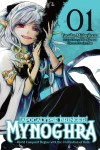
What an unexpected and delightful opening volume! The cover and first few pages of Apocalypse Bringer Mynoghra set a dark tone, showing a static, dark figure and a yandere-like young elvish woman. This, I thought, is going to be a gorey, dark read. Well, it’s likely to get violent in future volumes, but this opening one was heavy on humor, and on other fun elements too, as it sets the stage for a tale about isekai world-building and the common idea in light novels that villains aren’t so villainous (and heroes not so heroic). Volume one’s story begins with Takuto Ira awakening in a fantasy world next to Atou, the hero character he used in the strategy game he excelled at in his previous life, Eternal Nations. Together, they’ll build a nation with Takuto’s OP powers, though challenges are aplenty, with a refugee dark elf camp being the first among them. One neat element of the story is how Takuto appears to those other than Atou; he is a fully black, static-charged image that frightens others in this early-civilization style world, and he is accepted (and presented by Atou) as a god. Meanwhile, Takuto is (mostly) a very kind person; so is the loveable Atou, though she doesn’t mind playing bad cop to get things done for her beloved master. Their dynamic is adorable. And volume one is a mix of that same adorable tone and some more sinister ones, with, as I mentioned earlier, the likelihood of darker volumes ahead; another indicator is the more serious art that’s depicted in the original light novels as opposed to the cuter one used in this adaptation. I’m smitten with Takuto and Atou and excited to see how the story develops. And while I’m not yet ready to declare that this is going to be a great work—and perhaps LN readers can fill us in about the direction it takes—I am intrigued and ready to read more! ~ Twwk
Apocalypse Bringer Mynoghra is published by Yen Press.
“Reader’s Corner” is our way of embracing the wonderful world of manga, light novels, and visual novels, creative works intimately related to anime but with a magic all their own. Each week, our writers provide their thoughts on the works they’re reading—both those recently released as we keep you informed of newly published works, and those older titles that you might find as magical (or in some cases, reprehensible) as we do.

[…] READ Reviews of Issak: Vol. 1 // Vol. 2 // Vol. 3 // Vol. 4 // Vol. 5 // Vol.6 // Vol.7 // Vol.8 […]
[…] READ Reviews of I May Be a Guild Receptionist, but I’ll Solo Any Boss to Clock Out on Time: Vol. 1 // Vol. 2 // Vol. 3 […]
[…] Read Apocalypse Bringer Mynoghra Vol. 1 Review […]
[…] Reviews of Fool Night: Vol. 1 // Vol. […]
[…] 1 // Vol. 2 // Vol. 3 // Vol. 4 // Vol. 5 // Vol.6 // Vol.7 // Vol.8 // Vol.9 // […]
[…] READ Reviews of I May Be a Guild Receptionist, but I’ll Solo Any Boss to Clock Out on Time: Vol. 1 // Vol. 2 // Vol. 3 […]
[…] READ Reviews of Chitose Is in the Ramune Bottle: Vol. 1 // Vol. 2 // Vol. 3 // Vol. 4 // Vol. 5 // Vol. 6 […]
[…] Reviews of Fool Night: Vol. 1 // Vol. 2 // Vol. 3 // Vol. 4 // Vol. 5 // Vol. […]