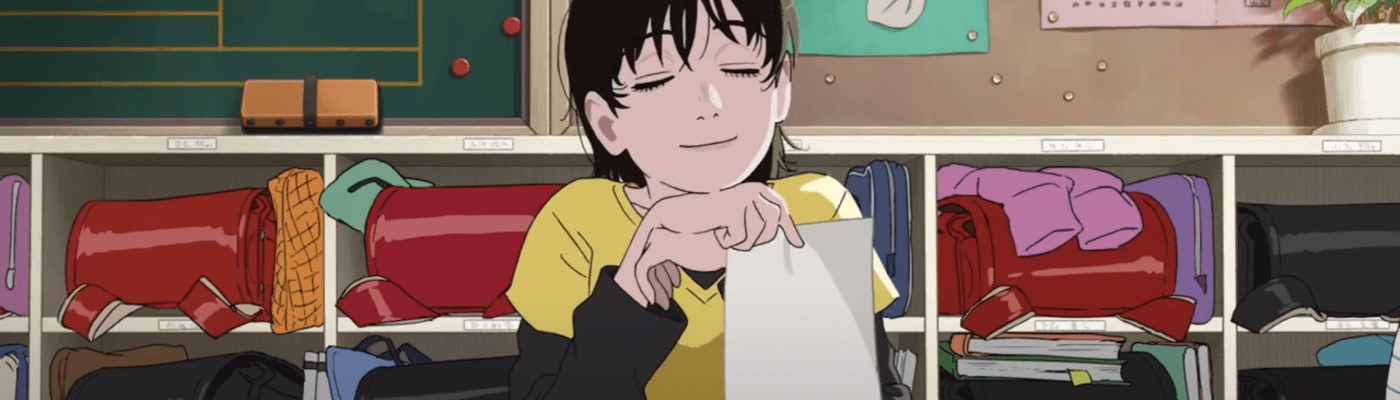
Look Back reorients the coming-of-age anime in a subtle, yet profound way, redefining what it is that propels the human heart from childishness to maturity. While it hits all the usual notes of the genre, from forging life-changing friendships to discovering talent and passion and working hard to make dreams come true, Look Back does not end there, in the moment of high school senior-year triumph. Instead, this moment proves to be the third-act twist, with an entire fourth act yet remaining to play out. And it is this latter part of the story where the title becomes so key, as a protagonist who has never done anything other than look ahead to her own goals and future, is ultimately compelled to look back. It is this act of facing the past, and what she sees when she does so, that ushers Ayumu Fujino into adulthood.
The story begins with Fujino as a fourth-grader who spends her life looking at herself in the artist’s mirror on her desk (used for reference in drawing expressions) as she draws and looks ahead to the next masterpiece of a 4-koma comic she’ll create for the elementary school newsletter. She’s also looking ahead to the praise she’ll receive from her classmates, and to life, one day, as a celebrated mangaka. She has eyes for nothing and no one else.

Fujino’s status as the school’s best artist is shaken when the work of an unknown and far more technically skilled artist appears next to hers in the weekly newsletter, exciting all the students’ praise. Faced with a rival for the first time, Fujino throws herself into leveling up, devoting her every waking hour to her craft, not just for weeks or months, but for years. The sketchbooks pile up and her social life dwindles as Fujino is consumed with surpassing the mysterious schoolmate. After years of dedication, Fujino finally concedes her failure and blends back in with the crowd of classmates who have long since abandoned manga. Her life drains of its sense of purpose just as her bookshelves, once filled with volumes on art, anatomy, and perspective, now sit empty.
But a twist of fate brings Fujino together with her former rival, the shut-in Kyoumoto, on graduation day, and the pair strike up a partnership that blossoms into friendship as they set their sights on debuting as a mangaka duo during middle school. Success follows success as they perfect their process and grow in confidence, particularly the now-former shut-in, Kyoumoto. But as high school graduation nears, what should be the exciting culmination of all their hard work—the opportunity for a manga serialization—instead becomes the point of their divergence. No longer are the two friends looking ahead to the same goal or the same life.
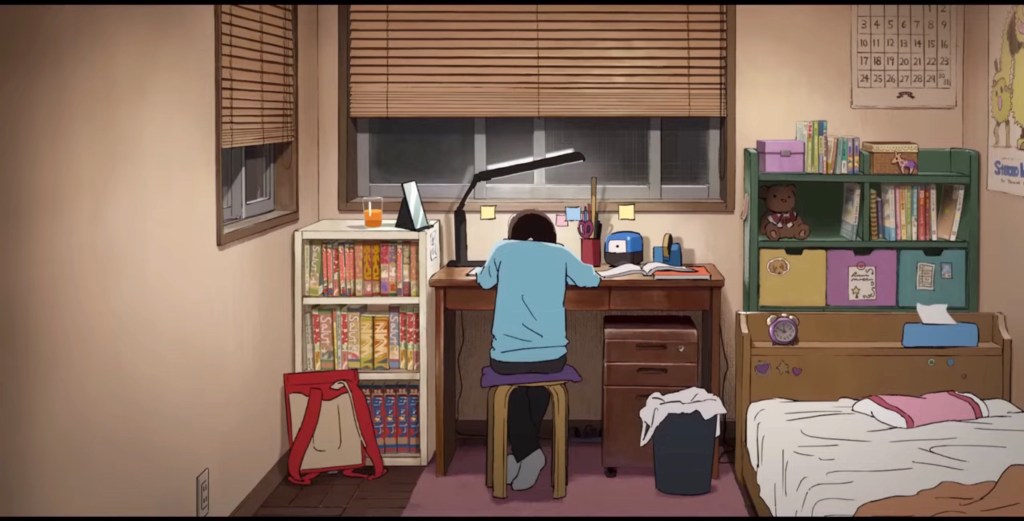


It is here that the story navigates into unexpected waters, ultimately requiring Fujino to reorient her gaze while revealing just how much more Kyoumoto saw all along. The result is not a comforting coming-of-age story, but it is a deeply human one, and one that audiences will no doubt find themselves looking back to, pondering alongside Fujino the complexities of our decisions and their implications, both for ourselves and for those with whom our lives are intertwined.
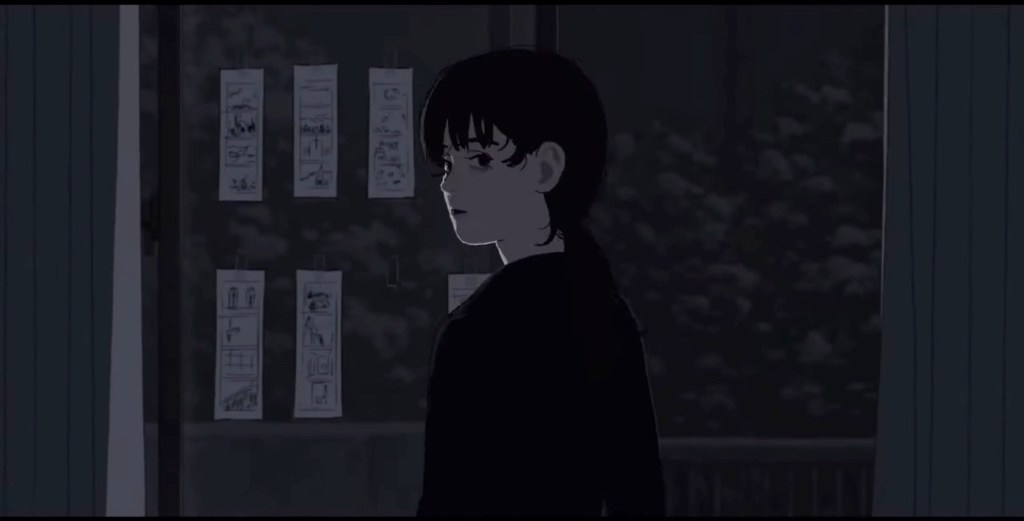
Look Back is directed by Kiyotaka Oshiyama in his feature film debut, though he also helmed the imaginative anime series Flip Flappers. Oshiyama wrote the screenplay here too, adapting the one-shot by mangaka Tatsuki Fujimoto of Chainsaw Man fame. The quality of this adaptation alone is deserving of a detailed, spoiler-filled review, but suffice it to say that Oshiyama has done an outstanding job of balancing fidelity to the original with dynamic translation into cinematic language that enhances the essence of Fujimoto’s story and draws out layers in the characterization that are easily missed in a first reading of the manga. The result is a film that doesn’t need to be rewatched in order to have a full, rich experience, but which at the same time demands rewatching if only to savor it all again.
This is particularly true of the main protagonist, Fujino, whose childish charm—hidden behind a rock-hard front of brashness in the manga—is brought to the surface through the loose, lively animation, bright color design, and ebullient score. Oshiyama also adds several brief subjective interludes that provide access into Fujino’s inner world, such as the brilliantly wacky animation of one of her 4-koma strips at the outset of the film, and the disorienting sequence when she is reduced to a mere speck among ever-expanding rows of identical school desks upon discovering that the one thing that set her apart from her classmates—superiority in art—is no longer hers to claim. It is these cinematic additions that so successfully hold in tension the innocence and childlikeness of a protagonist who can otherwise come across as arrogant and self-centered, transforming her into a character capable of inspiring both laughter and tears from the audience, if the sounds resonating in the theater at the film’s world premiere in France are anything to go by.
Indeed, I don’t think I’m alone in saying that Look Back was the surprise hit of the Annecy International Animation Film Festival for me this year. It truly is a masterclass in cinematic manga adaptation and in just how much depth you can convey in a mere hour-long feature. It is one that I will not soon forget.

To date, Look Back has only been released in Japan, but it is also featuring at AX this weekend and should hopefully get international releases soon.
Images taken from the official trailer.

- Film Review: All You Need Is Kill - 01.15.2026
- First Impression: Kaya-chan isn’t Scary - 01.11.2026
- First Impression: Dead Account - 01.10.2026

[…] previous years, I simply wrote up reviews of some of the films I was able to see and posted them as the movies received international release throughout the year. […]
[…] The setup may sound familiar to the seasoned viewer of sports anime, but 100 Meters successfully resists the predictable Mozart versus Salieri, talent versus training, dichotomy (and indeed, fallacy, imho) to which so many tales of competitive rivalry succumb. Instead, it explores the diversity of ways of running, in all their strengths and weaknesses, telling a story that bridges the energy and enthusiasm of coming-of-age with the unexpected challenges and disappointments of early adulthood, in a way that is reminiscent of Oshiyama’s stellar Look Back. […]