Sitara is sold into slavery as a child in 13th-century Persia, but fortunately for her, Fatima is a kind mistress, and pretty soon Sitara is like a member of the family. She hits it off well with the academically gifted young heir of the family, Master Muhammad, and thanks to this, quickly finds herself immersed in a full education. This is the Islamic Golden Age, so Sitara’s education is quite substantial, centering on science, mathematics, classical literature, and most of all, astronomy. But when her adoptive city of Tus is sacked by the Mongol Hordes of Genghis Khan, Sitara’s aptitude for learning and love of books becomes a double-edged sword, as it is her determination to protect the family’s precious library that brings her to the notice of the Khan’s son, who carries her away to serve as an interpreter for a particular book that his wife is keen on acquiring. How will Sitara fare in the land of the Mongols and the court of the Khan? What “magic” will she weave through her vast knowledge, and will it be enough to enable her to carve out a future for herself amid the political and religious intrigues that await her?
TL;DR: This is a unique series both for its subject matter and the art, meaning it won’t be to everyone’s taste. The two can feel a little at odds sometimes, with such perilous history depicted in chibi style. But if this potential dissonance doesn’t bother you, and you are interested in this time and place, then there is much that is fascinating to dig into here! Also, key historical figures introduced at the very end were, in reality, actually Christians, so I’m intrigued to see to what extent that side of the story will be explored. There’s much potential here!
Now, on with the spoilerific review…

Art & Design
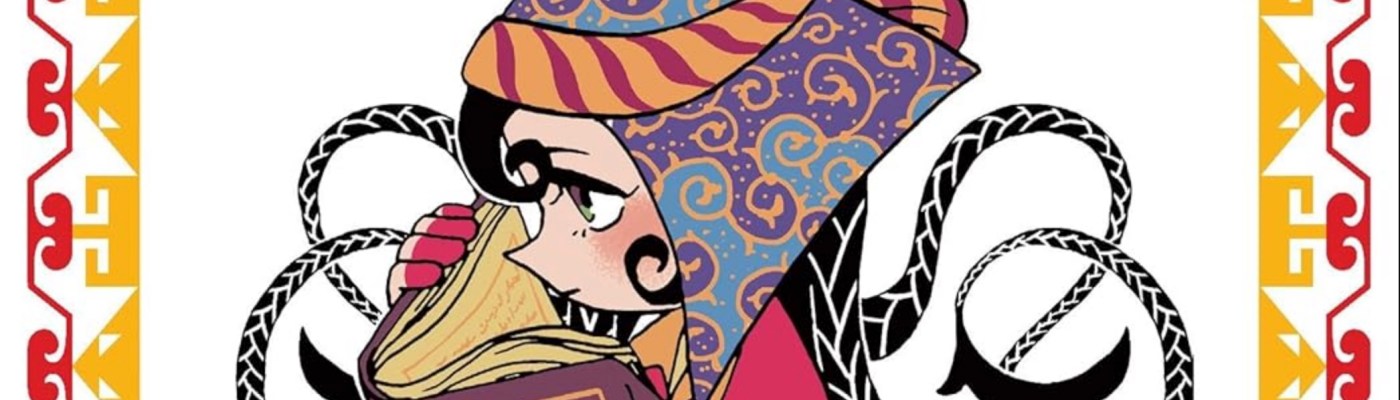
One of the first things that drew me to this title was the unique art style, which, on the cover at least, is an intriguing combination of chibi-like character design plus quite stylized decoration. This continues on into the pages and chapters too, where Persian-inspired patterning and other design details are pervasive—at least, for as long as our heroine remains in her homeland! This isn’t the kind of realism we see in other series set in Central Asia, though, like Kaoru Mori’s A Bride’s Story; instead, Mongol’s mangaka, Tomato Soup, evokes the art and fashion of the period and place through simplified, bold linework and three-tone shading. The result is a truly distinctive hybrid aesthetic that is instantly recognisable. It’s also particularly well-suited to animation studio Science SARU and their experiments with simplified shapes and bold color design, making it an ideal series for them to be adapting to anime! (It will air later this year!)
The Setting & the Period: 13th Century Middle East & Central Asia

I said it was the stylised design that first caught my eye, but the clincher was “Mongol” in the title—I do love a series set in Central Asia! It’s such an under-represented area of the world in entertainment media, and quite surprising to find in manga! There are a lot of fascinating details in this volume that have already got me diving down rabbit holes to learn more, such as the tents used by Genghis Khan’s nomadic forces, which, when erected facing South, function like a clock, using the principles of the sundial. The lengthy prelude set in Tus, Persia, was a real bonus as well, and is sure to delight fans of Assassin’s Creed: Mirage, set in neighbouring Baghdad (albeit a few centuries earlier).
Which brings me to the main reason I’m intrigued by this series: its firmly historical roots. The series is not only set during a clearly identifiable moment in history, when Genghis Khan and his four sons were laying claim to 9 million square miles of territory and founding the largest contiguous empire in history; it also centers primarily on actual historical figures—including the MC, Sitara (or Fatima, as she renames herself). I’m going to resist linking to her Wikipedia entry here though, because it is replete with spoilers! And although on one level I regret having been spoiled in my enthusiasm for historical rabbit hole diving, on another, I’m even more intrigued after having read a bit more about her and her contemporaries. This is because it turns out that the woman who unwittingly inspired the capture of Sitara and her precious book, Euclid’s Elements of Geometry, was actually a Christian! That’s right, Sorghaghtani Beki, who was the first wife of Genghis Khan’s youngest son, Tolui, was a Christian (and member of the Church of the East), as was her older sister, who was one of the Khan’s wives.
I’ll admit, that fact blew me away! I had no idea there was a thriving Christian church in this part of the world at that time, having naively assumed that the growth of the church had been in a Westerly direction only following Paul’s “No” from the Holy Spirit about entering Asia. Anyhow, the point is, I’m getting an education from this series and can’t wait to see if and how mangaka Tomato Soup develops the religious themes and the character of Sorghaghtani Beki, who was a significant figure in the history of the Mongolian Empire, renowned for her wisdom and leadership.
There are also little winks and nods to the contemporary reader, though, with my favorite being the reference to Mari Kondo, in the form of the “Cleaning Slave” who excels at tidying, all the while mumbling to herself about things sparking joy. Tee hee!

Slavery & the Sacking of Tus
So far, I’ve been singing the praises of this volume, but I’ll admit, for the first few chapters I was rather more skeptical. You see, I was not convinced by the depiction of slavery or the sacking of Tus; it just felt a little…sanitized. Sitara is sold into slavery as a young child, yet does not seem to confront any of the threat of exploitation and abuse that this would normally intimate, never mind any social barriers when interacting with the elites who own her. Instead, she is treated like a privileged daughter, and even encouraged (through pointed hints) to consider one day marrying the son and heir of the family she is sold into. To top it all off, with her dying breath, her mistress actually calls Sitara her daughter. Once captive to the Mongols, Sitara is perfectly safe, healthy, and apparently free to roam the encampment. So what’s going on here? Is this a case of plot armor, where we need to be able to buy into Sitara’s dedication to Fatima and her single-minded quest to avenge her death (which seems to be the setup)? I daresay that’s part of it.
But there’s something else that’s really key here: when we (contemporary Westerners) think of slavery, we tend to think of the American model of enslavement, which was particularly brutal and dehumanizing. But for most of world history, this was not how enslavement was practiced; there was instead a wide range of ways that the powerful would limit and lay claim to other human beings, from indentured labor—where the person was enslaved for a set period of time, and often retained some autonomy as to how they labored—to serfdom, a hereditary state where it was the labor of the individual that was “owned” by someone else. It wasn’t unusual for these kinds of “slaves” to have access to education or limited freedom of movement. What’s more, religious laws often enshrined the rights of enslaved people to humane treatment, which was the case in the Muslim world and among the Israelites. (The extent to which these laws were honored is of course another matter entirely.) So…I still think it’s a bit of a stretch that Sitara has had such a sunny experience as a slave and now as a captive, but I think this characterization of her experience is also thoughtful and thought-provoking, not least because it highlights just how brutal modern slavery was, and why it has had such a long-lasting impact on American society in particular.

Is She Really a Witch? Women of Science in the Islamic Golden Age
What this volume really excels in, though, is its depiction of the role of women in the scientific revolution of the Islamic Golden Age, which gifted us with significant breakthroughs in astronomy, algebra, calculus, geometry, trigonometry, the natural sciences, medicine, pharmacology and hospitals, engineering, architecture, philosophy, and law. The poet Rumi, often celebrated in Christian circles for his beautiful simplicity, focus on God, and value for creation, also dates from this period. Seriously, it changed the world! And women were not only involved in all of this profound discovery, but were even at the forefront. Their stories have largely been forgotten in the intervening eight centuries, but they are beginning to be rediscovered now, not just in academia, but in mainstream culture too, thanks to games like Assassins Creed: Mirage, whose historical consultants did some phenomenal work to weave the stories of women and women of science into the worldbuilding—and thanks to manga like this.
So no, Sitara is not actually a witch! But she may well be perceived as such by those for whom the thought of an educated woman is as fantastical as magic and spells and such! Regardless, the juxtaposition of science and mysticism is palpable in this volume from the first page, and Sitara is at the very heart of it as the one in whose “slender hand” rest “millions of souls.”
Final Thoughts
This is definitely an unusual read for many reasons, and the focus on historicity means that the setting and worldbuilding are foregrounded in this volume, while characters are pushed a little to the back. But if you enjoy learning about often overlooked places and periods of history, then this is a rewarding read! I’m looking forward to seeing to what extent mangaka Tomato Soup explores the Christianity of key figures, and religious themes more generally, though I may wait for the anime adaptation rather than continuing with the manga itself. Either way, I’m interested to see more!

A Witch’s Life in Mongol is published by Yen Press.

- Film Review: All You Need Is Kill - 01.15.2026
- First Impression: Kaya-chan isn’t Scary - 01.11.2026
- First Impression: Dead Account - 01.10.2026

[…] A Witch’s Life in Mongol, Vol. 1 (Claire, Beneath the Tangles) […]