
Historical manga—both fiction and non-fiction; the initial volumes of series featuring zombie idols and a hitman who’s an idol fan; and a light novel companion to Oshi no Ko and manga adaptation of an LN fantasy series are among the volumes we’re reviewing in this week’s Reader’s Corner! Check out all these, plus the latest volume of Solo Leveling, Dark Souls: Redemption, and more!
[Oshi No Ko] Spica the First Star (Vol. 1) • Almark (Vol. 1) • Ashita no Joe: Fighting for Tomorrow (Vol. 1) • Dark Souls: Redemption (Vol. 2) • The Hitman Stans (Vol. 1) • Issak (Vol. 13) • Sailor Zombie (Vol. 1) • Shadows House (Vol. 8) • Showa: A History of Japan (Vols. 1-4) • Solo Leveling (Vol. 13) • Unholy Blood (Vol. 7)
Sailor Zombie, Manga Vol. 1

High schooler Maiko wants nothing more than to stand out from the crowd, and she does so by being a slightly offbeat idol wannabe. So when the zombie apocalypse strikes before she even gets the chance to premiere her idol tribute troupe at the school festival, well, it’s not just the world, but her dream that’s over now, right? Wrong!! Just like the zombies now filling the world, Maiko’s dream clings to the semblance of life, as a secret song shared with her love interest back in the good old (living) days proves the key to defeating the dead! Maybe. This premiere volume is ten percent plot and characters, and ninety percent vibes! And I’m talking vibes in the plural here, as the artistic style and genre shift like a kaleidoscope—from the cartooniness of a gag manga, to the heavy, violent sketchiness of horror, to the soft sparkliness of shoujo romance, to the chiaroscuro of thriller—on and on it cycles, refusing to settle into a single pattern. And you know what, it’s pretty darned fun! The plot is your basic zombie apocalypse so far, but fresh enough (with the added idol angle—it adapts the live-action tv series that starred AKB48 members) to keep me interested. The humor is great, with two running gags standing out: First, Maiko’s hairstyle, which makes less and less sense the more you look at it (try figuring it out, I dare you!); second, the fourth wall-breaking, particularly with the array of characters who get letters or Roman numerals instead of faces and serve unabashedly as plot devices. All in all, Sailor Zombie is bursting with creative energy and promises to be a fun parody of a mashup of genres, with added zombies and idols, and just a dash of mystery. What’s not to love about that? ~ claire
Sailor Zombie is published by Yen Press.
The Hitman Stans, Manga Vol. 1
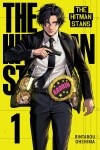
Who needs a dead puppy to motivate you when you’ve got the most powerful motivating factor of all—an idol?! The coolest, most deadly hitman this side of Baba Yaga appears in the form of Owaru Endou, a “killing machine” who coldly dispatches dozens of his yakuza organization’s enemies. How do you find release from such a horrible job? Endou finds it through his favorite idol, Kaorin, whose way of life encourages him to leave his own. That’s how volume one of The Hitman Stans begins. Well, more accurately, it begins with a hit—and I kind of love that because you immediately know that the series is going to have serious, violent moments. The Hitman Stans isn’t a serious series, but the yakuza moments are gritty and help you realize that while overall this is a humorous manga, a la The Way of the Househusband, it does have some John Wick to it too; indeed, both those series seem to have influenced this one. And I am 100% here for it. The blending of tones and genres works really well because The Hitman Stans seems as if it’ll ultimately be about the transformation of Endou from hardened killer to becoming the person he was meant to be and perhaps always was due to Karoin’s authenticity, kindness, and determination. There’s a real story here to go along with the excellent artwork, cool action scenes, and comedy (which it has in abundance). The potential is off the charts—and I think I may have found a new favorite. ~ Twwk
The Hitman Stans is published by Yen Press.
Ashita no Joe: Fighting for Tomorrow, Manga Vol. 1
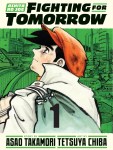
The year is 1968, and a 15-year old boy named Yabuki Joe wanders into a rough slum at the edge of Tokyo, with nothing to his name but the clothes on his back, a crafty mind, and a smart-aleck mouth. That last one quickly leads to a brawl which in turn reveals his blinding speed, split-second agility, and a lights-out punch—even if he’s clearly running on pure instinct without an ounce of real technique. One of the witnesses to this lopsided slugfest is Danpei, a drunken and washed-up former boxer, who only needs one look to declare he’s going to sober up and bet everything he has on turning the boy into a champion prizefighter (although more than a few other bystanders quip that they’ve seen this movie before). But our young hero protagonist couldn’t care less about boxing, tomorrow, or anyone in the world besides himself, and just sees the old man’s dreams as delusions he can take advantage of for a few free meals and some spending money. Joe’s brazen scheming, however, is about to get him in far over his head and into something he can’t bluff or brawl his way out of. The consequences of his actions will set him on the road to becoming a better man, willingly or otherwise… It’s financially risky to publish older titles which aren’t the current popular thing, but I sincerely hope the risk pays off for Kodansha because after reading this first volume of a series whose legendary reputation far precedes it, I have to read the entire run. Ashita no Joe is a fascinating work, in no small part specifically because it’s an unmistakably older work. Aesthetically, there are still very clear markers of Walt Disney’s and Osamu Tezuka’s influences in the seemingly childish, cartoony art style. But the story is also emotionally raw in ways you just don’t see often today. It was created in a time when Japan was far from the placid and orderly place it’s often depicted as now, but rather a post-war country still in the throes of seismic political and social turmoil. Yabuki Joe is no neat and clean little hero or a desperate attempt to be “edgy,” he’s a laundry list of character flaws and moral failures wrapped up in a blindly cocky attitude who is somehow still compelling to watch. A shameless liar with no pretenses. A fool who sees truths everyone else missed. Insufferable yet charismatic. The sort of young man which other men both envy and pity. It makes for endlessly compelling reading, which I will definitely continue to do. ~ WacOtaku
Ashita no Joe: Fighting for Tomorrow is published by Kodansha
Showa: A History of Japan, Manga Vols. 1-4 (Complete Series)

The early history of modern manga is littered with giants who made massive impacts on the artform which last to this day, but whose heydays were decades too early for them to achieve much recognition in the English-speaking world. Shigeru Mizuki was one of those giants, as his most famous series, GeGeGe no Kitaro, is seen in Japan as not just enduringly popular and financially successful, but also culturally significant for all the Japanese folklore it helped preserve. Showa, on the other hand, is both his autobiography and a retrospective on the Showa Period, the formal term for the 1926-89 reign of Emperor Hirohito. The manga explores Japanese history beginning with the Great Kanto Earthquake of 1923 and finishing at the dizzying height of the Bubble Economy of the late 1980’s. It makes for a fascinating contrast as we read of the Great Depression, the descent into military rule, the Second World War, the Occupation, and the Post-War Economic Miracle in textbook detail (and with photorealistic illustrations) and then “zoom in” to see Mizuki tell his own life story (in his iconic cartoony style) of what it was like for a boy from rural Japan to live through all that. The one drawback of this method is that it makes the series’ pacing quite uneven. The war in the Pacific dominates the narrative both emotionally and in terms of space as Mizuki goes into nail-biting, gut-wrenching detail of his experiences trying to survive the Solomon Islands campaign as an infantryman, when the Imperial Japanese Army and its suicidal interpretation of bushido seemed to be putting in more effort towards killing him than the Allies were. But this in turn leaves relatively little space for the 40+ postwar years of the Showa Period, which rushes by with limited details and at whirlwind speed by comparison. One is left with the distinct impression that as Mizuki settled down after the war into middle age, a hectic work schedule, and the countless little distractions and dramas of family life, very little besides the occasional news report of a spectacular crime could make much of an impression upon him. Regardless, the chapters on his wartime experiences alone are worth the price of admission, and I would highly recommend this series to anyone looking to understand the making of modern Japan. ~ WacOtaku
Showa: A History of Japan is published by Drawn and Quarterly.
Issak, Manga Vol. 13

As the illegitimate son of a dynasty driven from its ancestral lands, Prince Heinrich might not be much more than a bit player on the world stage, but he’s here to do his part regardless. Thus, he has taken upon himself to rally the few soldiers he has left to aid his family’s allies and save the great city of Breda from Spanish sack and massacre. To do that, he needs to neutralize Heusden Fortress, whose garrison has cut a critical supply route. But the garrison is commanded by the dreaded Viscount of Sabella, a commander unlike any our heroes have faced before. Spinola wages war for the fame and fortune it promises, Wallenstein wages war to achieve his grand political designs, but Sabella? He seems to have no goal beyond slaughtering whatever enemy happens to be in front of him to the last man, and he’s chillingly good at it. Any chivalric notions this scarred and skeletal terror might have once had died in the campaigns against the savage Ottoman Turks—there are no war crimes east of Vienna, only the victors and the dead. Defeating this walking Grim Reaper will be no small challenge for Heinrich or Issak, especially since they have to go on the offensive this time… Regarding my remarks about the series’ art in my review of the previous volume, it appears Double-S has started to find a more happy medium in his work/life balance and art quality has definitely improved. The major action sequence in the middle of this book is particularly well done. The story, however, slips up once or twice. There are points where the side which is supposed to lose a particular engagement will make an obvious blunder for no clear reason, or where what should historically be a well-known and well-worn tactic is treated as a brilliant new maneuver. But I also think my opinion of the series has improved since I came to accept what Issak is rather than waiting for it to become what I wanted it to be. Issak isn’t Vinland Saga: It’s not trying to be a character drama—it’s trying to be an action film. Or, to put it in cowboy movie terms (my other fandom outside of Japanese comics), it’s not trying to be The Searchers, it’s trying to be Tombstone. And you know what, I love Tombstone, so if Issak can be that I’m all onboard. ~ WacOtaku
Issak is published by Kodansha.
READ Reviews of Issak: Vol. 1 // Vol. 2 // Vol. 3 // Vol. 4 // Vol. 5 // Vol.6 // Vol.7 // Vol.8 // Vol.9 // Vol.10 // Vol.11//Vol.12
Solo Leveling, Manhwa Vol. 13
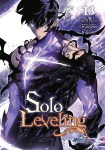
The complaints from people who hate anything popular has always been that Solo Leveling is all OP protagonist and no story. That’s not an entirely fair assessment—I’ll get to the depth later—but first, I have to say that volume thirteen does support that conclusion. I mentioned in my volume twelve review that this series that I have a real heart for has started to reach its weak point; the plot that’s been building is a little underwhelming, and in volume thirteen, the Rulers v. Monarchs storyline is shown for what it is: just another chance for Jinwoo to fight an impossibly strong opponent. It’s not the worse thing in the world, because as usual, the art is off the charts—breathtaking even if I’m not really sure of every single thing that’s happening. The volume also does end on a cliffhanger that I hated in the original novels and hate here, but it does feed into the overall vision of the author. What non-Koreans often miss is that this is a super pro-Korean series: Jinwoo celebrates the masculinity that is appreciate and loved by Koreans, while the other hunters and the boots on the ground during the catastrophe in volume thirteen, as they try to beat back the overwhelming assault forces, represent the heart of the Korean people. That layer of nationalistic depth may be problematic to some (every country except perhaps China comes off as being overly prideful in the series, and many in this volume—oh, Canada!), but it’s really the most significant part of the plot, and I think will help critical readers enjoy the story more—even in these final, lesser volumes. ~ Twwk
Solo Leveling is published by Ize Press.
READ Reviews of Solo Leveling: Vol. 3 // Vol. 6 // Vol. 7 // Vol. 8 // Vol. 9 // Vol. 10 // Vol. 11 // Vol. 12
[Oshi No Ko] Spica the First Star, Light Novel Vol. 1

What more really needs to be said in Oshi no Ko that hasn’t already in that compelling manga series? When light novels are released to accompany successful manga, they’re often warm but boring, reading like filler material that’s okay but unnecessary. That’s initially the feel for Spica the First Star, a light novel series (the cover indicates this is volume one, but a second volume has yet to be released in Japan) that uses the Spica system—two massive “twin” stars—as the concept behind stories involving Ai and her twin children. Three chapters and an epilogue fill this story, with the first taking place early in Ai’s work as an idol, and chapters two and three filling in Gorou’s care for Sarina when the two were both alive and in the same hospital. Following form, they’re nice but feel unnecessary. You are reminded of how close Gorou and Sarina were before their deaths (closer than the many years following in their “sibling” relationship) and get better insights into Ai’s character, though whether that’s a good thing or not should be considered (her one and only arc in the manga is perhaps the most perfect introductory arc I’ve ever read). But wait! The epilogue, which in actuality is an entire chapter previously written by Aka Akasaka and added to the end of this collection, makes the entire volume more meaningful. Written from an unexpected perspective and, again, providing more insight into Ai’s character, it’s easily the best chapter in the collection and ties it all together emotionally. It is by itself worth the purchase of Spica the First Star for Oshi no Ko fans. Whether future volumes have the same worth or end up feeling like “extras” at best (and part of the machine that the OnK creators are criticizing in the series at worst) will have to be seen. ~ Twwk
[Oshi No Ko] Spica the First Star is published by Yen Press.
Almark, Light Novel Vol. 1
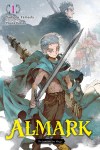
Almark is a young boy when we first meet him, the son of— *record scratch* Hold up! The artist for this light novel series is Posuka Demizu, the mangaka for The Promised Neverland?!?!?! I mean, I don’t really care now if the story is any good—I want every book in the series now! I’ve been deprived of TPN-like art for far too long! *long stare at the cover and images* Ahhh, that’s the stuff! Wait, you still want to hear about the story? Fine, here you go. Almark is the son of a northern mercenary. When a chance encounter gives him the opportunity to attend the Norkh Institute for Magic, he finds out that the southern lands look down on northern “barbarians,” and he has his work cut out for him fitting in and catching up with his peers’ magical studies. Meanwhile, some odd occurrences hint at deeper mysteries and dangers afoot on the campus… Thanks to Harry Potter, there’s no shortage of “magical school” stories these days; so what, if anything, sets Almark apart? The biggest difference to me is that this tale is a slow burn: It takes its sweet time showing us the school and the characters and unfolding its larger plot; there’s no rush, and we have time to savor each moment. And that’s a strength—the pacing feels just right, even though we’re just starting to see the bigger picture by the end. If anything, the story could have been stretched out further: Almark’s journey from the north to the south is covered in just a few lines, when at least a chapter or two could arguably have been dedicated to this. But the story wants to jump into the school shenanigans with a minimum of delay, and that works for me. I get the feeling that this narrative is winding up for some epic events in future volumes, and I’m here for it. —Now let me get back to admiring the art! ~ NegativePrimes
Almark is published by Yen Press.
Dark Souls: Redemption, Manga Vol. 2, Bonfire

The second installment opens with a new character and a chapter that could stand on its own as a complete horror story in its own right. Without going into spoilers, I liked it. Then the new character meets the woman and warrior we know from volume one. Together, they set out for the appropriately named Sanctuary, an old home of long-vanished dragons: our friends from volume one hope to save the woman’s son, while the new character wants to break his curse (the focus of the first chapter). Along the way, we see more of the world of Dark Souls and learn more of the lore about how it got this way, as well as our heroes facing off against the horrors of this world, of which there plenty! Creators Julien Blondel and Shonen have created another volume in this story that is well-paced, a balance between the peaceful but suspenseful and the violent and heroic. And it ends on a shocking note… ~ NegativePrimes
Dark Souls: Redemption is published by Yen Press.
Read: Dark Souls: Redemption Vol. 1 Review
Shadows House, Manga Vol. 8

Hello, fans of Shadows House! It’s been a while since a review of a volume in this series graced the digital pages of Reader’s Corner! But as the anime’s story line (as of season two) corresponds roughly to manga volume seven, it seems appropriate to pick up the narrative with volume eight, so here we are! Warning: SH depends heavily on spoilers! If you want to enjoy the story and have not yet made through the anime or the previous manga volume, stop right here! You have been warned! Commencing series spoilers in 3… 2… 1… Edward’s endeavors to uncover the rebellion in the children’s wing are taken to the next level: He interrogates every shadow there and wins over some allies, who begin spying on our intrepid heroes. Meanwhile, the rebels struggle to end the influx of coffee (seriously, author Somato must have had a traumatic encounter with coffee as a child), which leads to uncovering the truth about what happened to Rum and Miss Shirley! And without the coffee, Rickey’s brainwashing begins to wear off—but he doesn’t know who to trust, and believes Kate and her friends are trying to trap him! What will become of the forces of good before the powers arrayed against them? Shadows House hits the mark as well as ever, entwining worldbuilding, character growth, incredible art, and heartpounding plot twists. But what really elevates the story for me is how well it represents the way that social structures can twist and undermine even the best hearts and intentions, and how hard it is to resist such forces, or even to know what the right choice is under such circumstances. This story is only getting better—stay tuned! ~ NegativePrimes
Shadows House is published by Yen Press.
READ Reviews of Shadows House: Vol. 1 // Vol. 2 // Vol. 3 // Vol. 4 // Vol. 5
Unholy Blood, Manhwa Vol. 7

I’ll be honest, at this point my enthusiasm for Unholy Blood has flagged somewhat. The plot feels a bit repetitive as Hayan faces off against various Angels of Death, and she continues to leap before she thinks. Nevertheless, the story has its high points, if unevenly. The end of Vael’s arc has some good moments, and as the heroes face off against Levy, the next vampire antagonist (who has mind-reading and a few other tricks up her sleeve—and a personal grudge against Hayan), some nice plot twists bring back more of the fun again. The story is weakest when Yohan appears: There is simply nothing that elevates him beyond the caricature of a supervillain, and that does not bode well as we approach the climax of the story. However, the art continues to be stunning, and so I will continue to reading in anticipation of the story smoothing out the rough bits some more. Also, the cover for the upcoming volume—number eight—goes hard. Looking forward to it! ~ NegativePrimes
Unholy Blood is published by Ize Press.
READ Reviews of Unholy Blood: Vol. 1 // Vol. 2 // Vol. 3 // Vol. 4 // Vol. 5 // Vol. 6
“Reader’s Corner” is our way of embracing the wonderful world of manga, light novels, and visual novels, creative works intimately related to anime but with a magic all their own. Each week, our writers provide their thoughts on the works they’re reading—both those recently released as we keep you informed of newly published works, and those older titles that you might find as magical (or in some cases, reprehensible) as we do.


[…] Read: Ashita no Joe: Fighting for Tomorrow Vol. 1 Review […]
[…] Reviews of Ashita no Joe: Fighting for Tomorrow: Vol. 1 // […]
[…] READ The Hitman Stans Vol. 1 Review […]