
There’s something satisfying about an old-fashioned revenge story—seeing justice served and the bad guys getting their just deserts. But what is the price of vengeance? And what sort of culture does it breed? These are some of the questions Mamoru Hosoda explores in his latest film, Scarlet, a reimagining of Shakespeare’s Hamlet. Scarlet retains the medieval timeframe and many of the characters from the play, but shifts it to a fantastical world that straddles life and death. What results is a stirring, reflective tale about the inadequacy of vengeance and the transformative power of authentic relationships.
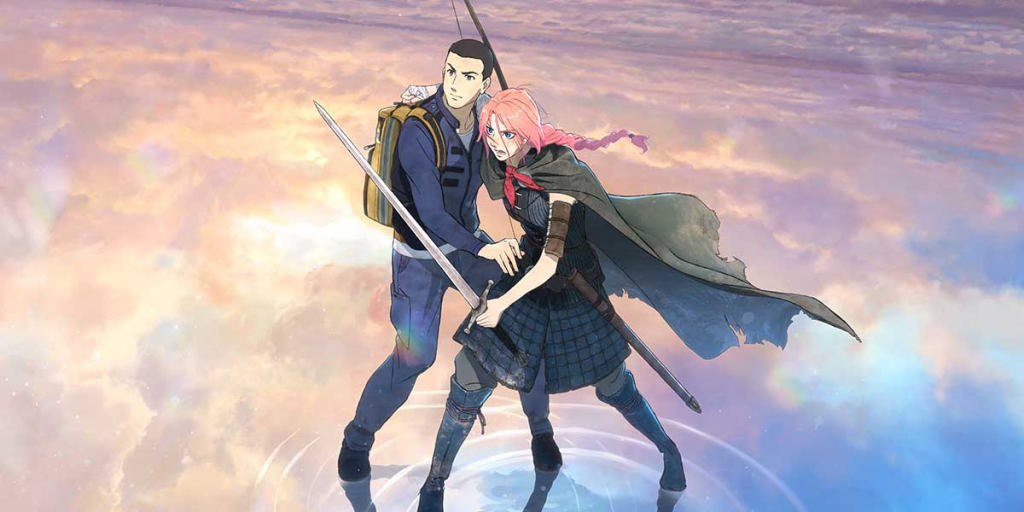
From the moment she was born, Scarlet was showered with love by her father, King Amleth, who is training her to be his successor. But her world is rocked when her uncle Claudius assassinates the king and usurps the throne, setting her on the path of vengeance. As Claudius consolidates his oppressive rule, Scarlet trains relentlessly in the barracks, steeling herself for an opportune moment to strike. That moment comes at a ball, where she empties a sleeping draught into her uncle’s drink before cornering him alone for the kill. But he’s one step ahead of his niece, having poisoned her drink first, and in the end, it is Scarlet who falls to the ground, her consciousness fading as her villainous uncle laughs triumphantly.
But the story doesn’t end there. Scarlet wakes up in the Otherworld, a purgatory-like realm, where she hears a voice telling her, “Claudius is here, too.” Her quest for revenge is not over; Scarlet can still give Claudius the eternal death that he deserves. Yet as she embarks on this quest, Scarlet comes face to face with the cruel realities of violence and hatred, and with those who speak of a better future where peace reigns. Through these encounters and a budding romance with a mysterious medic named Hijiri, Scarlet begins to question whether vengeance is really worth dying for.

Scarlet is a film about the trauma that drives people to seek vengeance and the power of human connection to bring healing. The eponymous heroine oscillates between her desire to avenge her father’s death and her growing disillusionment with the violence that permeates her life as a result. It’s a compelling struggle, and I found myself easily sympathizing with Scarlet in both her bitterness at those who had wronged her and her desperate search for healing. She is a well-realized character, complex in her motivations but also palpably sincere in all she does. The stellar performance of voice actor Mana Ashida (Confessions, Children of the Sea) conveys every shade of emotion, from angst and disillusionment to longing and hope, with richness and authenticity—so much so that her performance during the emotional highs of the movie gave me chills. These moments were beautifully supported by Taisei Iwasaki’s score, which is both grand—almost cosmic—and tender in its quiet joy and sorrow.
Though Scarlet struggles initially with slow pacing and repetitive cuts, the movie hits its stride in the second half, when Scarlet and Hijiri sojourn alongside a nomadic group of Otherworlders who have forged an unlikely camaraderie across cultural and generational divides. This message of unity across differences will come as no surprise to longtime fans of Mamoru Hosoda and studio Chizu. Hosoda has directed several movies where characters find healing and connection at the intersection of colliding worlds, including the 2021 hit, BELLE, where virtual reality becomes the space where the main characters express themselves, find healing, and then carry what they have learned into the real world. Likewise, in Scarlet, two worlds collide in a powerfully visual way: the real world, bursting with a bright, energetic color design, and the Otherworld, steeped in a muted, earthy aesthetic.

Scarlet’s production and character design likewise lend themselves to the cross-world themes, bringing together Western and Japanese animation. Jin Kim reprises his role from BELLE as character designer, joined by Tadahiro Uesugi. Both animators are Disney alumni, having worked on Big Hero 6 and other Pixar titles, and Hosoda credits them specifically with the details in the expressions and costumes of the lead characters. International influences play a big role in the grimdark aesthetics of the costumes, which complements the Otherworld’s harrowing setting while highlighting each character’s quirks. Scarlet’s wardrobe, for instance, develops rapidly at the beginning of the film, as she cobbles together uniforms from warriors slain by her own hand, but stagnates as she begins to question her search for revenge, reflecting her character arc throughout the movie. That’s the kind of attention to detail that separates good designs from the greats.
The animation, too, is hybrid in form, combining CG with elements of hand-drawn 2D animation. Hosoda toyed with CG animation when creating the virtual worlds of Summer Wars and BELLE, and his work reaches new heights here. The 2D real-world opening sequences give way to a striking blend of 2D and CG in the Otherworld. The CG is a standout here, as stunning backgrounds underpin the macabre setting, while the dynamic camera allows for breathtaking, sweeping shots. Overall, the animation is cohesive and magnificent, as viewers have come to expect from Hosoda’s works.

Scarlet is a beautiful movie showcasing the work of a director who continues to insist on the hope that is to be found in human connection. Revenge and violence cannot provide the justice that they promise. Instead, Scarlet urges viewers to believe that the work of building bridges between different worlds is worth it. What a timely message!
Scarlet is currently on limited release in the US, distributed by SONY Pictures, and is scheduled for broader international release on 6 February 2026.

- Film Review: Scarlet - 12.19.2025
- Film Review: Virgin Punk, Clockwork Girl - 11.15.2025
- First Impression: The Fragrant Flower Blooms with Dignity - 09.07.2025
