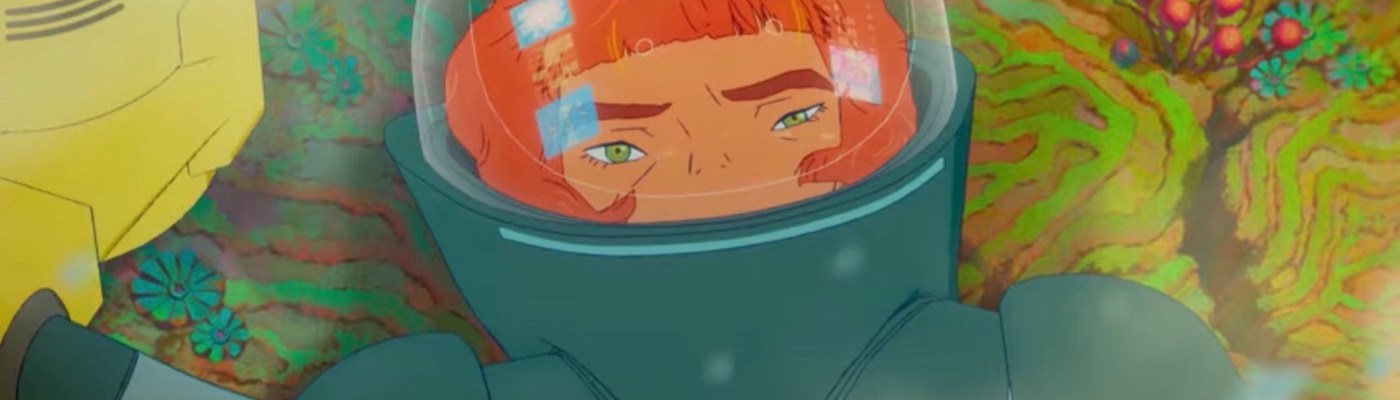
Kenichiro Akimoto’s directorial debut is nothing if not ballsy, taking on Hollywood action film royalty and effectively rebooting one of the most highly rated sci-fi films of all time. And it absolutely holds its own, and then some. All You Need Is Kill adapts the same source material—the light novel by Hiroshi Sakurazaka—as Doug Liman’s 2014 blockbuster, Edge of Tomorrow, giving us dazzling animation, tight scripting, and the best female action hero to grace the big screen in some time.
Rita Vrataski is a rank and filer of the United Defense Force stationed at Darol, the gargantuan alien plant that took root on Earth a year or so earlier. Apart from its sheer size, Darol doesn’t seem to be particularly invasive, let alone sentient, so when hordes of virulent lifeforms suddenly erupt from the alien flora, no one is prepared, least of all Rita. She manages to survive for about two minutes before perishing—and waking up again at the start of the day. Think Groundhog Day, but on the first day of the end of the world. With seemingly infinite resets, can Rita figure out how to survive Day 1 and warn the world?
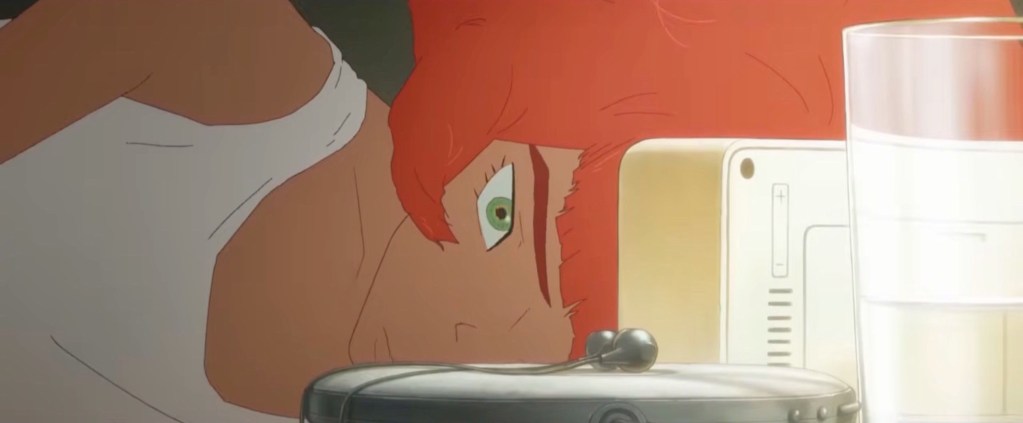
Akimoto’s recentering of the story onto Rita is risky, but it works, thanks to strong writing of the kind that seems to be eluding many a ”cinematic universe” in recent years. To put it simply, Rita is no Mary Sue. She starts out her cycle of days with a skill level barely hovering above zero, lacking the strength, stamina, and tactical knowledge to survive a five-minute death run, or the leadership skills to persuade others to take her warnings seriously. And she dies for it, over and over again. But she also learns, in gradual, realistic increments, with her achievements conforming to the laws of physics and the limits of her physique.
Rita levels up, but it’s still not enough to save her, let alone the world. Then one loop, she notices a deviation and tracks it to a shy young man named Keiji. He, too, has been looping (in synch with her deaths, no less), but unlike Rita, he’s no fighter. Even so, Keiji may just be exactly what Rita needs, someone who can fill in for her blind spots, who will complement rather than duplicate her strengths. It is Rita’s partnership with Keiji that adds real depth to her character, transforming her arc into something more than simply skilling up. Meanwhile, Keiji himself expands the definition of what heroism can look like, while also injecting a good deal more science into this military sci-fi than Tom Cruise’s Lt. Cage in Edge of Tomorrow, making for more satisfying worldbuilding.
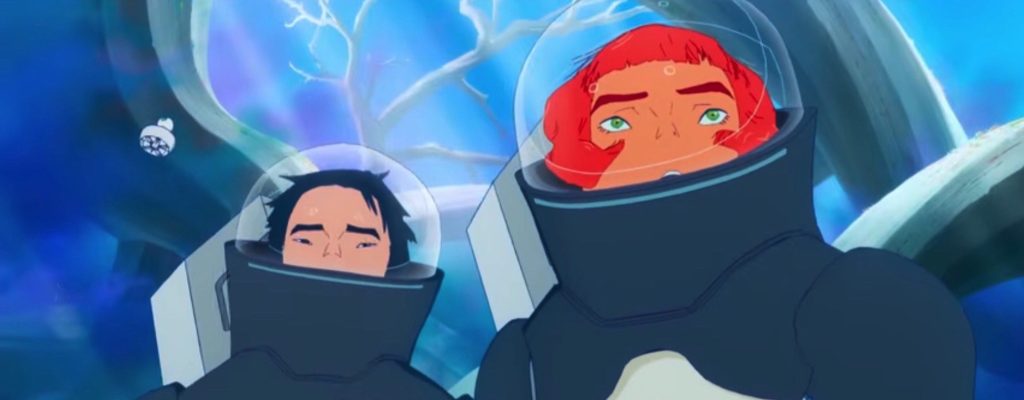
Alongside director Akimoto, we have veteran screenwriter Yuuichirou Kido (Dr. Stone, Kaiju No. 8, Keep Your Hands Off My Eizouken) to thank for this. Between the two, the storyboarding and writing are so tight as to waste not a single frame or word of dialogue, while yet allowing the two leads enough space to breathe and grow into their partnership. The result is a rewarding action film with the deceptively toned runtime of 82 minutes, recalling the likes of Gravity for its svelte scripting and editing, but also for its deftness at showing and not telling. We get to know Rita initially more through her expressions and actions than her lines, seeing firsthand that she is no team player, but nor is she a quitter.
The quirky, energetic shape language of Izumi Murakami’s character designs intensifies the characters’ expressiveness, pushing human forms into something just a touch alien, with eyes that are slightly too wide apart, lending them an otherworldly feel that compels attention. In the case of Rita, the design reinforces the plausibility of her character: She’s a normal young woman, not a runway model in a uniform, and can look both stunningly heroic and rather like an awkward turtle by turn. (Her hair is a character in its own right, but not in the usual way for an anime girl!)

The designs and overall animation style recall the work of Masaaki Yuasa at Science SARU (Ping Pong the Animation, Inu-Oh, Ride Your Wave, Keep Your Hands Off My Eizouken), with the same fearlessness when it comes to showing figures even from their ”bad side” or odd angles, and bursting the glamor bubble that anime characters usually exist within. The likeness in style is no surprise, given that Murakami was Key Animator for practically all of Yuasa’s projects at SARU, and has been described as “one of Yuasa’s most reliable animation allies”; but here, she brings a dash more elegance and restraint to the at times reckless deformations of Yuasa’s stylings.
Complementing the animation style is the equally unique color design. While post-apocalyptic films—and increasingly these days, cinema more generally—inevitably adopt the washed-out palette of scorched earth or layer the world in gloomy grey filters, the color design here is positively kaleidoscopic! This end of the world is bursting with vibrant, colorful life, enough to make Jacques Cousteau jealous (and to conjure up the brilliant and bizarre oceanic creatures his documentaries captured, often for the first time). It is a bold artistic decision, and it pays off, setting this adaptation apart from the rather bleak, dismal norms of the genre. It also harkens back to the psychedelic heyday of European animation in the 70s and the likes of Moebius—whose stylized forms and fine linework are echoed here in the alien flora and fauna—giving the alien invasion a bit of a trippy feel alongside the terror. Tying it all together is the evocative sound design and score, which capture a full range of moods and emotions, and even “tell” a few jokes along the way.


The studio behind the film, Studio 4℃, takes its name from the temperature at which water is its most dense, when all the core elements of the chemical so vital to life are compressed into the most streamlined of forms. This is an apt metaphor for All You Need Is Kill, which delivers on every level—artistry, writing, and sound—in one condensed package, ready for viewers to drink in. What an impressive directorial debut! Here’s to many more “loops” of this kind of filmmaking.

All You Need Is Kill is distributed by GKIDS and opens in the US on Friday, 16 January 2026.
The film premiered at a positively electric midnight screening at the Annecy International Film Festival in June 2025, which I was privileged to attend.

- Film Review: All You Need Is Kill - 01.15.2026
- First Impression: Kaya-chan isn’t Scary - 01.11.2026
- First Impression: Dead Account - 01.10.2026

[…] At the risk of making Mike more bitter, All You Need is Kill is currently playing, and we really enjoyed it! […]