



Let’s go on a journey.
After this episode, I do believe I’m as out of breath as Kaori and Kousei are.
In episode four of Your Lie in April (Shigatsu wa Kimi no Uso), our duo takes to the stage, and as expected, have troubles. Kousei again loses the ability to hear music as he overthinks, especially about his mother. But when Kaori decides to stop her performance and start again, Kousei is able to focus on her, and the two create a duel of sorts that brings the audience to it’s feet (before Kaori falls off of her’s).
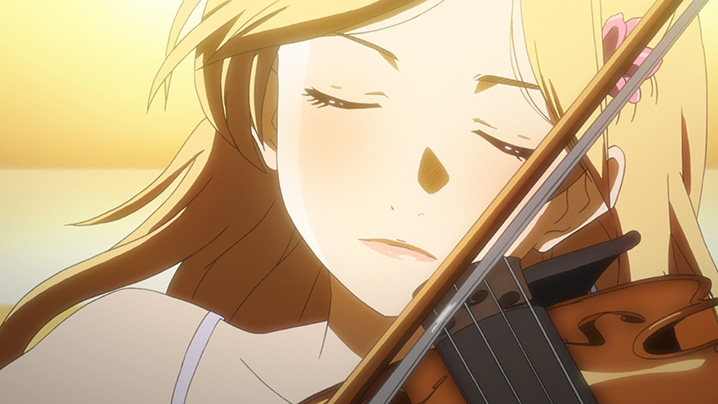
Throughout the episode, the theme of a “journey” is brought forth time and time again. Kousei realizes that Kaori is bringing him somewhere. Although he was a prodigy, Kousei had never known the music he played with intimacy, instead focusing on perfecting it technically as ordered by his mom. Actually, that’s not quite true – a flashback shows that at one time, when Kousei was just beginning, he understood the beauty of music (as did his mother before her condition occurred or worsened), the magic of it – the kira kira in it. But along the way, he lost that, and music became something to master rather than to enjoy and know.
Kaori is leading Kousei on this journey as one who understands the nature of music. She has a relationship with it – something dynamic, as seen by how she approaches pieces. And though she points to music as the journey, Kaori actually functions as music itself. As Kousei comments, “This girl is the journey – [she’s] freedom itself.”
There’s a good analogy happening here, as Kousei resembles many people in our culture who have gone away from religion. In a distant past, they remember stories of Jesus and God and Noah and Moses, but now, those are just that – stories. The narratives of youth have settled into the realm of knowledge, no longer touching the heart. And though once they may have believed as a child, they now dismiss their religion. It has no power to them – it’s not active and living.
Even for those who still attend church, the same might be occurring. They may see no fruit in their lives. All the head knowledge is there, but as with Kousei and music, something is missing – the relationship.
When Kousei realizes that music is living, that it’s more than recitals and replication, he begins to hear it again. Life is once again breathing into him. He thinks to himself, “I can hear your sound. You’re here.”
And what does it take for him to see and hear? Very simply, this – he has to listen to Kaori when she says, “Look at me.”
For the Christian, it can be simplified to that as well. For all our head knowledge, or for all the lies we’ve bought into about life and religion and God, He remains there to answer us, and more than that, He’s here to go with us on a journey. He will lead and we will accompany. But what we must do is look at Him.
Look up. Look up at the cross. Remember who we are. Remember who He is. Remember what He’s done.
Christ went through torture and pain, beyond the excruciating physical pain of the cross and into the impossible despair of being separate from God, out of love. And God, as the Bible describes, will go to all lengths to be with us. Just as Kaori shows when she stops in front of everyone, sacrificing her recital score, to help Kousei along, God, too, will go to all lengths for our us – He is the father in the story of the Prodigal Son who embarrassingly runs to the son that showed hatred toward him; He is the crazed woman who celebrates after finding just one missing coin (meaning one lost soul); and He is the King who dies for the same people who caused Him death.
And he beckons to us, “Let’s go on a journey.”
Just look at Him. Follow along. Start a relationship with Him. You’ll find that kira kira in your life – and you, too, will twinkle.


- FINLANDS at SXSW: Fuyuko Shiori’s Relentless Vision - 03.30.2026
- First Impression: Agents of the Four Seasons: Dance of Spring - 03.28.2026
- Fanart Friday: Ruby, You Are Not Alone - 03.27.2026