I love the numbers reflected in our reviews this week: 1, as in the initial volumes of four series we review this week. 5, as in the volume of Chitose where the other shoe drops. 19, as in almost caught up with the 20 volumes of Fly Me to the Moon that VIZ has released. 108, as in the number of times the villainess has been killed in a brand-new series we’re reading. And 100,000,000, which is the number of years you’ve got to train to be OP. Check out all those numbers and more in our seven manga and light novel reviews this week on Reader’s Corner!
Chitose Is in the Ramune Bottle (Vol. 5) • Drifting Dragons (Vol. 1) • Fly Me to the Moon (Vol. 19) • I Kept Pressing the 100-Million-Year Button and Came Out on Top (Vol. 4) • The Villainess Turns the Hourglass (Vol. 1) • The Villainess Who Has Been Killed 108 Times: She Remembers Everything! (Vol. 1) • When I Became a Commoner, They Broke Off Our Engagement (Vol. 1)
The Villainess Who Has Been Killed 108 Times: She Remembers Everything!, Manga Vol. 1

Scarlet has died a whopping 108 times, mostly violently, although that last time she just tripped on the stairs. She begins her 109th life as a newborn baby, determined to change her fate by staying out of trouble and studiously avoiding the five “heroes” and so-called saint responsible for her first 107 deaths. Hardly has she thought this when Blood Stalker the assassin (one of those heroes and currently just a kid) shows up, saves her life, and becomes a cross-dressing maid. No, really. Another hero who is likewise currently a kid, ship captain Seraphi Orange, seems likely to align himself with Scarlet after crossing paths with Scarlet’s dad. Meanwhile, it turns out Alisa, the “saint” and true villainess, is somehow responsible for the time loops, something her begrudging ally Solomon the master scholar (a third member of the heroes) is well aware of. This volume was partly what I’ve come to expect from time-traveling villainess stories, with a sympathetic protagonist and the promise of averting at least some of the tragedies of past timelines (not all of them, alas). The villains here are super evil, while Scarlet is portrayed as having good intentions even during some of her worse moments in past lives, making her easier to root for. What really makes this story intriguing, however, is the reveal that Alisa is causing the time loops. Usually in this kind of story, only the protagonist knows about their past lives, and it’s something that gives her an edge against life’s trials. But here, the villainous characters are already fully aware of (and indeed responsible for) what’s going on. It’s a crucial difference that might help this manga distinguish itself from similar time-traveling-villainess stories. I know I’m curious enough that I’ll pick up the next volume. ~ JeskaiAngel
The Villainess Who Has Been Killed 108 Times: She Remembers Everything! is published by Seven Seas.
I Kept Pressing the 100-Million-Year Button and Came Out on Top, Manga Vol. 4

With the interschool tournament and witchblade punishment complete, you’d think a little rest might be in store for Allen, Lia, and Rose. Think again. The trio has returned to campus just in time for the craziest club recruitment season you’ve ever seen and…what’s this? The student council wants in on Allen, too? And since when did this volume four become the series’ beach volume? Basically, quite a lot of nothing happens in volume four, other than a few character introductions and fun new dynamics being established between previously introduced ones (as well as an introduction for what appears to be the next arc), but all of this fluffy material is most welcome. These school-life events are a whole lot of fun. Still, I haven’t forgotten my complaints; in fact, they remain and are growing, because now it’s not only Lia and Rose that went from being terrific characters to stock ones (although Rose’s unexpected fantasies about Allen are hilarious), but the entire scenario for the series is dwindling in importance as the manga searches for the next shonen challenge for Allen to overcome. His 100 million years of practice don’t seem to mean much anymore, which is kind of like Luffy deciding that his search for One Piece was no longer important after about 20 chapters. Well, I guess this change in direction ultimately doesn’t matter much since I Kept Pressing the 100-Million-Year Button is more about the laughs and adventure shenanigans and less about the storyline, but it does portend that this particular reviewer will drop the series sooner rather than later unless it somehow pulls a second surprise better than the first, which was that a series I pegged as silly nonsense was worth reading at all. ~ Twwk
I Kept Pressing the 100-Million-Year Button and Came Out on Top is published by Yen Press.
READ: I Kept Pressing the 100-Million-Year Button and Came Out on Top Reviews Vol. 1 // Vol. 2 // Vol. 3
Drifting Dragons, Manga Vol. 1

In a different world’s version of the Industrial Revolution, humans have begun to sail the sky in steampunk blimps, but they’re not the masters of the air yet. That title belongs to the dragons that drift through the heavens unopposed, except for the handful of “drakers” willing to risk their lives to hunt the creatures for glory, profit, and the best cuts of dragon meat. The crew of the Quin Zaza is one such collection of individuals, and this is the story of their adventures, misadventures, and favorite dragon recipes. I’ve found that in truly excellent series, the first volume is often the weakest. This trend is perhaps unavoidable, given that the characters, worldbuilding, and plotlines need to be set up before the story can have a proper payoff. This is the case in Drifting Dragons volume one, where Taku Kuwabara is playing it safe with a collection of one-and-done plots to flesh out his story world and establish his cast and character dynamics. There are also some instances of what TV Tropes calls “Early Installment Weirdness”—when early chapters have details that don’t fit the later parts of the series. Most notable is a scene with a double-entendre conversation between Takita and Mika. They’re just doing the ship’s laundry, but the framing makes it sound like they’re doing something else entirely. That scene feels completely out of place if you’ve read the later volumes. Still, there is a significant difference between “weakest by comparison” and “weak in absolute terms,” and while volume one is the weakest of the Drifting Dragons series, it’s still strong overall. If there is anything at all you like in the volume (such as the incredible artwork), stick it out because the story only gets better. ~ WacOtaku
Drifting Dragons is published by Kodansha.
Fly Me to the Moon, Manga Vol. 19

Picking up where the last volume left off, this one is focused on the visit to Tokiko’s estate that was actually Tsukasa’s hideout. It was a place she could go if she needed to disappear because someone learned her secret. There’s actually an entire fake village and fake mansion just to throw off anyone who comes looking for Tsukasa’s true hideaway. However, as it happens, the schoolgirls Nasa teaches are out seeking summer adventure, and led by the mysterious Kaguya (totally not a significant name in this manga), they find the safehouse. Tsukasa and Kaguya meet, and there are hints that they have some kind of connection. The rest of the volume is occupied by silly summaries and other gags, like jokes about the mangaka’s past work Hayate the Combat Butler and high-heeled shoes. I admit I was kind of disappointed by this volume; it just didn’t feel like it had much substance. There was also some tacky fanservice. It’s not a terrible volume, but definitely not as good as what I expect from this manga. I’ll still keep reading though, since I’m invested at this point. ~ JeskaiAngel
Fly Me to the Moon is published by Viz.
READ: Fly Me to the Moon Reviews Vol. 1 // Vol. 2 // Vol. 3 // Vol. 5 // Vol. 6 // Vol. 7 // Vol. 8 // Vol. 9 // Vol. 10 // Vol. 11 // Vols. 12-13 // Vol. 14 // Vols. 15-16 // Vol. 17 // Vol. 18
The Villainess Turns the Hourglass, Manhwa Vol. 1
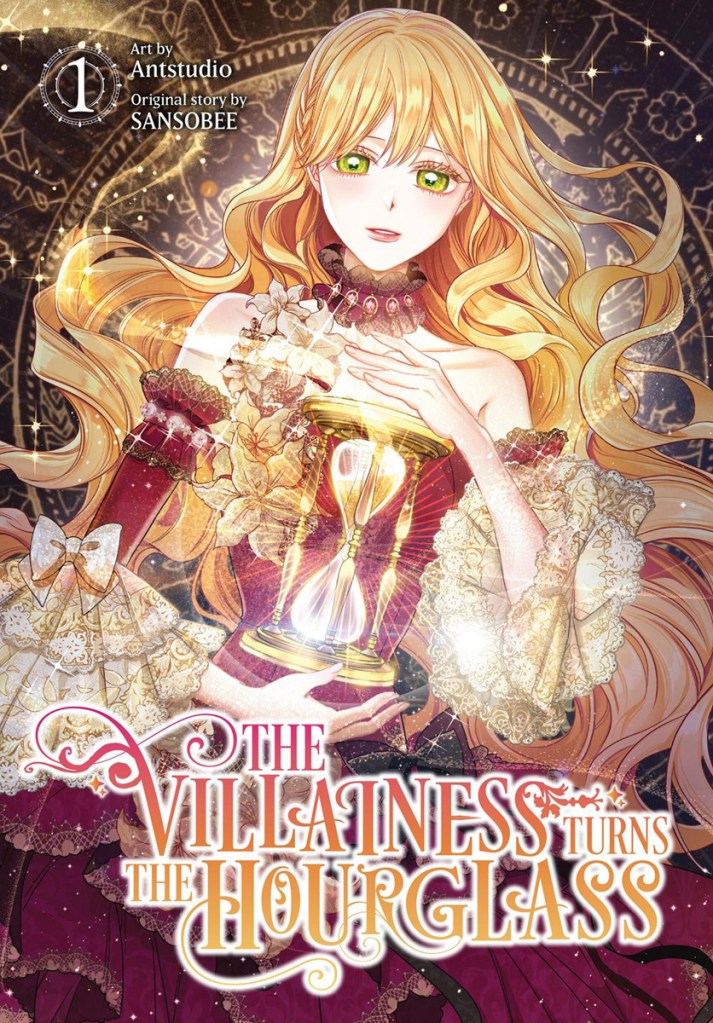
Sometimes in a story with a revenge-based plot, it turns out the protagonist’s idea of “vengeance” was actually pretty tame all along, and so they can achieve it without doing anything unsavory. Other times, the protagonist may start out with genuine ill intentions, but finds love, learns the emptiness of revenge, etc., and veers off the hardcore vengeance track. And then there are stories like this, where the protagonist starts with a cutthroat, malicious determination to punish those who wronged them, and…doesn’t show any signs of changing. In her first life, Aria was a hapless pawn manipulated and exploited by her vicious stepsister Mielle. Thanks to a time reset, Aria gets a do-over, and she’s determined to play the villainess and make Mielle et al. suffer. Time reset stories often have redemptive themes, as the protagonists uses their past-life experience to make better choices the second time around. This is NOT one of those stories, and that left me disappointed with this volume. Yeah, Mielle and her cohorts are evil, but that doesn’t make Aria’s manipulative behavior any easier to stomach. The story is devoid of the positive themes I tend to associate with time reset and “villainess” plots. So, I guess I’d only recommend this if you’re in the mood for a story about a “villainess” who deserves the title? ~ JeskaiAngel
The Villainess Turns the Hourglass is published by Yen Press.
When I Became a Commoner, They Broke Off Our Engagement! Manga Vol. 1
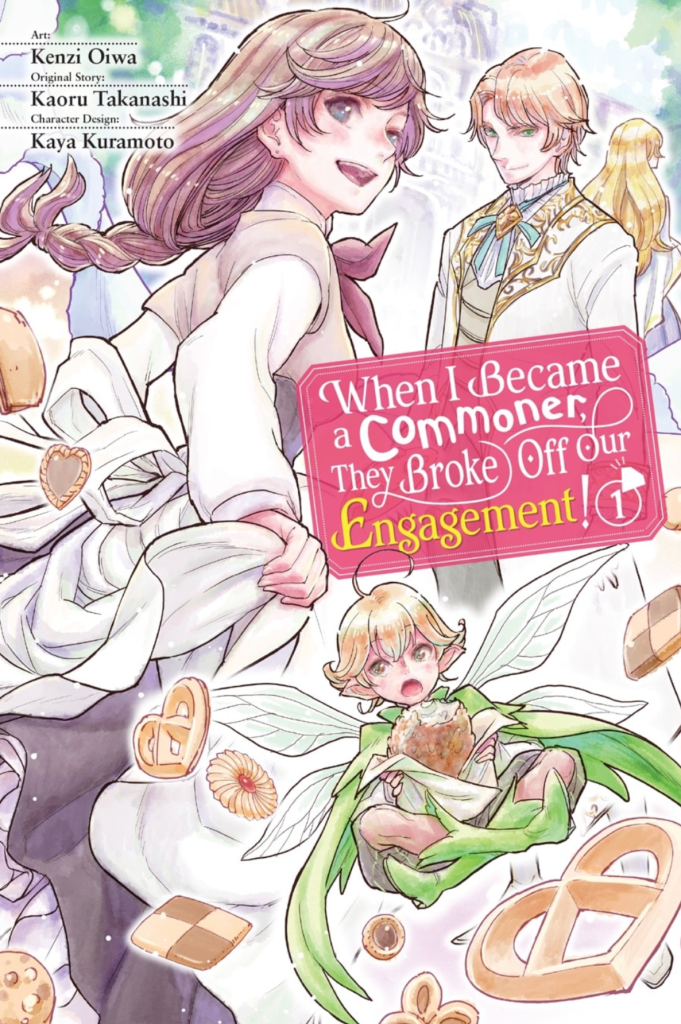
Thirteen-year-old Anna was raised in a noble house, but isn’t related to them by blood, as she was actually swapped at birth by a mischievous faerie. Another faerie (she names him Klew) shows up and reveals the swap to her, which explains a number of oddities in terms Anna seemingly not fitting in with her family. Her brother Henry is kind, but their parents not so much. We also meet her fiancé, Edmund, who seems to be the type of boy who acts abrasively toward girls to conceal his awkwardness around them. There’s some amusing culture shock as Klew tells Anna how commoners live. She starts learning to cook, and Ed validates the old notion that the way to a man’s heart is through his stomach, as he and Anna grow closer thanks to her cooking. Oh, and we start to learn about Annette, the other girl. Anna feels majorly inferior to Annette and fully expects to be rejected by both her families (and Ed too) once the truth gets out. Eventually, at the instigation of the original faerie miscreant, Anna’s noble family meets Annette and promptly identifies her as theirs. Even Henry turns against Anna. My main complaint with this volume is that it’s jarring and unsatisfying how rapidly Ed goes from constantly-insulting-Anna mode to best-buddies-with-Anna mode just as soon as she makes him a crepe and some udon. Henry’s abrupt rejection of Anna, after he’s been established as such a kind and doting brother, also felt forced. That said, I’m at least interested enough in finding out what happens to her that I’ll tune in for the next volume. ~ JeskaiAngel
When I Became a Commoner, They Broke Off Our Engagement! is published by Yen Press.
Chitose Is in the Ramune Bottle, Manga Vol. 5

There’s this moment in volume five of Chitose Is in the Ramune Bottle when the titular uber-popular boy gazes at his friends and thinks, “Everyone is really an individual, after all. I mean, our personalities and hobbies and tastes are quite different.” In a nutshell, that’s what this volume is about. Hiromu, who has struggled to differentiate between the four main girls who are desperately in love with Chitose (when he changes character perspective, for instance, he literally writes opening phrases like, “After cleaning the campsite, I, Yuuko Hiiragi…”), presses very hard toward doing just that in this volume. And despite the quote above, which exemplifies the author’s attempts to separate the girls by archetype (which hasn’t worked at all so far in the series), Hiromu is now really putting in effort toward giving each girl a voice. The setting for volume five is perfect for allowing this change in the series to take off, giving the author room for long passages filled with the girls’ thoughts, as it’s the series’ “summer volume,” with the group attending a fireworks festival and then vacationing at the beach. Differences between how each of the girls thinks start to become more obvious in their actions and as we directly peer into the girls’ thoughts—especially cover girl Yuuko’s. For better and worse, this leads to Hiromu having to address the elephant in the room: Why exactly do these girls love Chitose so much? He’s already been established as a good dude in previous volumes, but the author hasn’t created a character who’s so incredible that it makes sense he’d be more desired than any guy I’ve personally ever met. The things he says are so eye-rollingly stupid (including all the innuendo), yet the girls play along and say equally dumb things. It’s no better in volume five; Hiromu is still unable to establish that kind of character, though he tries by making Chitose honest to a fault, which ultimately makes him compelling to me as a reader, which is significant. Just as compelling are the honest thoughts from others that we become privy to, as we get read the inner monologues by some of the girls (especially by Yuuko in this volume), which include self-doubt and jealousy. This really helps to make the girls feel real. I appreciate the author’s efforts, as well as a slam-bang ending (Hiromu’s conclusions are as good as any light novel writer’s)—so much so, in fact, that I now intend to make a spreadsheet about the girls to refer to when I’m reading so I’m not as confused as I’ve been! After all, if the author is willing to put in the effort for a series that’s been worth reading for its many great moments, then I will, too. ~ Twwk
Chitose Is in the Ramune Bottle is published by Yen Press.
READ: Chitose is in the Ramune Bottle Reviews Vol. 1 // Vol. 2 // Vol. 3 // Vol. 4
“Reader’s Corner” is our way of embracing the wonderful world of manga, light novels, and visual novels, creative works intimately related to anime but with a magic all their own. Each week, our writers provide their thoughts on the works they’re reading—both those recently released as we keep you informed of newly published works, and those older titles that you might find as magical (or in some cases, reprehensible) as we do.

[…] READ Drifting Dragons Vol. 1 […]
[…] Reviews of Drifting Dragons: Vol. 1// Vol. […]
[…] Reviews of Drifting Dragons: Vol. 1 // Vol. 2 // […]
[…] READ When I Became a Commoner, They Broke Off Our Engagement!: Vol. 1 Review […]
[…] READ Reviews of Fly Me to the Moon: Vol. 1 // Vol. 2 // Vol. 3 // Vol. 5 // Vol. 6 // Vol. 7 // Vol. 8 // Vol. 9 // Vol. 10 // Vol. 11 // Vols. 12-13 // Vol. 14 // Vols. 15-16 // Vol. 17 // Vol. 18 // Vol. 19 […]
[…] READ Reviews of I Kept Pressing the 100-Million-Year Button and Came Out on Top: Vol. 1 // Vol. 2 // Vol. 3 // Vol. 4 […]
[…] Reviews of Drifting Dragons: Vol. 1 // Vol. 2 // Vol.3 // Vol.4 // […]