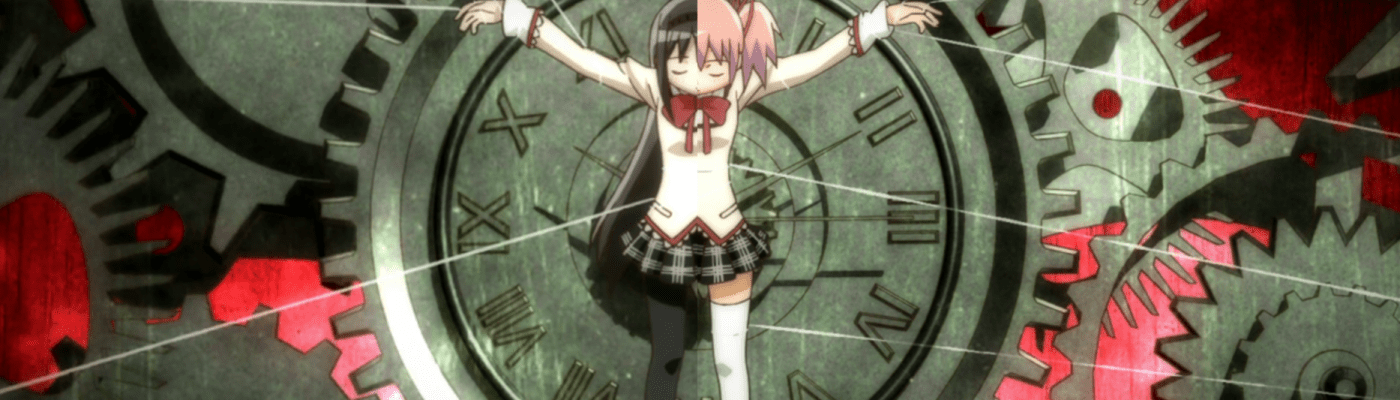
Madokami–excuse me, Madoka–and Christ are often compared with each other in discussions about Puella Magi Madoka Magica, which is no surprise, given the overwhelming number of parallels between their ultimate acts. At the same time, other posts have pointed out the ways in which Madoka does not make for a good Christ figure. So who is right? Well, both of these readings are missing something important, and that something is actually a someone. There is another person in the story who is absolutely crucial, and without whom not a single magical girl could have been saved: Homura.
Homura and Madoka together form a more complete image of Christ than just Madoka alone. But it’s not a simple question of summing up their positive traits and adding them together. Instead, it’s their dynamic, and not just their complementary characters, that creates a Christlike image. Let’s discover how their intertwined sacrificial love brings about that glorious ending.
Faithfulness in the Face of Temptation
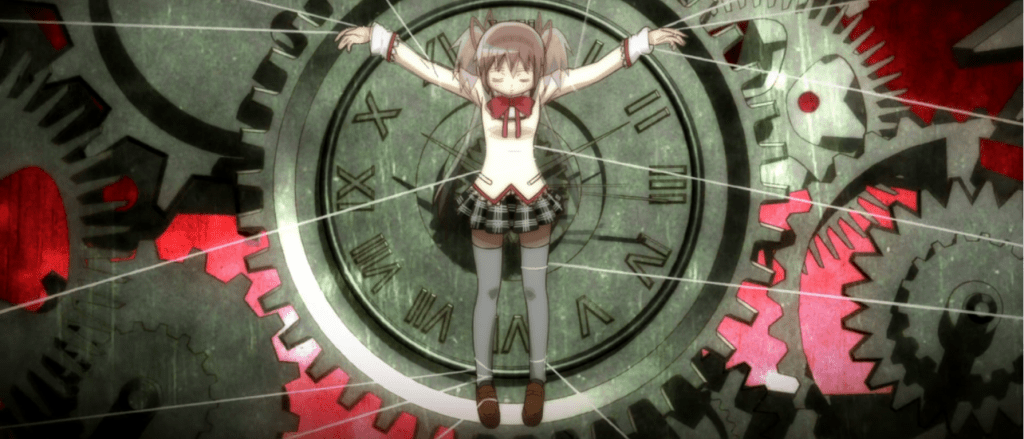
Homura’s mission is a lonely one, with most of her fights taking place offscreen, as she collects as many grief seeds as she’s able. But she’s right there beside Madoka whenever her help is needed. From episode 4 on, Homura makes it clear to Madoka that she doesn’t have to become a magical girl, and despite technically leaving the choice up to Madoka, Homura herself would prefer that she drops the idea altogether. This sets up a situation that brings to mind the temptation Jesus experienced by the devil in the desert.
In the gospel of Matthew, after Jesus is baptized, he goes out into the wilderness and fasts for forty days, during which the devil unsuccessfully tempts him three times. As the metaphorical devil of the story, Kyubey tempts Madoka in three different ways as well. First, he pushes Madoka to become a magical girl to save her friends from witches, but we find out later this was a misleading solution that would only delay the inevitable. When this fails, Kyubey tries to tempt Madoka with power. Her low sense of self-worth makes her susceptible to this, but not for the reasons we might expect. She doesn’t want power in order to elevate herself and look down on others. Instead, she sees the promise of power as an opportunity to serve others. And lastly, he tempts her with godhood, which only moves Madoka for the same reason she wants power: to save her friends.
These temptations echo those of Christ: Just as Madoka is tempted to find a solution for magical girls that would only be temporary at best, so too is Jesus tempted to solve the problem of humanity (hunger) with a temporary solution, using his own effort. He was tempted to embrace power and to use it flagrantly. Lastly, he was offered lordship over the whole world, a reward for bowing down to Satan. For both Madoka and Jesus, temptation was at its heart about whether they could and should solve the world’s problems through their own elevation. Neither succumbed, but while Jesus resisted the temptations of the devil by himself, Madoka couldn’t do it on her own. Instead, in all of these situations, she would have succumbed to the temptation if not for Homura.

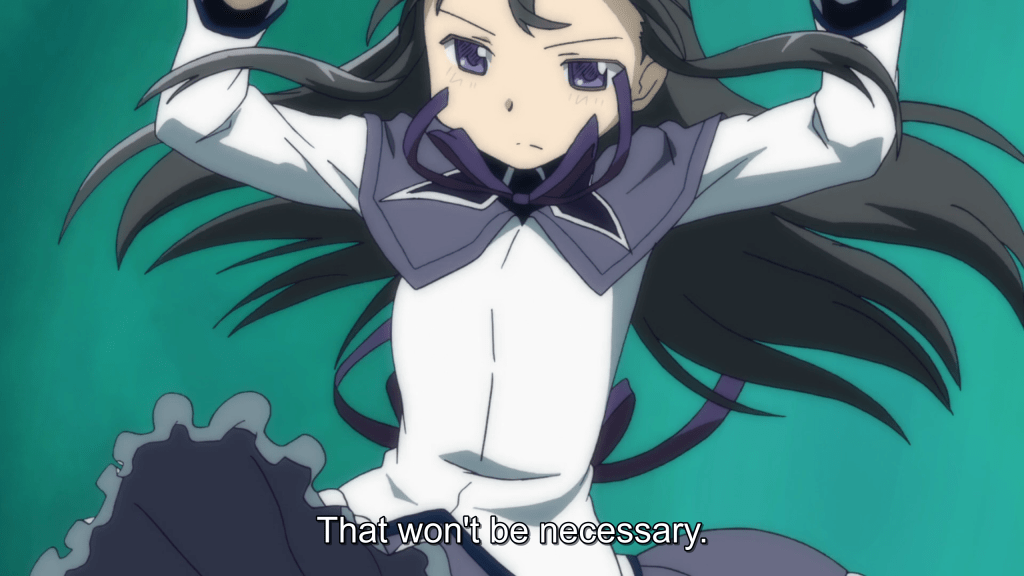

Homura is the guardian angel who stands between Madoka and the devil-like Kyubey. She intervenes each time Kyubey tries to trick Madoka by taking charge of the situation, imploring Madoka to reject the burden that Kyubey is trying to push on her. This might seem a bit contradictory, because isn’t it a good thing for Madoka to become a magical girl in the end? Yes, but to become one right now in the way Kyubey is setting it up would be wrong. It’s a question of timing. In the same way, Jesus eventually went on to do all of the things Satan tempted him to do: he miraculously created bread to feed thousands, he walked on water and calmed the storm in a great demonstration of power, and he fought for and gained the world, but he did it in God’s timing, and according to his Father’s ways. With Homura’s protection, Madoka is able to weather the storm of temptation. Because of this, she has more time to think her wish through, which ends up making all the difference. Stay tuned!
Longsuffering Meets Compassion
I can’t think of a work of fiction that portrays a greater willingness to endure suffering for someone they love than what we see with Homura. After Homura’s wish is reshaped into a promise to Madoka, she commits to her new mission by giving up an important part of herself: her own self-image. She always saw herself as weak and timid, but in order to honor her promise, a person like that won’t do. As a sweet and sensitive girl, Homura is not fit to be a strong iron-willed protector. But Homura keeps on trying and trying and trying. She won’t let her “soft” personality get in the way of saving the girl she promised to protect.
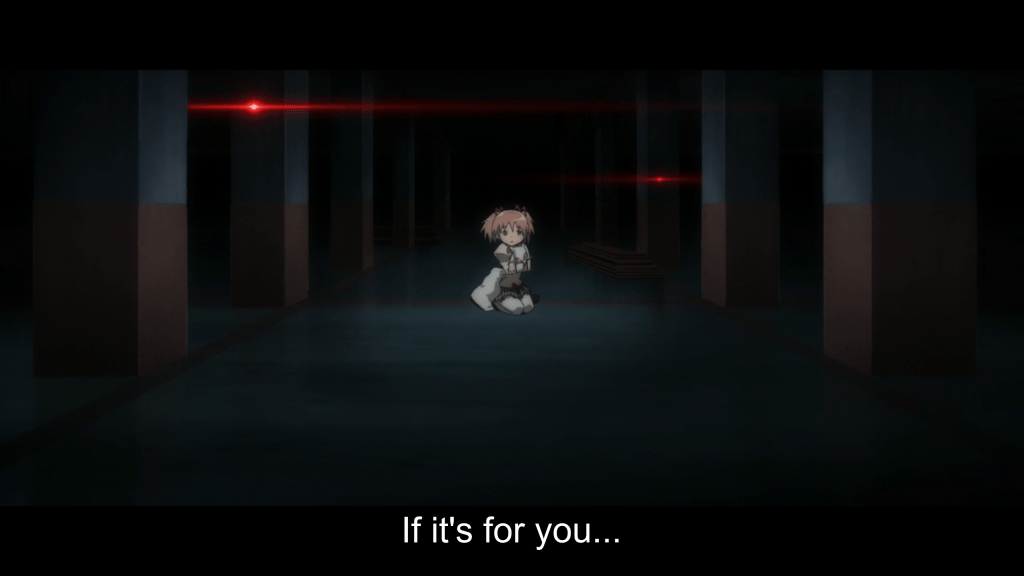


Usually, when people suppress their true selves, it’s to gain popularity and approval. But Homura’s goal is nobler. She doesn’t mind being disliked by everyone if it’s for Madoka’s sake, even if that means being disliked by Madoka herself. Homura takes on a heavy burden, reminiscent of the burden Christ was destined to carry: He was despised and rejected by mankind, a man of suffering, and familiar with pain.
The result of Homura’s determination is the main timeline of the anime, where we see a seemingly cold and strong Homura, and a hesitating and sobbing Madoka. It’s difficult for a first-time viewer to understand how this counter-nature circumstance only exists out of necessity. In the original timeline, the roles were almost exactly reversed, with Madoka being the strong and confident magical girl who protected the weak and insecure Homura.
Homura transforms radically through her experience of excruciating suffering. She sees the one person she cares about the most die or succumb to despair over and over again. And rather than getting closer to the end with each repetition, she only seems to dig herself deeper into this hell, because on top of the pain of seeing Madoka get hurt, she also grows more distant from her friend with each new timeline. The Madoka she protects is no longer the Madoka who protected her. Rather than her fight being a team effort, Homura acts on a promise made to someone in another world. She is all alone in this struggle, but giving up is not an option. Her weakness, her feelings, they all have to make way. Whatever it will cost her, she will save this one girl.
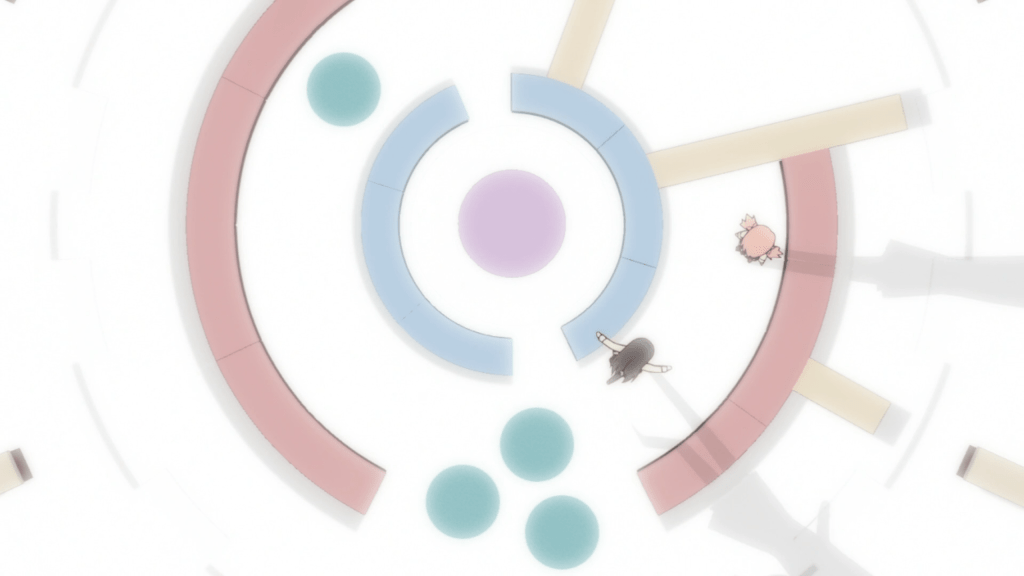
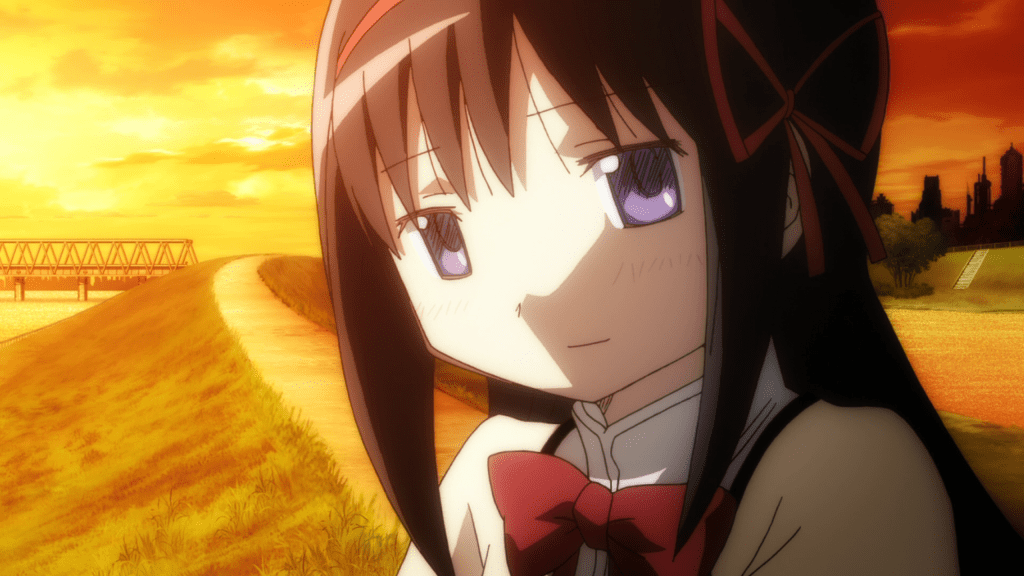
But we see Homura reaching her limit in episode 11, when she pretends that she has everything under control and that Madoka’s help is not needed. Despite not being able to understand what Homura is going through, Madoka is perceptive enough to see through Homura’s cool act. Madoka assumes that Homura has good intentions, and wants to accept her protection. But Madoka also sees through Homura’s facade and senses that Homura has no chance. The depth of Madoka’s compassion results in her crying for Homura, rather than acting indignant at her dishonesty. Her kindness makes the sting deeper for Homura than any insult the other girls threw at her. At this point, the pressure to give up and cry on Madoka’s shoulder gets the best of Homura. She betrays her promise to be strong and bear anything and instead confesses to Madoka how much she’s suffering in her lonely fight.
The vulnerability of both of them here makes me think about that moment when Jesus stood in front of the tomb of Lazarus. When he saw how much Mary and her friends were grieving the death of Lazarus, Jesus cried. This powerful God, who would, in the very next moment, resurrect Lazarus, felt a deep compassion when he and his loved ones were faced with loss. His genuine sadness showed the Jews around him that he truly loved Lazarus. Right here, Homura’s vulnerability has a similar effect on Madoka. Homura has been trying to be a savior by being tough and strong, but it is when she weeps that Madoka sees her properly, and perhaps as a friend, for the first time. Homura now finally reveals that she has been bearing all of this just for Madoka. After she regains her composure she repeats her original wish: she insists on being the protector and reassures herself of the nobility of her goal by embracing Madoka, the person who’s worth fighting for. She asks Madoka to trust her because the situation is too crazy to completely explain it to her. As far as possible in her position, Madoka understands and believes Homura.

Homura in Gethsemane
From this moment on, until Madoka’s wish, Homura goes through her darkest and loneliest hour. Her struggle during this time mirrors that of Jesus in the garden of Gethsemane. Jesus knew he was going to be crucified the next day and was in severe agony. Even though he knew he had to die to save us, he prayed: “My Father, if it is possible, may this cup be taken from me. Yet not as I will, but as you will.” The cup is a symbol of the role Jesus had to fulfill as Messiah, to die for our sins. Something similar is going on here with Homura. Except instead of asking to let the cup pass from her, she wants to take it from Madoka. Homura might not be aware of it, but right now she’s playing her last part as protector. She’s coming to the point where she’ll have to accept that she can’t drink from Madoka’s cup. Madoka herself will have to finish what she was destined to do.
For the moment though, Madoka has to watch Homura fight this hopeless battle against Walpurgisnacht, which is the embodiment of the despair of all the magical girls. For Homura, the ineffectiveness of her attack strategy is not new, yet she keeps fighting, just as she has over a hundred times before. Except, something is different this time, and not in a good way…

After getting pinned down in rubble, she would have continued her fight in a new timeline by leaving this one. But Kyubey’s crafty demoralizing has reached its fulfillment because Homura no longer believes that her suffering has been for good. Despite her strong determination, Homura is defeated because she’s now losing the one thing she had left: Hope to save Madoka. She reaches the most bitter moment in the anime, where, rather than being able to be proud of her efforts, she comes to believe that she has done nothing to help the person she loves but has instead only brought her more suffering.
The tragedy of this moment is so great that it could be a worthy final scene. But Madoka’s sudden entrance takes the story in a new direction. Now, at last, Madoka is able to relieve Homura of her horrible burden. That same burden that Homura fought so hard to keep off Madoka’s shoulders, must ultimately be returned to her. Incredibly, Madoka has found a way to understand Homura’s feelings across a gap of over a hundred timelines. She knows Homura’s desire to protect her and will now both honor and reject it. This seems paradoxical, but the necessity of this tension was planted earlier in the series with the double meaning of the apple. Homura’s prayer to protect Madoka was full of nobility, and she showed a truer loyalty than anyone had ever seen. But her wish was a rebellion against God’s will. Madoka is the courageous hero, and in the end, she must play the main role of savior.
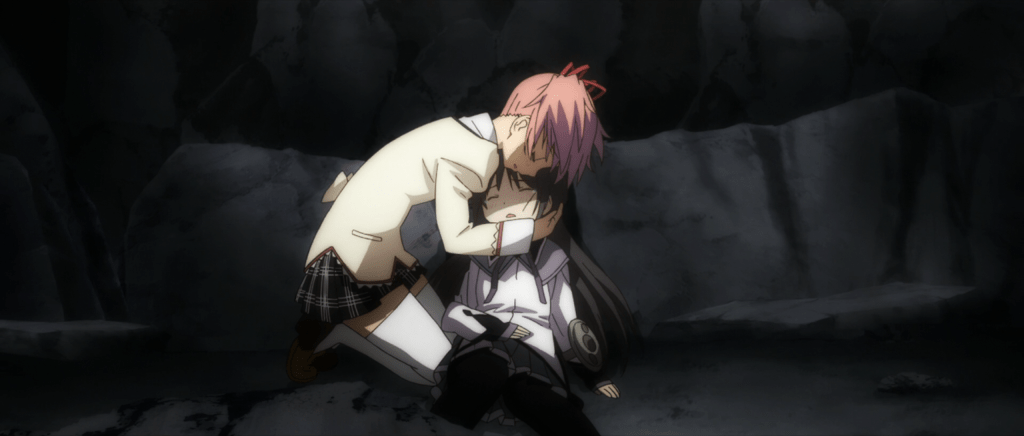
From this point on, we no longer see the Madoka that we saw throughout the series. We see the true Madoka, full of the courage and focus that we saw in the original timeline, but with the added wisdom and understanding that transfigures her. Madoka now makes an impossible demand of Homura: Have trust in me and let me sacrifice myself for you. Homura’s entire life’s purpose has been to fight against this very thing, so there seems to be no way she could possibly accept this outrageous request. But against all logic, Homura actually has a sliver of trust in Madoka. Just before this moment, Madoka’s mother showed a similar counterintuitive trust in Madoka, by letting her go outside during a natural disaster. It’s almost as if during these last moments before her wish, Madoka is emanating a premature aura of Godhood. But now it’s time for Madoka to make her wish and justify the trust that her loved ones have put in her.
The Cross Defeats Kyubey
Madoka uses Kyubey’s plans against him and makes a wish to erase all witches before they are born. She adds the stipulation that she herself will be the one to carry out this wish. For a moment, Kyubey thinks that he has won. Madoka just gave up her soul after all and seems to have submitted herself to Kyubey’s diabolical system just like all the other magical girls. Kyubey makes the same mistake that the devil made two thousand years ago when he thought that he had defeated Christ by sending him to be crucified. Christ didn’t resist, because it was precisely on the cross that his two nailed hands were able to restore those lost to sin back to him. It was through death that he destroyed death forever.

Just as Jesus ascended after his victory over death, so too does Madoka ascend to Godhood. Homura is carried away with her to witness her ascension and first act as Goddess. Standing on what appears to be the surface of the moon, Homura hears Kyubey speaking to her. He reveals himself to be a bit of a sore loser and tries to drive Homura to despair one last time. Kyubey explains that the staggering amount of hope emanating from Madoka’s wish is enough to give birth to a new universe. Rather than deforming into a witch, magical girls will now find a home in this new universe of hope, which could be called Heaven.
Yet, Madoka’s wish is not without cost, as an equal amount of despair is unleashed in karmic reaction to her profound action. We see this play out in the current universe, with the earth being covered with despair. But Madoka’s wish destroys the grip of this despair forever, and she counters Kyubey’s narration, unleashing her arrows of salvation on that doomed Earth, and making even that dark world a hopeful place.
The lives of magical girls in the new world created by Madoka’s wish are sometimes characterized as essentially the same as before, but this couldn’t be more wrong. Rather than their hopes being a tool to be exploited by Kyubey to lead them to certain doom, they are now warriors of light whom Kyubey–himself now transformed by Madoka’s recreation of the universe–cooperates with to fight the physical manifestations of sin, known as wraiths. Instead of preying on these girls to harvest energy, Kyubey has now become their friend and ally. He has become the creature he should’ve been from the beginning, reminiscent of this passage from Isaiah 11: “The cow and the bear shall graze, their young shall lie down together; and the lion shall eat straw like the ox.”
This by itself makes the new world incomparable with the previous one. But the greatest change in the new world is something so amazingly good that we tend to push it out of our minds. The prayers of these girls, often spoken in their darkest moments, are no longer misdirected to the story’s allegorical satan. From now on, their prayers go to heaven directly, just as the girls themselves will do at the end of their mission. This is a promise to each magical girl and one that Madoka personally gave to Homura.
Madoka Reassures Homura

The ending is not a bittersweet one where Homura is alone despite her efforts to save Madoka. Rather, Homura must continue to hold on only for a short while longer in this dark world. Once her duty is done, she will be greeted with the fulfillment of her deepest longing. She will be with Madoka forever, which was foreshadowed in one of the most beautiful reconciliation scenes in anime. All time travel stories have a problem where even in a happy ending, the main character is the only one who remembers the previous timelines. But stunningly, that sadness has no place in Madoka Magica’s ending. Madoka is now a Goddess who knows all the timelines, and because of that, she’s able to connect with Homura in a happy completeness that nobody dared hope for. The bliss of this moment is so great, that we couldn’t blame Homura if afterwards she were to think all of this was simply a dream. But Madoka has thought even of that element of anxiety, and gives Homura her red ribbon, as a form of evidence that her reconciliation with Madoka is real and that it wasn’t simply a dream.
Madoka’s red ribbon seems to be a homage to Spirited Away, which uses a similar motif when Chihiro leaves the spirit world with a special purple hairband. Perhaps Madoka’s promise to Homura, the promise that they’ll meet again, should be enough. But Madoka gives this red ribbon as an additional sign, to make Homura resolute in the face of any doubt, whether it comes from others or herself. As Christians, we have a similar assurance that we receive from the Holy Spirit. The Spirit comes in a less tangible form than a red ribbon (I wouldn’t rock it as well as Homura anyways), but the assurance he gives is no less powerful. In this broken world, we can already experience a part of the peace and joy that God will complete in the next. But this joy is not only here to be a foretaste. It also transforms us into the person we were always meant to be. In the final episode, we see this happening to Homura. Through her interaction with Madoka’s parents and little brother, we see that her sweet and kind side, which she has been rejecting throughout the story, has now finally returned, and her insecurity is replaced with contentment and strength of mind. Her conversation with Madoka’s mother shows her as a new person, gentle and humble, but with a knowing look on her face, as if she knows something that’s too good to be told.
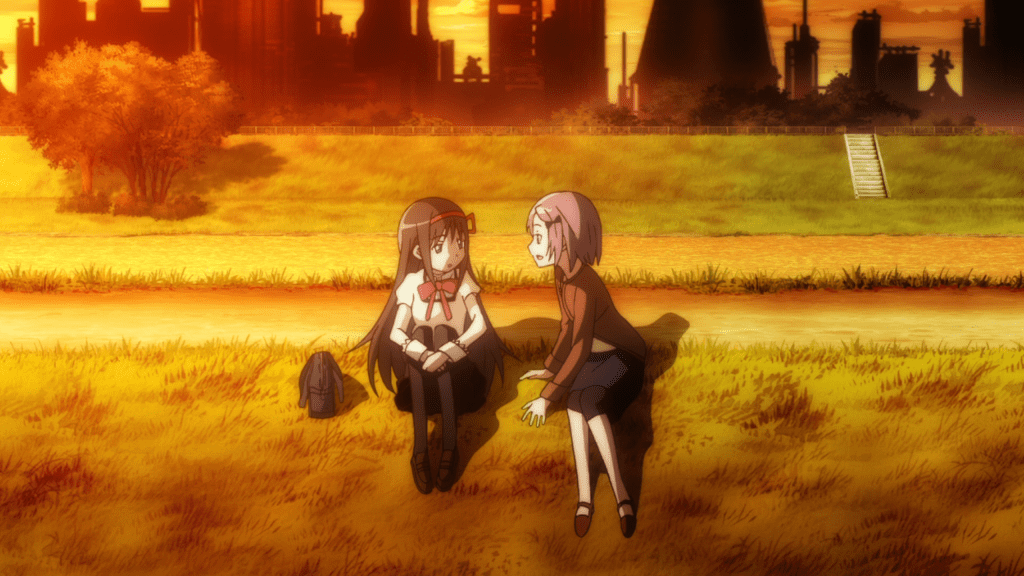
The radical change that Madoka and Homura went through might explain some of the unclarity when rating Madoka as a Christ figure. Sure, if you isolate Madoka as she is in episode 12, she might appear incomplete, because the epilogue shows her mostly in a display of triumphant power. But when we include the whole journey of both girls together in our analysis–their beginnings as imperfect messiahs, their selfless desire to protect each other–and consider how they facilitate each other in the role of savior, we see a fuller picture. We see that salvation did not come before the suffering of the cross: the loyal sacrifice Homura has made across countless timelines has directed and empowered Madoka toward that final victory over death and despair. And Madoka’s transcendent compassion and hope have ignited a belief in a happy future, even in the heart of one who bore as much pain as Homura. The anime leaves us with Homura facing the dark world that she trusts Madoka to redeem in the end.
Homura’s resolve to keep on fighting inspires hope in me as well. Like Homura, I need that promise for a better future to get through this current life. I’m glad that Homura received the guarantee of reunion that lies in the red ribbon, and I’m even more joyful, knowing that Jesus gave us a gift of no less value.

- First Impression: KILL BLUE - 04.11.2026
- First Impression: Kujima: Why Sing, When You Can Warble? - 04.10.2026
- First Impression: My Ribdiculous Reincarnation - 04.08.2026