
The Disappearance of Nagato Yuki is a charming spinoff full of amusing nods to the better-known anime The Melancholy of Haruhi Suzumiya. But although Haruhi gets booted from the title, she still has a major presence in the story. Of relevance to the current season, her approach to Santa Claus aligns surprisingly well with a famous “wager” posed by French philosopher, scientist, and mathematician Blaise Pascal.
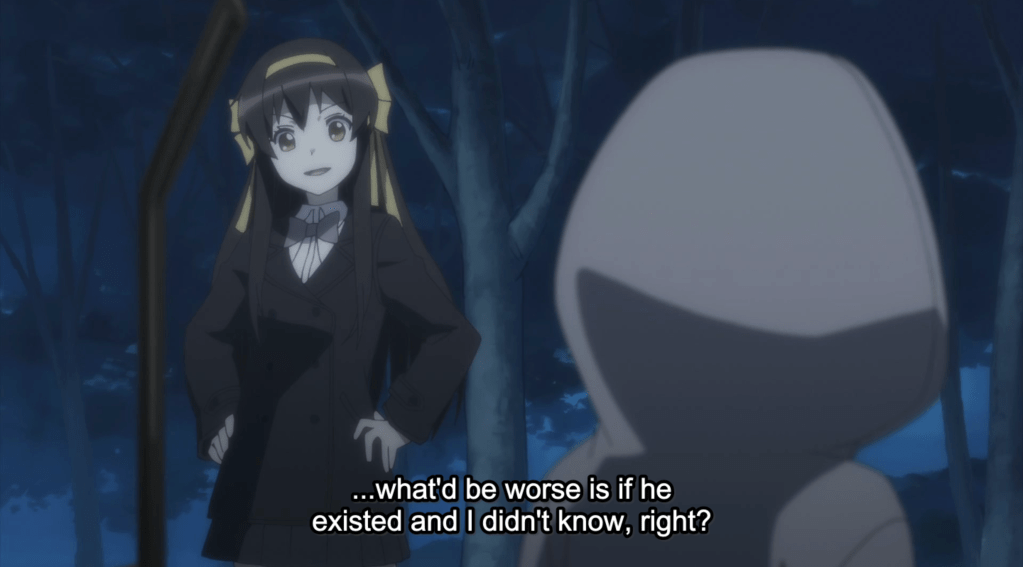
In the second episode of Disappearance, fittingly titled “Joy to the World,” a flashback shows us how shy-girl protagonist Nagato first encounters the dynamic force of nature we know as Haruhi Suzumiya. Haruhi dragoons a passing Nagato into helping her to write a message to Santa Claus on the ground, under the assumption that Santa will see it from the air. A flustered (and nearsighted) Nagato does her best to help out. During the scene, Nagato asks Haruhi whether she believes in Santa, and the latter admits that she doesn’t know if he’s real, but points out, “What’d be worse is if he existed and I didn’t know it, right?”
Haruhi’s reasoning evokes Pascal’s Wager, found in the Pensées. Pascal framed the issue in terms of betting that God does or doesn’t exist, and the risks and rewards involved in such a bet. If there is a God and one believes in him, one will gain greatly. If there is a God and one does not believe, one loses much. If there is no God and one believes anyway, one neither loses nor gains. Finally, if there is no God and one doesn’t believe, one likewise neither loses nor gains. Considering these four possibilities regarding God’s existence, the bet with the most potential for winning is believing in God.
Now let me be clear, philosophers and theologians have all sorts of things to say about Pascal’s Wager. It is emphatically not a proof for God’s existence, nor was it ever intended to be. It’s just a thought experiment. The point is simply that, purely in terms of risk and reward, it is rational to at least be open to the possibility of God’s existence. The wager is not the destination, but merely the first step of a journey toward faith. In the same way, Haruhi figures she has much to gain and nothing to lose by writing a message to Santa, while she would miss out if Santa does exist and she ignores him.
Haruhi with her wager stands in contrast to the male lead of Melancholy, Kyon, who opens the entire series with a smug monologue about how he is too smart to have ever believed in Santa. Where Kyon is dismissive of the supernatural, Haruhi is humble enough to be open to possibility. But what would evidence of Santa look like to Haruhi? Well, in this episode, she’s hoping to encounter the man personally. In her words, she wants to catch Santa and string him up—which makes Old Saint Nick sound like a whopper of a fish!

Haruhi seeks. She is not content merely to treat the wager as a mildly interesting but ultimately meaningless intellectual exercise. Her wager causes her to do something; it provides the motivation for her to attempt to confirm Santa’s existence for herself. She doesn’t make assumptions, and she doesn’t take someone else’s word for it. The question “What’d be worse is if he existed and I didn’t know it, right?” spurs Haruhi into action.
Pascal’s Wager has much the same purpose: It encourages us to seek Christ himself, for ourselves. Jesus is the greatest argument for God’s existence. But how can we look for him?
The most direct way to learn about Jesus is through the written word. In contrast to Santa—to whom we traditionally need to write letters—with God, it is he who has written to us. We encounter the Lord throughout the Bible, and especially in the eyewitness testimony about him found in the New Testament.
But while God has taken the initiative of writing to us, that doesn’t mean communication is a one-way street. As silly as it may sound, there’s a parallel between Haruhi’s message and prayer! After all, in each case, humans reach out to an unseen being. Through prayer, we can ask God to help us know him better, and he will answer. As God declares through the prophet Jeremiah, “Then you will call upon me and come and pray to me, and I will hear you. You will seek me and find me, when you seek me with all your heart.” Or consider the promise of the Lord Jesus himself: “I tell you, ask, and it will be given to you; seek, and you will find; knock, and it will be opened to you. For everyone who asks receives, and the one who seeks finds, and to the one who knocks it will be opened.” When and how God responds to us is up to him, but he does hear our prayers.
Other people can also help us investigate God. Just as Haruhi conscripts Nagato to help with her quest to capture Santa, so too can we involve others in our search (albeit hopefully in a less overbearing fashion). People can help us to know God through a wide variety of means. Some do so through the lived example of a life centered around trusting and loving the Lord. Some, such as Pascal himself, have left insightful writings that can help us think about God. A more modern variant of this is the many sermons that have been recorded and posted on church websites, free for the listening. And of course there’s always the option of direct conversation with another person about their faith.
The apostle Paul’s message to the ancient Athenians holds true today: “And he made from one man every nation of mankind…that they should seek God, and perhaps feel their way toward him and find him. Yet he is actually not far from each one of us.” The manger, the cross, and the empty tomb are all part of the same story, one in which God demonstrates his existence by taking on human form, interacting with us, dying, and rising from the dead. If you’re a believer, perhaps considering these two wagers will reinforce your confidence that your faith is rational. And if you’re not a believer, I hope the wagers of Haruhi and Pascal might encourage you to consider taking that first step and being open to the possibility of something wondrous and supernatural. “Joy to the World,” indeed.

- First Impression: I Want to End This Love Game - 04.14.2026
- First Impression: Wistoria: Wand & Sword Season 2 - 04.13.2026
- First Impression: The Drops of God - 04.10.2026

[…] The Disappearance of Nagato Yuki-chan (Eps. 1-2) – “Precious Place,” “Joy to the World” [1] […]