
“The hero transcends logic. The hero overturns what we thought we knew and drives away the darkness. He’s so uncomplicated… And he shines, bright and joyous.”
So says Makoto “Smile” Tsukimoto, the ping-pong prodigy who never smiles. “Do you believe in heroes, coach?” he asks the elderly teacher who trains him. Smile is an observant, stone-faced teenager with glasses whose blood doesn’t seem to rush even in the middle of the most tense of games. That he believes in heroes is truly a surprise.
Ping Pong may very well be the Evangelion of the sports anime genre, though, and it’s full of such surprises. Don’t let the unusual art style or the niche sport discourage you: This story is one for the ages. Daring, enigmatic, deeply human, it introduces us to a plethora of fascinating characters and pushes them (and us) to the limit.
Ping Pong punches so hard because it overcharges every frame, arc, and concept with meaning. Symbols grow before our eyes. We see Chinese superstar Kong Wenge surrounded by flying planes. We see Kazama, the captain from Kaio Academy, climbing a mountain and becoming a giant, a beast, a dragon. We see a giant robot fighting a flying hero all around Smile. These symbols are striking, but their meaning is not clear—at least not until the Christmas episode.


Ping Pong chooses its festive episode to unveil the meaning beneath these symbols, to provide hidden details that force us to recontextualize what we have seen so far. In this sense, the episode is much like the first Nativity, which unveiled the true meaning of some ancient messages presented in the rich language of symbols—that is, to the centuries-old mysterious, layered, evocative prophecies of the coming of the Messiah that were fulfilled on that day.
So, as we arrive at the manger of Bethlehem, let’s shine a light upon some of these prophecies, as we do the same with some of the rich symbols of Ping Pong.
Of foreigners and stars
Kong Wenge is an antagonist in the series, but he’s also a star, even as he descends from the heights to shatter the world of our characters. Ping-pong is the national sport in his native China, where he was a champion. Down on his luck, exiled to Japan, he fights to become famous again and get a second chance. Proud, professional, and prickly, Kong has made ping-pong his livelihood even since he was a little kid.
From his high horse, he discovered Smile’s talent and challenged him. For him, victory is the plane flying over his head back to his country, his neighborhood, and his mother—victory is returning home, as many of us do at Christmas.
But (spoilers ahead!), this route is now closed to him forever. When he loses, the rising star falls to the ground. And yet, in this episode we find Kong enjoying Christmas, singing with his team. Ping-pong has become Kong’s livelihood in a new way: He is a coach. His personality is still thorny, but he gives others what his own coach gave him. And, even if he cannot go to his mother, she can come to him. In this moment of song, we see that the antagonist, the loser, has found peace and joy.
One of the first Nativity prophecies originates from a losing enemy mentioned in the oldest piece of Aramaic literature, the earliest point of evidence in the history of the West Semitic alphabet. This is the Deir Alla inscription, datable to ca. 840–760 BCE, which mentions Balaam, son of Beor. This prophet was in the service of King Balak of Moab, who ordered him to curse Israel, which was by then a wandering multitude of nomads coming from Egypt (Numbers 22:5-7).


But Balaam would not curse Israel. Instead, like Kong, he discovered something great in this insignificant new rival. Balaam worshiped a God who turned out to be the God of Israel. After a strange journey full of prodigious events, the prophet tried to comply with the orders of his king, but could not.
Israel would not only defeat Moab but become a rising star, blessed eventually with a powerful king of their own—a king who would gradually be revealed to be everlasting. As the Book of Numbers tells us (24:7-9):
[Israel’s] king shall be higher than Agag,
and his kingdom shall be exalted.
God, who brings him out of Egypt,
is like the horns of a wild ox for him;
he shall devour the nations that are his foes
and break their bones.
He shall strike with his arrows.
He crouched, he lay down like a lion,
and like a lioness; who will rouse him up?
Blessed is everyone who blesses you,
and cursed is everyone who curses you.
Israel didn’t have a king yet in the days of Balaam, but in time, David would indeed defeat the enemy nations, establishing a royal house whose emblem was a star.

In Numbers 24:17, Balaam tells us this:
I see him, but not now;
I behold him, but not near—
a star shall come out of Jacob,
and a scepter shall rise out of Israel…
God told David that his house and his throne would last forever (2 Samuel 7:16). And when the final King of his line came, a literal star marked his birth. Many pagans were conquered by him, but not with weapons. Instead, their hearts were united to Israel and to God. The Son of David had a gift for those who accept Him and transcend their earthly aims: peace, joy, and Christmas.
With a new humility and a new freedom, when Christmas comes, the faithful rejoice like Kong and look at the star. We do not curse Israel, nor the loss of our own pagan dreams and concepts, because they have taken a new form. We are now a new Israel, strangers in a strange land, yearning for our heavenly home, which sends us a messenger. And we have the power to foster the same gift in others, including them in the blessed feast.


Of beasts and sons
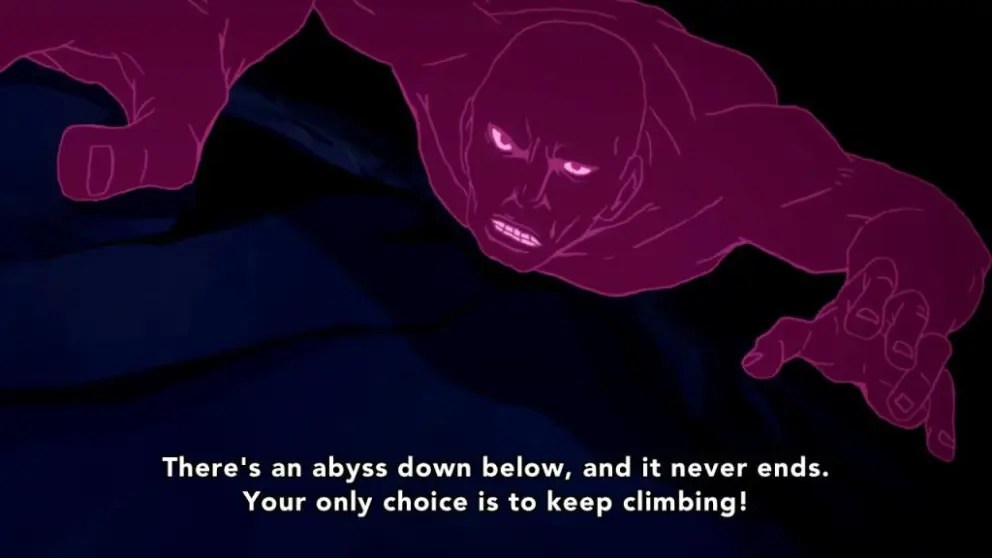
For a show about table tennis, Ping Pong has pretty disturbing imagery. Most of it is associated with Kazama “the Dragon” Ryu from Kaio Academy. When Kazama plays, he becomes a giant, a monster, a great purple dragon. Mountains and abysses pop across the screen. Kazama is more than a rival: His victories destroy the will of both his rivals and teammates to continue practicing the sport. And he takes pride in this.
Living in a world of shaved heads, robotic ping-pong gadgets, and Spartan training, Kazama intimidates his rivals with his sheer power and scoffs at the concept of “heroes.” He is, consequently, the main antagonist of the show. But the Christmas surprise Ping Pong has for us this time around is in the revelation of the deep-seated, philosophical unhappiness of the Dragon.
Heavy is the crown, as they say, and the champion feels trapped. “Heroes don’t exist. What exists is reality,” he says. And reality is a never-ending, anxiety-inducing struggle where any distraction might become his downfall. “There’s an abyss down below, and it never ends. Your only choice is to keep climbing!” Kazama spends Christmas alone in his bathtub under a reproduction of the Thinker, the famous statue by Rodin, while his girlfriend drives at top speed beneath the Christmas lights.


Kazama’s despair is not the despair of the defeated, but that of the victor. What is the endpoint of all the struggle, of all the suffering? Sooner or later, the winner falls from the podium and a new champion takes his place. Kazama’s sensitive father committed suicide by jumping off a mountain because he couldn’t keep up with the harsh reality of business. Kazama climbs the same mountain again and again, trapped in a cycle of suffering, anxiety, and victory.
One of the wildest, most terrifying Christmas prophecies comes from the time of Israel’s Babylonian captivity, after the crushing of their armies and the destruction of their beloved Temple circa 587 BCE. Daniel the prophet describes a vision in which a never-ending cycle of beasts destroying beasts, culminates in a nightmarish being that arrogantly defies God:
“After this I saw in the visions by night a fourth beast, terrifying and dreadful and exceedingly strong. It had great iron teeth and was devouring, breaking in pieces, and stamping what was left with its feet. It was different from all the beasts that preceded it, and it had ten horns” (Daniel 7-8). This beast seems to have the cycle of destruction embedded in its very being: “Another horn appeared, a little one coming up among them; to make room for it, three of the earlier horns were plucked up by the roots. There were eyes like human eyes in this horn, and a mouth speaking arrogantly.”
The vision is explained: Babylon, the nation that has crushed Israel and other powerful pagan nations, destroys and is destroyed in turn in a cycle of meaningless violence. Just as with Kazama, victory only means more beasts, more struggle. The monster of arrogant words has nothing to offer but despair.


But, as the prophet Daniel watches, the great beast dies, and as for the other beasts, “their dominion was taken away, but their lives were prolonged for a season and a time” (Daniel 7:11-14). And then:
I saw one like a man
coming with the clouds of heaven.
And he came to the Ancient One
and was presented before him.
To him was given dominion
and glory and kingship,
that all peoples, nations, and languages
should serve him.
His dominion is an everlasting dominion
that shall not pass away,
and his kingship is one
that shall never be destroyed.
The cycle is broken. “One like a man” comes down from heaven. The beasts that terrified the world are given a new kind of life. A new, formidable power has entered this world. Wielding it is a loving hero who transcends every frontier: the true king, glorious, powerful, and everlasting. He comes from the “Ancient One” whose hair is like wool and whose throne is of flame: God himself.

A hero will also rescue Ping Pong’s Dragon, transcending his logic, overturning his darkness, and bringing a sense of fun and light previously alien to him. Not all the beasts need to be killed: They just need to lose their hold upon our souls. Daniel tells us that, in facing our demons—the abysses that threaten to consume us—we can also count on a godsend.
“People can fly,” said Kazama. By walking on the water, ascending to Heaven, and having armies of angels sing His birth, Jesus filled his witnesses with wonder. And now, in him, His people can transcend this world without betraying the good it has. Not by ourselves, nor by our own effort—no matter how much we climb, we will never reach heaven—but with help from above, an extended hand that can bring us up.
Jesus, our hero and the Son of God, became also the Son of Man on Christmas Day, fulfilling the prophecy. He is here to give our battles new meaning. He helps us ascend in ways that seem impossible for us: As the angel said when announcing His birth, “for God, all things are possible.” No matter if we win or lose in the eyes of this world, we can smile. Which brings us to…

Enter the Hero!
Here comes the final punch. The most important symbol in the show is that of the flying superhero who comes to fight a giant robot gone berserk. It is in Smile’s videogame, in the Subway advertisements he sees, and all around his matches. It is easy to tell who the robot is: Cold-blooded, passive-aggressive, oblivious to all social cues, Smile keeps bulldozing through all of his matches, questioning everyone and everything as he continues winning.
The curveball that the Christmas episode has for us here is that Smile is not rude because he wants to be. When we see him spending Christmas all alone in a dark room, with nobody at home, humming to himself and playing video games, we understand that he has always been alone—except when he was playing ping-pong.
Parents are supposed to give us our first insight into the nature of the universe. They are meant to be signs of God, our Father. But as a side effect, their sins and shortcomings might impact their children terribly. We see this in Smile, who lives in a cold, desolate world where the best he can do is to be out of the way. The supposedly cold-blooded teenager actually feels deeply, but has trouble expressing it. But if Smile is the robot, who is the hero he says he believes in?
I know I have included a spoiler warning already, but the truth at the core of Ping Pong the Animation is so powerful that I repeat: Spoilers ahead!
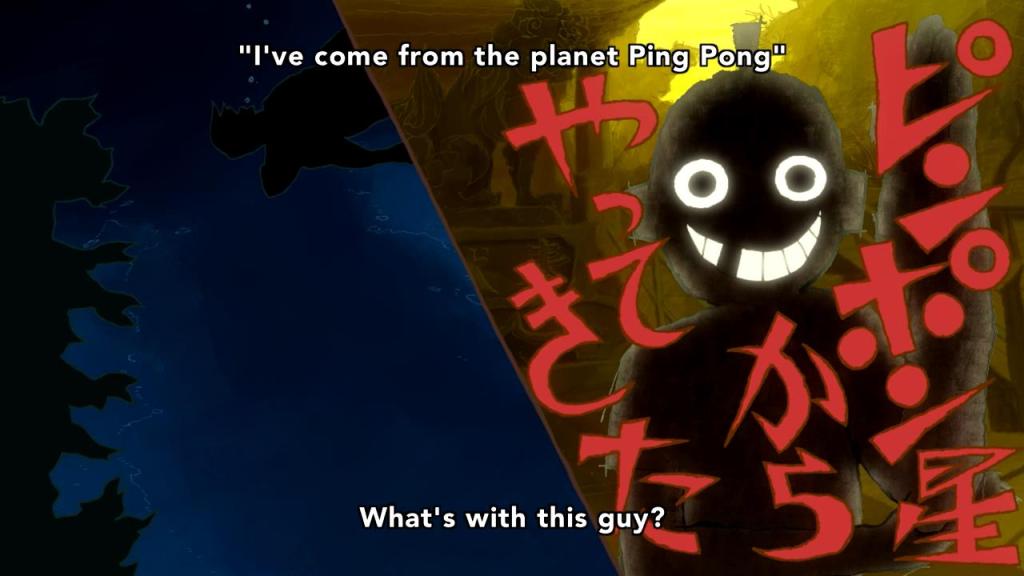
We first see this hero in symbolic flashbacks. A young Smile is trapped in a school locker, attempting not to feel anything, when a winged being comes to his rescue. A masked superhero strikes a pose, full of conviction, at the top of a staircase. An alien “from the planet Ping Pong” defends Smile from bullies, teaches him that ping-pong is fun, that he can play too, that “blood tastes like iron.”
Only in the final episodes do we understand the unlikely truth: Smile’s hero is the quitter, the slacker, the frustrating Hoshino “Peco” Yukata. We learn the story: Three kids used to play together in the same after-school ping-pong club. One of them, Peco, was a genius, able to challenge even the adults. Another, Manabu “Akuma” Sakuma, had no natural talent for the sport he loved.
And the last boy, Smile, came because Peco accepted him despite his expressionless demeanor, made him laugh, defended him from his bullies, and decided to teach him to play after school.
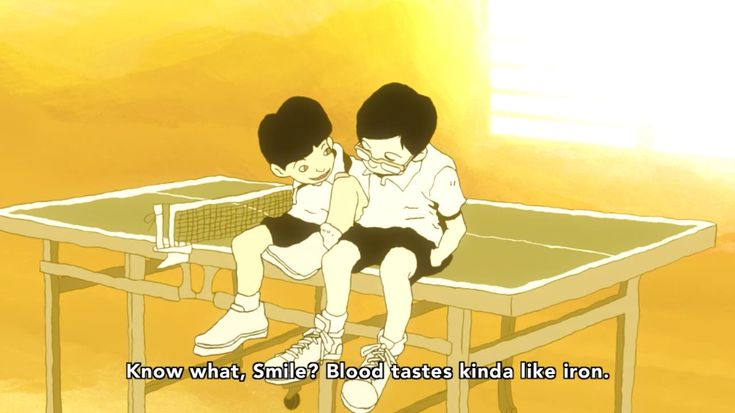
Smile met a hero, a sign of crazy hope beyond the rules of his empty world. “Call me if you’re in a pinch,” said Peco with childish conviction. “Chant these words three times: ‘Enter the Hero! Enter the Hero! Enter the Hero!’” Smile started playing, taking inspiration from his friend. And he became better. Another prodigy, even. But when Peco grew complacent and Smile surpassed him, he didn’t have the heart to defeat him, and started letting him win.
That is, until Kong Wenge called his bluff. Now, everyone knows that Smile is a prodigy, and Peco has vanished. But Smile is still waiting for him. He cannot bring himself to say so, but he waits. He hopes. He silently calls. And his hero comes back. “Blood tastes like iron,” he says again: Some things are worth the pain. And in the end, he fulfills the prophecy: Peco overcomes Kong, who had smashed him. With his joyful playing style, he brings light to the dragon. And, in the incredibly epic finale, he brings the fun of the game back to his childhood friend.
But way before the showdown, on Christmas Eve, Peco himself needs to be brought back to the light. In his darkest hour, when he jumps into the sea, his frenemy Akuma, a weak but enthusiastic player who had obsessed over defeating him from childhood, saves him and gives him his dream back.
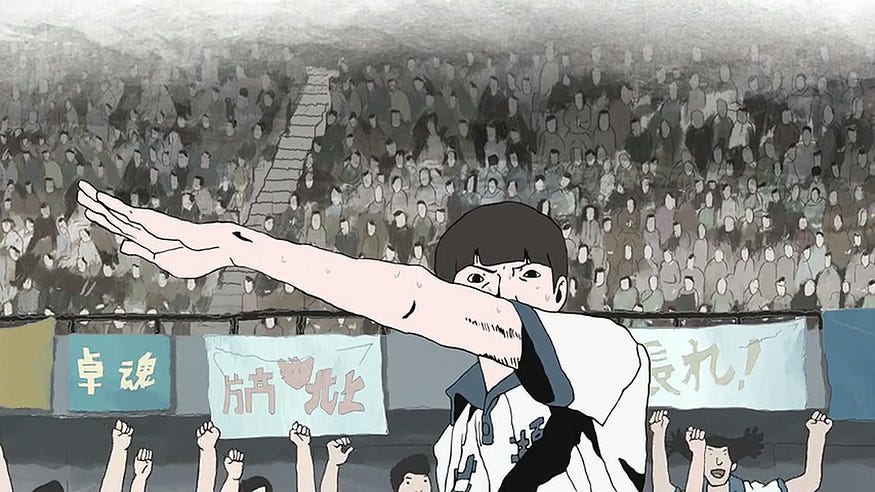
“I used to be a golden god! Nobody could compare to me!” Peco had dreamt of becoming the best ping-pong player, but his defeat crushed him. Israel also had a time of glory under its own teen prodigy, King David, but David was capable of adultery and murder, showcasing in his own heart the future destruction of his kingdom. Like Peco, he discovered the limits of the dream.
A David redux was not the solution, so what was? David himself actually shared the answer through the Psalms, his prophetic poems. A Son of David would come. Taken together with famous passages from the Book of Isaiah, these prophetic writings paint a spiritual portrait of the new hero we glimpsed in Daniel, filling in details of his birth (Psalm 72:10) and nature (Psalm 110:1). Isaiah called him the “Emmanuel,” the “God-with-us,” and described him thus (Isaiah 7:14):
For a child has been born for us,
a son given to us;
authority rests upon his shoulders;
and he is named
Wonderful Counselor, Mighty God,
Everlasting Father, Prince of Peace.
To be heroes, we must first be saved, like Peco. And our Savior is the true Hero, the Prince of Peace. In Jesus of Nazareth, we meet someone who truly transcends logic, overturns what we thought we knew, and drives away the darkness. An uncomplicated force, strong as an earthquake but innocent like a child. A hero who shines, bright and joyous, coming to our rescue once and for all, to establish (or renew!) a lifelong friendship.


Only in this show would ugly, talentless, envious Akuma save Peco. Likewise, it is also a minor, sometimes overlooked prophet who predicted the fact that our hero would come from a small, sometimes overlooked city of Judah. The prophet was Micah, and the city was Bethlehem (Micah 5:2).
Akuma also provides Peco with a decisive reason to play: “You love ping-pong more than anyone!” This is the true reason for heroism, and also the reason for Christmas: that God loves us more than anyone. Enough to send us a champion: the Son of Man, the Emmanuel, the Son of David, the ultimate king of the star, whose love never wavers, even in the face of immense suffering. After all, blood tastes like iron.
People can fly. The miraculous hero comes, as he said he would, ready to rescue us, to fight for us, to lead us to a better place. The homesick have a home, a family they can be part of, in the forgotten city of Bethlehem. As the messengers announced: Once again, enter the hero! Merry Christmas!
Ping Pong the Animation can (and should!) be streamed at Crunchyroll.


[…] Ping Pong: The Animation (Ep. 6) – “You Love Table Tennis More Than Anyone Else!” [1] […]