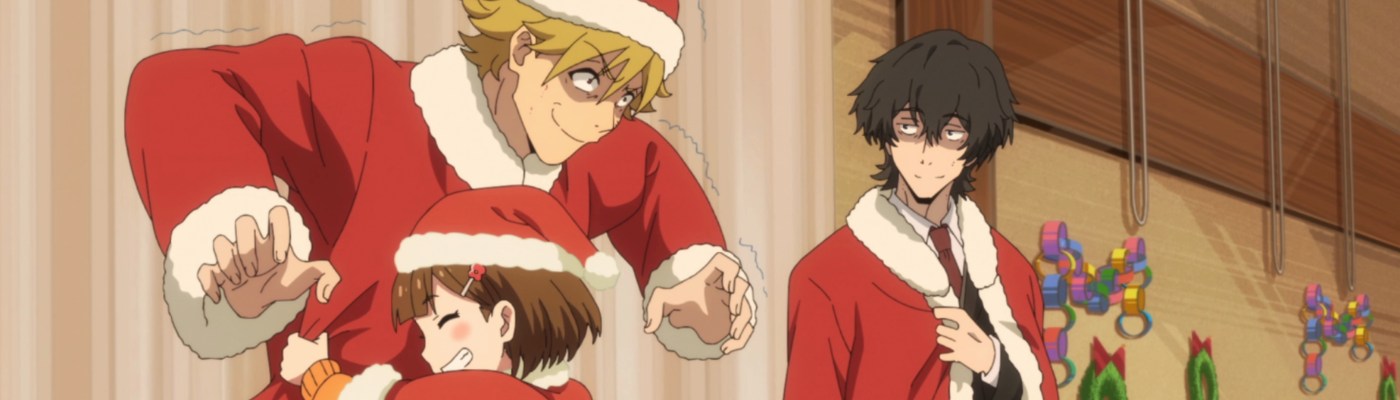
A Christmas encounter with an orphaned pre-schooler forever changes the lives of two hitmen in P.A. Works’ comedy Buddy Daddies. Not your usual Christmas anime episode! (Especially considering the on-screen executions, trigger warning!) But don’t worry, Buddy Daddies is just getting started: the final three episodes also revolve around Christmas, one year later, and it’s in considering these two Christmases together—what has changed and what hasn’t—that the series stumbles into something meaningful, creating an apt picture of the life of faith. You see, what Buddy Daddies shows us is that one “Christmas encounter” is never the whole story; instead, one Christmas leads always to the next and the next after that. It is many Christmases—and not just one perfect Day—that make up the walk of faith.
Spoilers ahead.


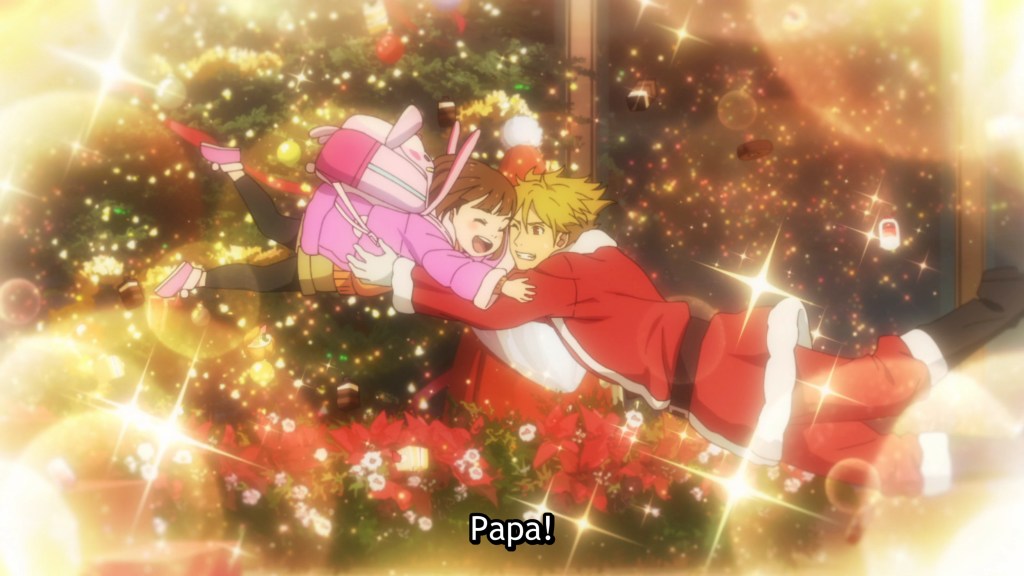
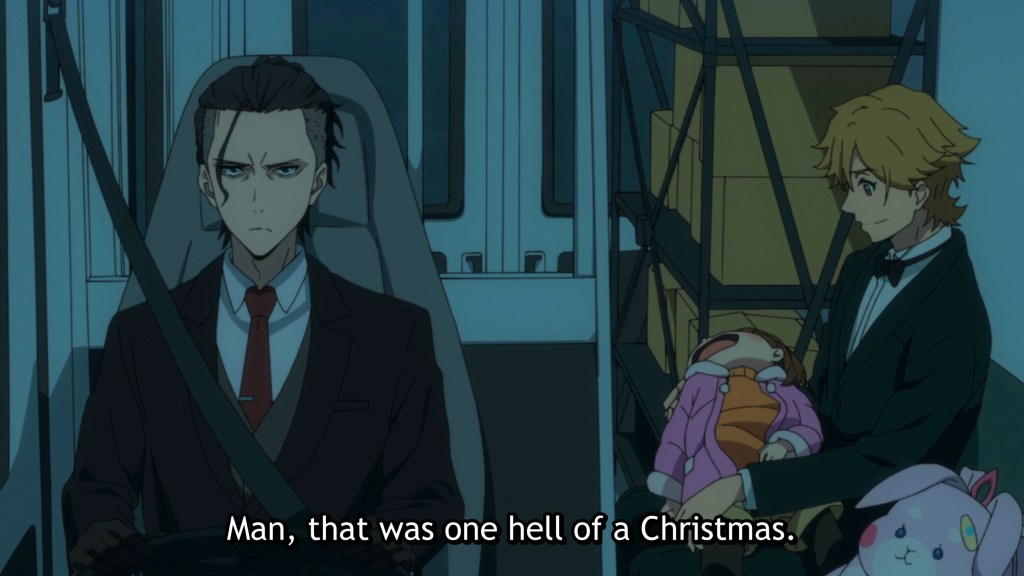
A puppy isn’t just for Christmas, and neither is a child. Kazuki and Rei begin to figure this out as it becomes clear that the little girl who gatecrashed their assassination gig on Christmas Eve—blowing their cover as she joyously greeted Kazuki as her daddy (he isn’t) and barrelled into him for a pint-sized bear-hug mid-gunfight—doesn’t really have anyone else to look after her. Her mother is still alive (for the time being), but not in a fit state to care for her. So the two bros make just enough room in their apartment to accommodate the kiddo, just for the time being. No biggie, right?
Now of course what follows over the coming episodes is the inexorable expansion of that “just enough room” and the abandonment of that “just for now” until, before the two hitmen know it, Miri has taken over their world—not just their apartment, which is duly rearranged and redecorated to accommodate her, but their hearts as well. Their daily habits and demeanor change as they become more responsible (well, Kazuki at least), yet also more joyful and engaged with the delight of daily life as seen through the eyes of a child. They begin to change the types of “jobs” they take on, staying away from the lethal kind and anything that could put Miri in jeopardy (or interfere with nursery school drop-off and pick-up times). Kazuki even recovers his lost memories as he begins to heal from his past and make amends to those he’s hurt. Others in their lives notice the changes in the two buddies; some are happy for them, others are not.
Miri gives them new lives, better lives. And it is good.

Except that it isn’t, not fully. Despite these transformations, Kazuki and Rei continue to cling to their old life in certain ways. Some of it is just little stuff, like Rei’s preference for gaming late into the night rather than tucking Miri in with a bedtime story, and his continued shirking of school pick-up duty. But some are more major issues that are being ignored. The two continue to work for a crime syndicate, and there is no reckoning with the fact that they have left a trail of bodies behind them, including that of Miri’s real father (criminal though he was). When the girl’s mom shows up at the nursery school, begging for a chance to be with her daughter now that she’s cleaned herself up (and is dying of cancer…), the men step back and fade from Miri’s life—at least for a moment. Almost immediately, their checkered pasts catch up with them and put Miri and her mother at the top of a hit list, with Mom succumbing to her wounds on Christmas Eve, while Miri is rescued in the nick of time by Kazuki.
That night, the two ersatz fathers confront a reality they had not understood before: it’s not just about playing happy family. It’s not just giving Miri a bedroom and a tidy home to live in, learning to cook hamburger steak (her favorite meal), and accommodating their schedules to her. It’s not just about befriending the other kids’ moms at nursery school to help build a community for her, making small sacrifices to tend to her when she’s sick, and spending quality time with her making loving memories together. These things are precious and meaningful, but having Miri in their lives calls for deeper transformation too. It’s a greater commitment than what they realized at first, going far beyond the basics of childcare.
More specifically, it’s going to mean putting her first, not just with the small stuff, the daily things, but in terms of the entire orientation of their lives. They’re going to need to quit their jobs, leave the crime syndicate, and start over from scratch with Miri as the true center of their lives. And in the penultimate episode, when they are reunited on that second Christmas Eve, they decide do it. Kazuki and Rei commit to protecting Miri and their life with her, first and foremost.


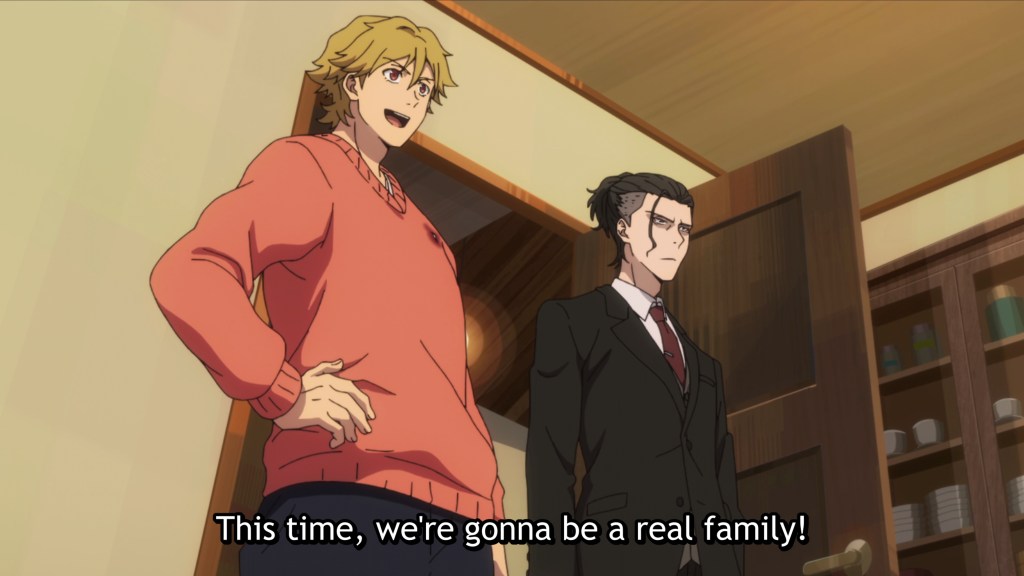
The next day (and final episode), they finally break ties with their old lifestyle, which costs Rei, in particular, quite dearly. Afterward, when they show up in time for Miri’s pre-school Christmas pageant, it is a sign of their recommitment to having her in their lives—recommitment here not because they betrayed her or “backslid” in some way, but simply because, now that they’ve realized the implications of being family with her, they understand what it means to commit to Miri in a whole new way. So they make new promises, to Miri and to each other.
And in a moment, they transform from “Buddy Daddies” into “Daughter Daddies”, as the new title card that pops up on screen proclaims. This tiny shift in wording represents the complete reorientation of their lives on this second Christmas, away from themselves, the buddies, and toward the one who’s given them their new life, their daughter, Miri.
It’s like they’ve been given new life for a second time.



Isn’t this an awful lot like the life of faith? I think it was C.S. Lewis who spoke about how we have multiple conversion experiences as believers. Yes, it’s the initial one, welcoming Jesus into our lives as Savior, that sees us first entering into new life. But as we grow, mature, and face life’s difficulties, so too do we encounter God in new and deeper ways that have such a profound impact on us that it feels like we’re being saved all over again. We receive new life continually, in other words. Sometimes we do backslide, it’s true, and must return, meaning that we experience the renewal that comes with homecoming; but often, it’s simply that we’re being ushered to a deeper place of intimacy with God, understanding a little more about what it means to be his child, his son or daughter. And encountering our Creator on that new level compels our hearts to sing anew and reiterate the commitment we have already made, as it gains new meaning. Like with Kazuki and Rei’s second Christmas, their second new life.
I like to think that this is what Paul meant when he described our becoming more like Christ as going “from glory to glory”—with each new glory being like another conversion, another taste of new life along the path of eternity. It’s certainly what he talked about in many other verses: our minds being renewed continually, pressing on in running the good race, outworking our salvation in fear and trembling at its profundity and incomprehensible grace, as we rely on the mercies of God that are new each day. The process of sanctification, of becoming like Jesus, is accomplished immediately on a spiritual level, outside of time and in eternity, as we are credited with Jesus’s righteousness before God. But it also unfolds within time, more gradually, and (it often feels like) in fits and starts over a lifetime, as the Master Gardener prunes us and we grow into fruitfulness. The Kingdom of God is both ”now” and “not yet”. So too is our transformation, our becoming who we were made to be.

Like Kazuki and Rei, on one level, we change immediately when we welcome the true Christmas Child into our lives. He introduces us to a whole new way of living, simply by being in our homes and in our hearts! We are changed, and the change is visible. But there is still more to come; deeper transformation, greater freedom, and more genuine communion that come as we learn and experience more of what it is to be family with God.
And as with Miri and her papas, sometimes this process is not easy. There will even be seasons where it feels like it’s really, really hard—where we realize that the stuff we were living with unconcernedly until now really does need to be confronted (like Kazuki and Rei’s criminal lifestyle, and Kazuki’s painful past) and that it’s going to hurt as we face it; or where it seems like God has abandoned us somehow and our family bond with him is gone, as when Miri goes to live with her mom, leaving her papas more alone than they ever were before.
Sometimes, there are valleys in between the “glories”.
But Buddy Daddies reminds us of one crucial thing: there will always be another Christmas—and another encounter with the Christmas Child. And we can be confident in this because our Good Father knows that we need all the Christmases we can get! He will never leave us or forsake us; he keeps on reaching out and showing up, never quite in the ways we expect, maybe, but he can be counted on nonetheless. He’s already prepared that next encounter, that fresh understanding that will fill us with renewed life and set our hearts to singing again!
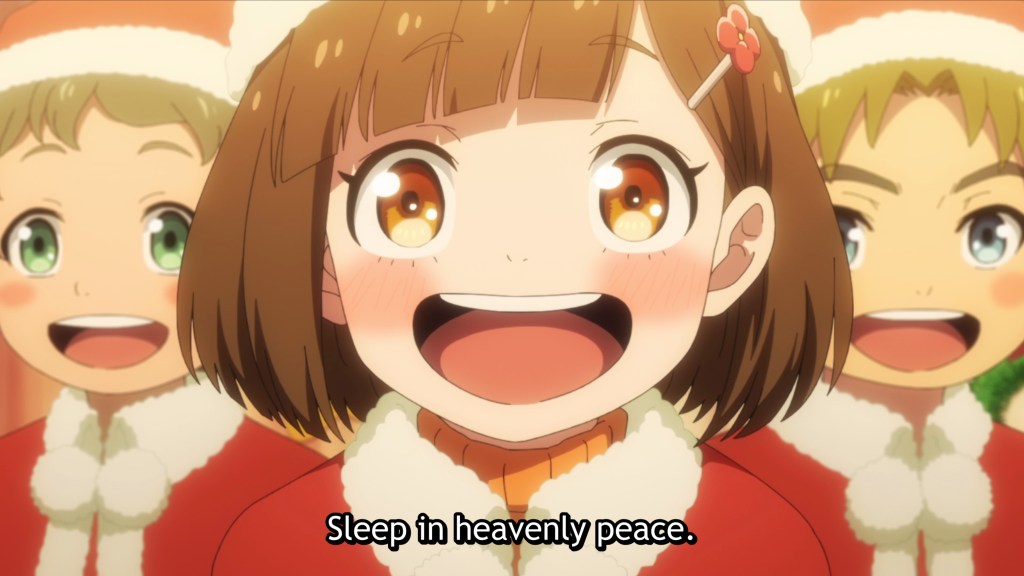

So no matter what kind of Christmas Day it is for you this year, whether it’s one spent on a glory, filled with joy and in loving company, or somewhere in between glories, know this one thing: you are God’s beloved child—you are the little Miri for whom he’s redesigned not just his apartment, but all of reality, making space for you in his heavenly home, in his eternal story, and in his very heart—and he’s a way, way better daddy than any goofy hitmen could ever be.
And so with that, let us all join together in saying, “Bring on Christmas!”

- Miracles from the Gutter, Turkey ep. 12 - 12.03.2025
- The Grace of Turkey: A Bowling Girls’ Gospel - 11.26.2025
- Review: Riviere & the Land of Prayer, Vol. 3 (Light Novel) - 11.20.2025
For an anime about hitmen, Buddy Daddies was surprisingly endearing! I loved seeing how the two hitmen grew and changed over the year from one Christmas to the next. Yes, one holiday encounter often results in a future of encounters. I love how in Buddy Daddies, it takes all the craziness of a Christmas adventure like what we saw in the anime movie Tokyo Godfathers, and then shows where that adventure leads.
That’s a great comparison! And you’re so right—the two guys get some really good character development in the series. Glad you enjoyed it!
[…] Buddy Daddies (Eps. 1, 11-12) – “Piece of Cake,” “Everyone Will Be Hypocrites,” “Daughter Daddies” [1] […]