
Waku waku!
It’s summertime! Which means all the excitement of Hollywood blockbusters, new anime series, shaved ice with beans, and anime conventions. This year, we’re dispatching our usual Beneath the Tangles “inside man,” Agent T.R., to North America’s premier anime convention, Anime Expo 2025! His mission, should he choose to accept it? To get us the sweet scoop of adzuki on all the latest, tastiest anime news and insider tidbits that make the anime industry tick.
What won’t be the usual this year is the format we’ll be using to cover the con. In the past, we’ve wrapped everything up with a bow into one gianormous post-con piece. This time, to keep you all pumped and on the edge of your seats, popcorn mid-nom-nom, we’ll be delivering updates in bite-sized bits throughout the event in what we are calling ‘Daily Dispatches’. That said, you may see multiple updates throughout the day, as our not-so-secret agent transmits whatever intel strikes his fancy. No microfiche necessary either. We’ll also have a dedicated photographer snapping photos throughout the four-day event to include with the transmissions.
So sit back and buckle up. Cause it’s about to get fun.
<match strikes, cue the hype music!>
Days
Wednesday // Photos • Thursday // Photos • Friday // Photos • Saturday // Photos • Sunday // Photos
Events
Openings Ceremonies • The Art of Battle: Creating High-Impact Fights in Manga and Webcomics • Demon Slayer 6th Anniversary Celebration • Frieren: Beyond the Journey Panel • Hall Crawl • Amuse Creative Studios
Wednesday (Day 0)
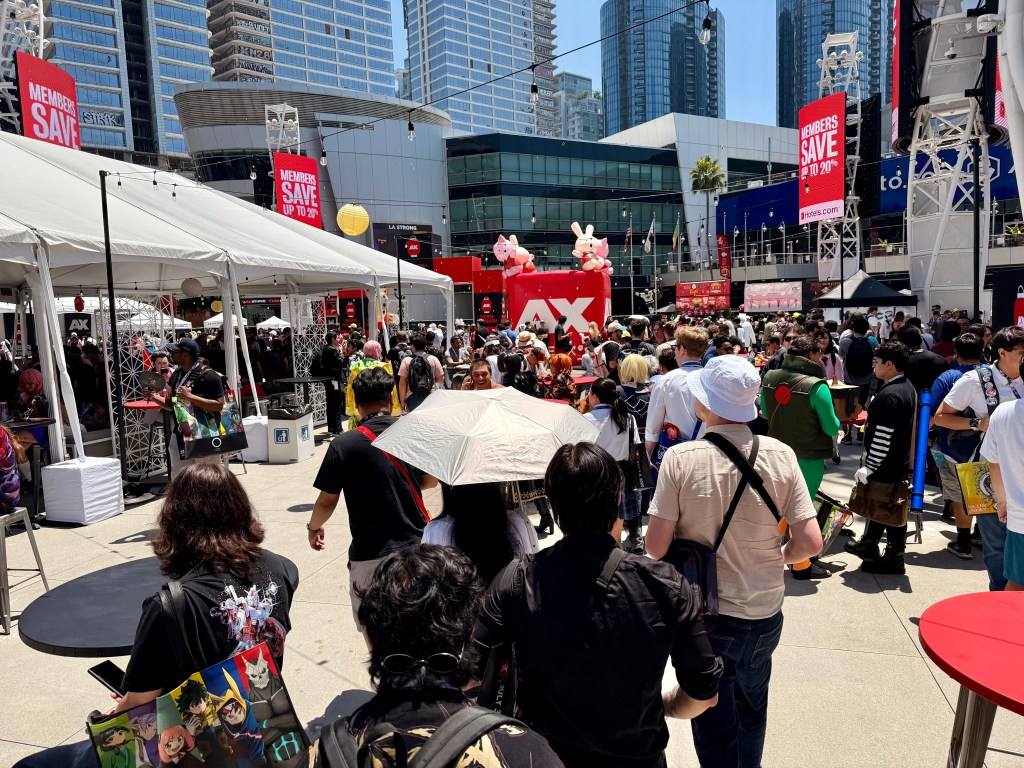
This year, AX has expanded massively, now taking over both Microsoft Square and Peacock Theater as the new Main Events location. Microsoft Square is now home to the AX Beer Garden and stage, which makes me wonder what will become of the old location. While the Peacock had been used for select concerts in the past, its use for Main Events now is very welcome, increasing attendance capacity to 7,100, likely a good 50% more than before, which will be appreciated by many who are often otherwise left hanging in the queue and disappointed when the line is cut off.
As for what becomes of the old Main Events location, word is that it’s the new Artist Alley, which is likely going to receive widespread praise. Since my first AX in 2018, the Artist Alley at AX has always been one of the friction points for the con. In years past, it’s been situated in the underground parking garage, where sometimes temperamental air conditioning has created a sauna that resulted in multiple fainting events. I’ve always found it to be an absolute crush of people as the aisles are just too tight, resulting in a shuffle fest as you slowly crawl down each row, straining to see what you can between the bodies.
With the progressive growth of AX’s “Annex”, a sort of Exhibit Hall overflow for small exhibitors, and the relocation of the “Adult Section” of the Exhibit Hall to the underground parking last year, Artist’s Alley really needed somewhere else to go. Now being moved above ground to a dedicated hall, I’m curious to see how well it performs in a completely improved environment.
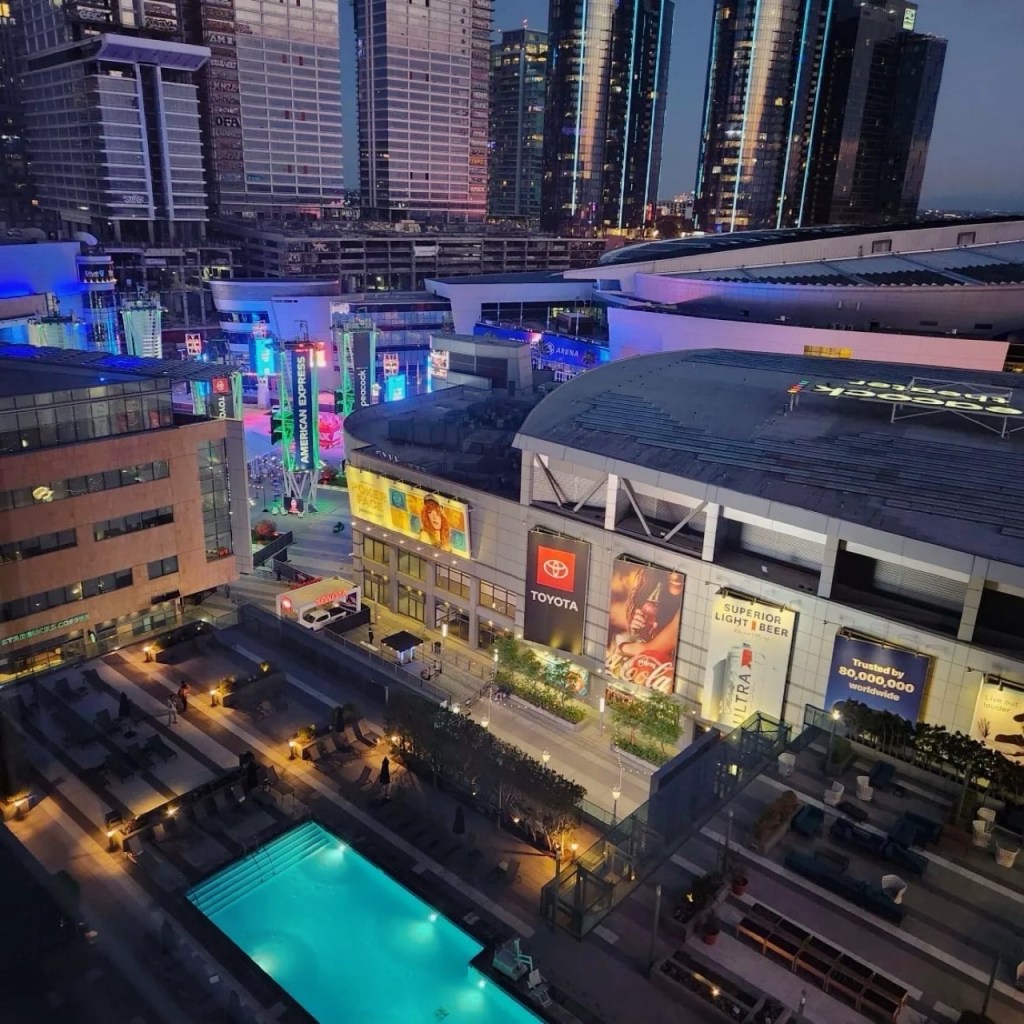
Photo Log (Day -1 and Day 0)
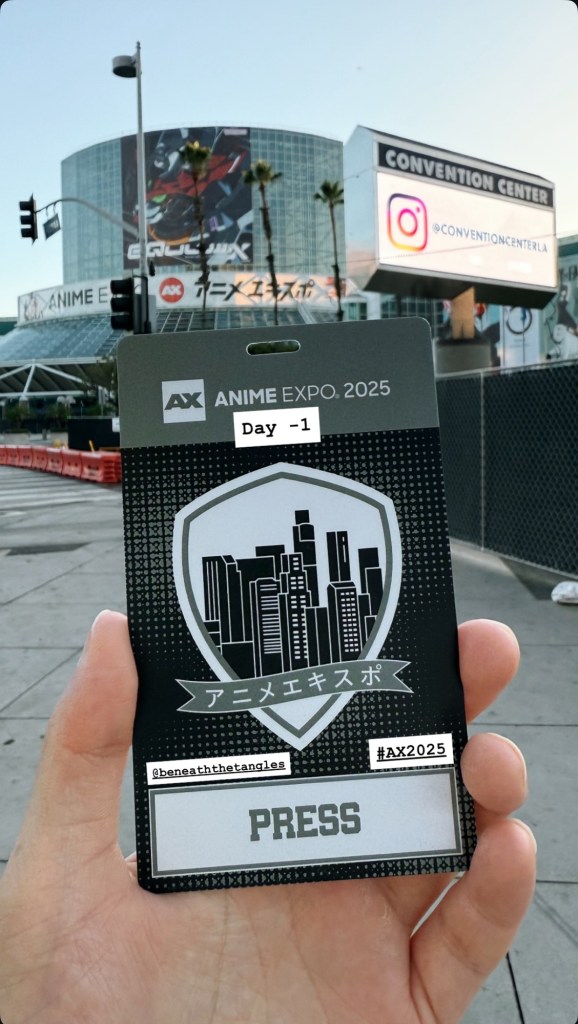

Thursday (Day 1)
Opening Ceremonies
Anime Expo kicked off with the Welcome Ceremony, for which there was the added hype this year of being in the Peacock Theater, with its better seating and acoustics. There were few hiccups with the move, though the usual lack of overhang outside to provide some shelter from the sun for the waiting attendees persisted. Even at 10 am, people were starting to cook, especially the cosplayers in leather and latex.
In the theater, Taiko drums were already on stage for the traditional drumming opener. Heavy metal music throbbed to hype the crowd, and as the lights turned down, the theater appeared approximately 50 to 60% full, a big improvement over previous years, when the program would hit room capacity and some in the queue were left hanging. A check of the time noted the ceremony purposefully started ten minutes late, providing more time for attendees outside to get in before the start. Another much-appreciated improvement.
The opening Taiko drummers brought their A-game. A staple at many anime conventions, the group featured their front row soloists dancing between percussions, spinning and striking the drums in flourishes with their beaters, sometimes even backwards.
The show hosts, led by voice actor Brandon McInnis, then came on stage and provided what I would like to call the “AX Sampler,” a little taste of everything the convention has to offer. Between the spots for the AX Fashion Show, Maid Cafe, Masquerade, and AX Dance, there was a feature for AX’s “Idol Summer Escape,” a ticketed event that gives an up-close experience to the world of Japanese idols.
To offer a better glimpse of the Idol Summer Escape, Aonyan, a Japanese solo idol, performed. Formerly part of Dempagumi.inc and ARCANA PROJECT, the 28-year-old seemed unfazed at having to fill an entire huge stage all by herself, carrying the torch of kawaii proudly, even though she is past the usual retirement age for idols. I’m glad to see her still dancing and singing. Anime is something for all ages, and no one should feel compelled to “graduate” from what they enjoy just because of an arbitrary date on a calendar.
Following Aonyan was Sakurazaka46’s performance to Hunter x Hunter. The massive girl group offered quite a contrast to the solo Aonyan, dancing and singing in unison as they built a human mountain for the lead singer to scale and strike a pose atop. Sakurazaka46’s appearance was part of promoting AX’s “J-Pop Sound Capsule,” a ticketed six-act music event that attempts to encapsulate all the wild variety found in a Japanese capsule machine.
Another interesting new addition for AX is Sukeban having their World Championship Fight on premises. Billed as a fusion of anime/manga/cosplay with professional wrestling, it seems that anime is slowly integrating into fandoms once thought to be too dissimilar.
Each year AX, hosts a charity auction with the proceeds to benefit a worthy non-profit organization. This year’s recipient is Animator Dormitory, which offers housing and technical support to new animators. Unfortunately, work in the Japanese animation space typically offers low wages, making it difficult for young animators to stay with their craft. I’ve experienced this as a manga creator myself, working in an unrelated field and writing manga as a passion project in my off time.
As the ceremony wound down, the absence of a teaser for the Anime Music Video competition was noticeable, despite it always being appreciated in hyping the crowd prior to their descent upon the Exhibit Hall. While it was definitely missed, it was understandable that it had to be skipped, given how much the ceremony had to cover within an hour. As always, the signing of the Daruma doll closed out the event. This year’s signature was none other than Final Fantasy XIV and XVI’s director Naoki Yoshida (Yoshi-P), who came on stage accompanied by Mog to the thunderous applause of the crowd. Waves of Final Fantasy battle music echoed throughout as the event hosts struck martial poses, slowly bobbing and swaying in place, awaiting the next action command, as Yoshi-P emblazoned his Final Fantasy signature into the doll’s right eye, officially kicking off Anime Expo 2025!
The Art of Battle: Creating High-Impact Fights in Manga and Webcomics
Moderated by Megan Peters from Screen Rant and headlined by Uru-chan, WEBTOON creator of unOrdinary, a webcomic with over 1.3B episode views, the panel hit room capacity easily. A noted RWBY fan, Uru-chan, and the panelists discussed the finer points of what makes for a compelling fight scene. Here’s some of the advice they had to offer to both veteran and budding manga creators. And for those who just enjoy watching anime and reading manga, it’s a look behind the curtain as to what goes into making a memorable scene.
When planning for a battle scene, the panel recommended establishing what the stakes are before the first punch is thrown. What is the reason for this fight? What will the consequences be? By giving readers an idea of how the world will change as a result of the fight, the conflict will have more impact and value. The more difficult the stakes, the more gratifying the battle. Often, the fights that stand out are battles where a philosophy of ideals is clashing. Memorable fights are often more than good vs. evil. After all, heroism is seen differently around the world. Because of this clash of ideals, it’s important that a creator has a strong sense of who the character is.
In situations where the stakes aren’t high, like between sparring partners in a training arc, then try to make the fight fun. Consider revealing something like a new power move or showing off some eye-catching artwork. Fights, whether just sparring or “for keeps”, should also not go as intended. Have the unexpected happen to keep readers engaged and turning the pages (or scrolling).
Battles can vary widely between the format it’s created in. For North American Comics like Wolverine, because of the page limits in a serialized comic book, battles are often just a few panels with the objective of making things look as cool as possible. In manga, where there’s a lot more creative space available, the actual fight mechanics matter and are expected, to a degree, by readers. The panelists recommended drawing fight choreography from other works that inspired you to create manga and webcomics.
In the realm of webcomics and Webtoons, because of the endless scroll feature from up to down, action is best delivered in a top-down direction. Because readers engage with a single panel at a time, rather than two pages at a time with manga, play around with focusing on faces and expressions. Since there are fewer eye distractions with only a single panel, and there are no limits to space, explosions and movements can be rendered to flow off the screen to intensify each panel.
Photo Log (Day 1)
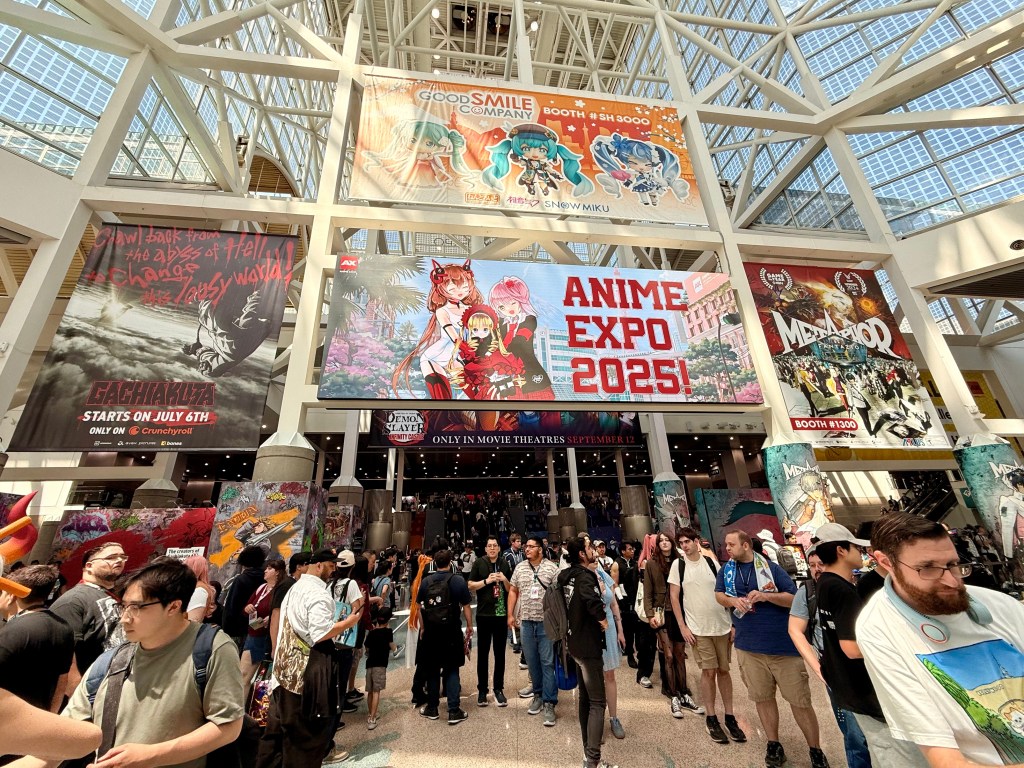
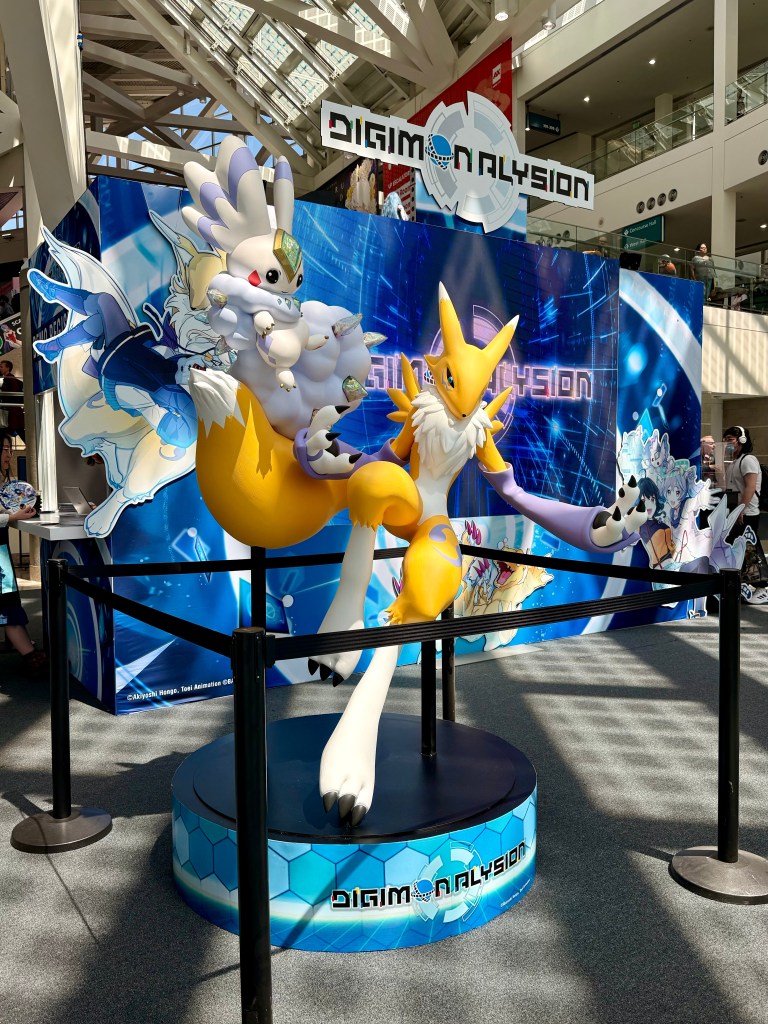

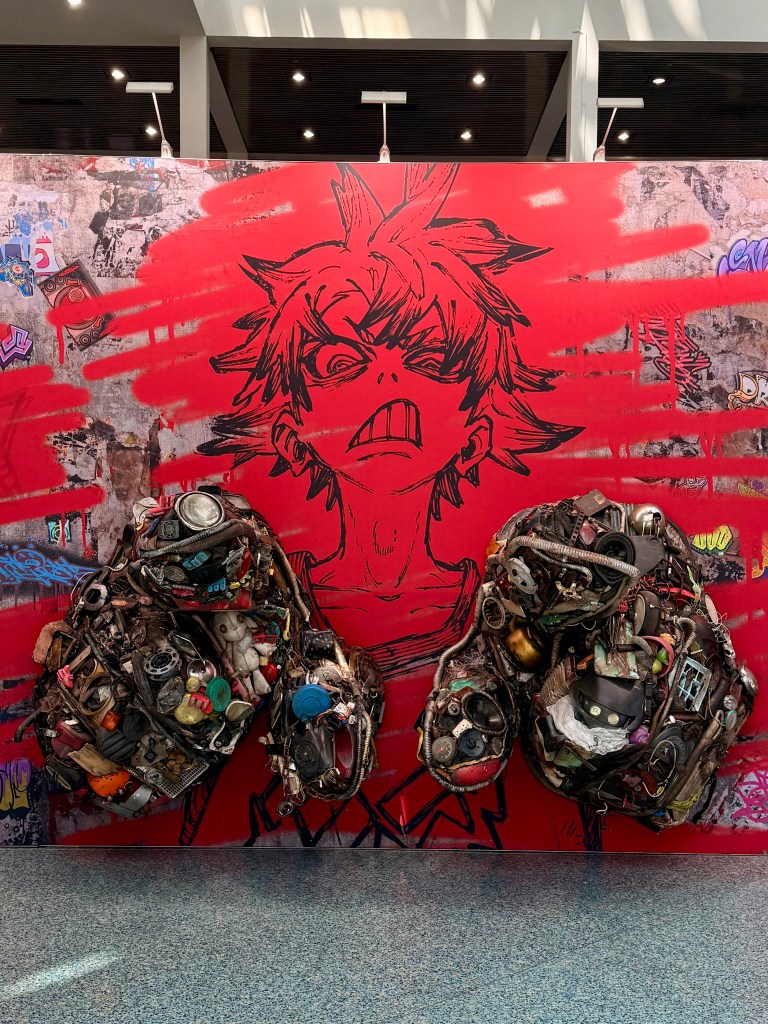

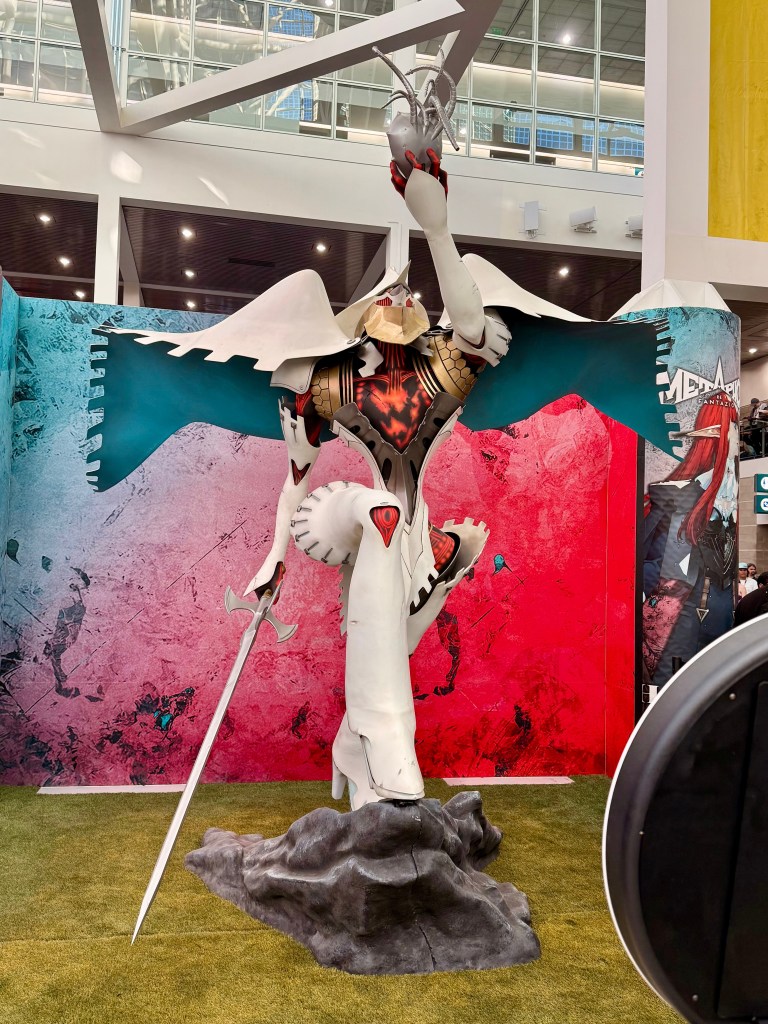
Friday (Day 2)
Demon Slayer 6th Anniversary Celebration
Being on the Fourth of July, Day Two launched in a big way with live acoustic fireworks from Demon Slayer. Since it was a free concert, an immense number of attendees packed in around the Peacock Theater, constructing a snaking line into the AX Beer Garden that seemingly had no end. Given the immense interest by attendees, the program was ultimately delayed by 30 minutes to allow everyone the opportunity to get in prior to the start. By the time the lights dimmed, the theater was near capacity as the Demon Slayer Corp theme echoed throughout.
As the fluttering flag of the Demon Slayer Corp faded, the audience was transported to the world of Demon Slayer, with Tanjiro catching sight of his slain family. Despite being a smaller chamber orchestra, the group played with passion. With only limited strings, the sound of each individual instrument was more poignant, making the scene all the more raw and painful.
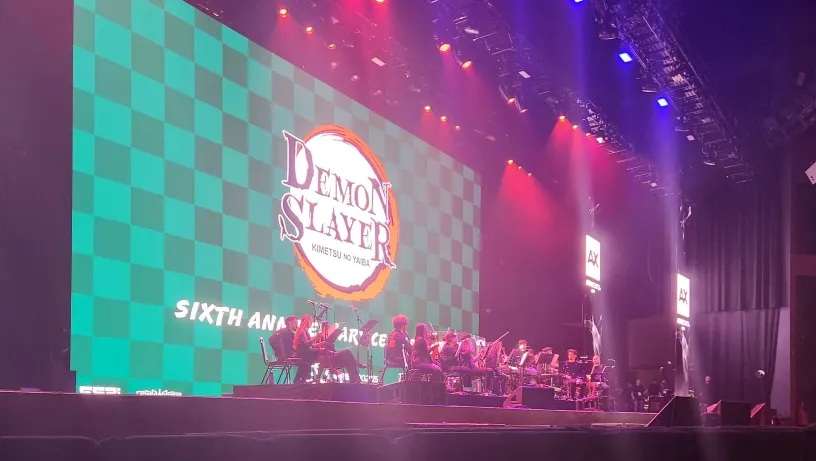
While Tanjiro desperately carried his critically wounded, ill-fated sister, the theater broke into cheers as Natsuki Hanae, Tanjiro’s voice actor, strode onto the stage and joined the orchestra, live reading his lines. The live reading made Nezuko’s transformation even more heartbreaking as the tears streamed from Tanjiro’s eyes, and then, eventually, a singular teardrop from Nezuko. As the scene faded to black, the theater held its collective breath, taken by the enormity of the moment, before breaking into thunderous applause.
The orchestra played on, featuring music from memorable scenes, including when Tanjiro first confronts Giyu Tomioka, the impossible boulder, and lastly, Tanjiro’s first encounter with Zenitsu Agatsuma. Aleks Le joined Natsuki Hanae in reading lines from this scene, displaying his incredible emotional range, which is showcased so well with the flamboyant drama king Zenitsu. The incredibly well-choreographed battle between Tanjiro and Rui followed, the live music making the deadly threads feel all the more lethal. When the orchestra came to its conclusion, the theater rose in a standing ovation.
Demon Slayer: Kimetsu no Yaiba – The Movie: Infinity Castle releases in the US on 12 September 2025.
Frieren: Beyond the Journey Panel

Ever wondered about the journey of adapting “the story after the journey”? As soon as Producer Yuichiro Fukushi picked up the manga, he wanted to adapt it. For him, Frieren is a story that connects deeply with fans given its immense and diverse world setting, how the passage of time is conveyed, and the deep character development and interactions. However, with the first season being a whopping 28 episodes, the production team discovered that being given so much run time was a huge challenge. With only so many resources, the team struggled with how to balance the season, considering there were so many touching mini-stories they wanted to incorporate. The team was determined not to lose the charm of the manga
Chiaki Kobayashi, the voice of Stark, shared that he was moved to tears when he found out that he had landed the role and was going to be a part of the series. His hope is that the series will be appreciated a hundred years from now, and that he can live on with future generations through his voicing of Stark.
When Evan Call, the composer of the series, was added to Frieren, his first reaction was to dive right into imagining what kind of music he wanted to create, so that the soundtrack could be more than just typical background music. He wanted the music to be an additional character voice—a voice representing the wider world with its vast cast of characters and landscapes. With 70 tracks to score, the Bluegrass-trained musician called upon his lifelong desire to compose and arrange a much wider range of musical stylings, which now feature throughout the series. But if you listen closely, you can still hear hints of Bluegrass peppered throughout.
Evan played parts of the soundtrack on a digital keyboard and explained his creative process. He apologized for his mistakes while playing, stating that while he grew up with the piano, he never wanted to practice, instead spending his days thinking only of composing and arranging. Regardless, he still played well, explaining how certain chords can be used to create tension in a scene. Evan was able to see the animation beforehand only in a few instances while composing, in order to sync the music to the action. He composed blind, as it were, for the vast majority of tracks, imagining for himself where they would be used in the series—something that is ultimately decided by the sound director. Only when the series debuted did Evan find out where all the music ended up.
Chiaki Kobayashi then voiced the solar dragon village scene, which provided him the opportunity to display his impressive range of emotions. When asked if he had the same power as Stark, and would fight the solar dragon himself, Chiaki gave a flat “no”. Yuichiro Fukushi also said no to the same question, with the caveat that he would only fight the dragon if it would save his production team from demise. Meanwhile, Evan answered that both of his hands would be full of mini dachshunds, so he couldn’t either.
What about Season 2 spoilers? Chiaki Kobayashi stated that we’d be seeing a lot more of Stark. Yuichiro Fukushi apologized that no one else could come to Anime Expo since they are still in the middle of production. Evan Call shared that Season 2 was recorded in Budapest with a massive orchestra and choir, which leads one to believe the music will be even more epic.
Season two of Frieren: Beyond Journey’s End premieres in January 2026 on Crunchyroll.
Photo Log (Day 2)


Saturday (Day 3)
Hall Crawl
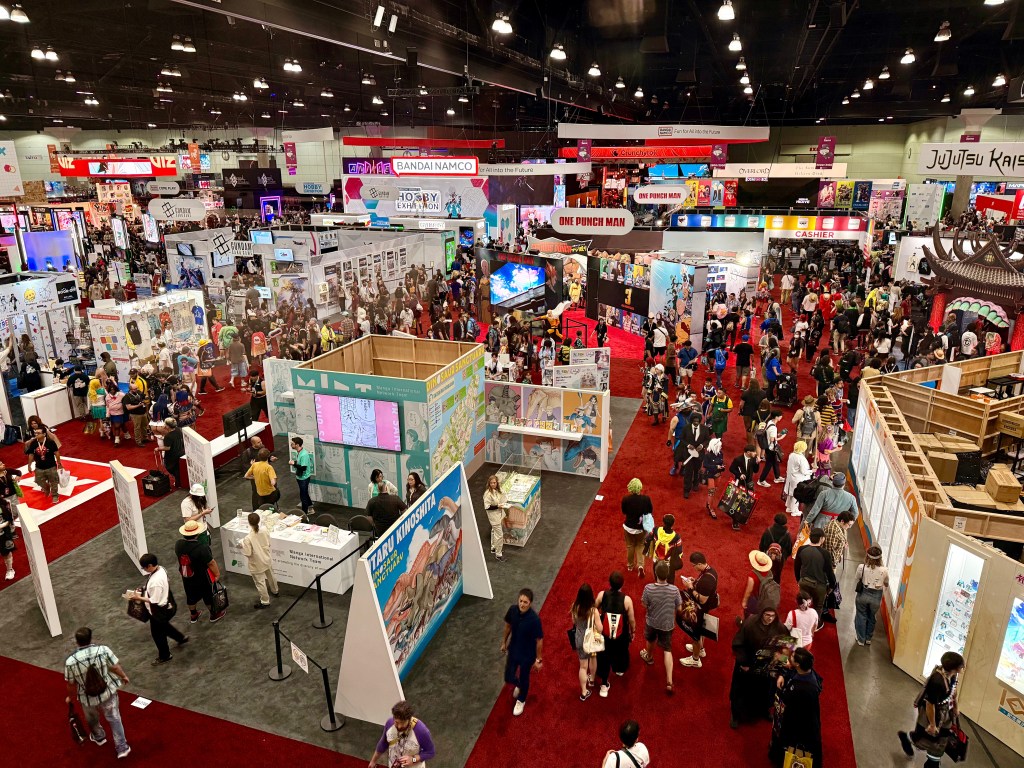
With the previous two days spent mostly attending panels, the focus for Day 3 was on covering the three different halls that make up Anime Expo: the Exhibit Hall, the Entertainment Hall, and Kentia Hall (Artist Alley). Of the three, the Entertainment Hall carried the greatest amount of anticipation. With Main Events relocated to the Peacock Theater, this allowed for a significant increase in the total available space of the Entertainment Hall. The hope was that the Artist Alley would be the beneficiary. However, due to significant changes in the size of exhibitors in the Exhibit Hall, much of this newly available space instead became something of a catch all for those who were bumped from the Exhibit Hall.
Having attended AX since 2018, this year the Exhibit Hall had the greatest number of expansive booths ever, each space bringing its A game to grab attendees attention. The massive booths created a lot of open space between them, allowing for easy navigation throughout much of the venue. Building upon improvements from 2024, the hall featured a return of the placement of the biggest exhibits towards the back, keeping congestion away from the front doors and allowing easy entry.
Of the exhibits, Crunchyroll stole the show with their neon orange tunnel created from multiple square arches. At the end of the tunnel, huge LED screens rotated through several anime landscapes for attendees to pose in front of. Flanking either side of the tunnel, were quick carnival games for attendees to participate in, either Demon Slayer or Gachiakuta.
However, among all the quick games available, Ghost in the Shell won hands down with their absolutely ginormous claw game. Towering over much of the exhibit hall, the claw fished for clear beachball-like capsules with various prizes inside. As for the most hyped booth, it was hard to decide on a clear winner between Crunchyroll or Gundam CCG which was packed with people waiting around for a chance to participate in a demo.
However, one downside to all these mega booths was far less space for everyone else, leading to the elimination of participation by some smaller companies. Notably missing were such names as Seven Seas, Yen Press, and our dear friends at Jesus Otaku, ending their decade-long presence at the convention. Looking ahead, hopefully the Exhibit Hall can continue to offer space for everyone – both large and small – to participate, rather than becoming something exclusive to the largest corporations.
While I would have preferred that Artist Alley received a space upgrade to the Entertainment Hall, it remained in the basement at Kentai Hall. As usual, Artist Alley was something of a visual overdrive with fan art of everything from vintage anime series to the recent, ultra hot K-Pop Demon Hunters. Walking down each aisle you were bombarded with art on each side as well as a constant stream of cosplayers flowing by in front of you. Anyone with wings was particularly challenging as they made projectiles that wanted to stab you when trying to slip by. The viral Plague Rat cosplayer also showed up, though it may have been a copy cat rather than the original. It didn’t look like they were randomly hand stamping anyone with bubonic plague, something a little too dark and disrespectful for my tastes, given a pandemic which resulted in between 25 to 50 million deaths.
Elimination of the Annex this year allowed for a significant number of more artists to participate, however this did mean that fashion and small indie publishers were excluded. It must be challenging for the showrunners to decide how and to whom to allocate such limited space.
Photo Log (Day 3)


Sunday (Day 4)
Amuse Creative Studio
Rarely do I receive an invite addressed directly to me. Let alone one from Amuse Creative Studio (ACS), whose parent company Amuse Group is known for such powerhouse films as “Your Name.” (Kimi no na wa.) and 2008 Academy Award winning “Departures” (Okuribito). ACS reached out because they wanted me to make sure to attend their panel on Day 4. Being their first appearance at Anime Expo, they also asked for any recommendations on how to put forth the best program possible.
“How the Pros Make Anime & Manga” was thoughtful, polished, and well executed. Featuring Kazuhiro Nishikawa, CEO of DandeLion Animation Studio, illustrator-writer Shinobu Seguchi (Prisoner Riku, Oedo Fire Slayer), and editor Rei Hebiguchi (Weekly Shonen Champion), the trio examined their past and future works, the joys of success, and the challenges that face future manga creators.
After a gripping video trailer for Prisoner Riku, a story of a boy falsely imprisoned and his attempts at escape from the equivalent of the Supermax, the panel took a deep dive into Oedo Fire Slayer. The manga, which released earlier this year, is an adaptation of the 2017 Japanese novel revolving around firefighting during the Edo period. Given that building construction during the 1770s involved mostly wood and paper, house fires were a serious concern. Firefighters were seen as Ronin samurai doing battle with the flames. The manga plunges readers into a team of misfit firefighters trying to unravel a mystery around a series of arsons. Amuse Creative Studio will be releasing the associated anime Oedo Fire Slayer: The Legend of Phoenix in January 2026.
Moving onto the Q&A, the trio fielded a number of questions. One of most thought provoking was on the future of AI in the industry. To this Kazuhiro Nishikawa quoted Heraclitus, “The only constant is change.” The panel went on to explain, for better or worse, AI isn’t going away and should be accepted with a helpful attitude. For creators like artists and writers, AI is a tool in their quiver to succeed.
For example, DandeLion Animation is already using both 3D and 2D animation techniques, as seen in “The First Slam Dunk”. Rather than storyboard traditionally, that is drawing a series of several illustrations to explain a particular scene prior to further animation, DandeLion instead uses motion capture with live actors to block the scene. The live actors are then converted into animation. AI can assist with the 3D portion of a project, while illustrators do the 2D portion. The two halves are then stitched together into one.
Shinobu Seguchi elaborated that it’s important that the industry develops rules on to what extent AI can be used in a project. For example, while it can help someone with developing their ideas, it shouldn’t be doing the illustrations. His own work on Prisoner Riku was a daily routine of seven years of non-stop writing and drawing over 337 chapters. AI should not be used as a shortcut to avoid the time and dedication to the craft of manga.
When asked to look back at their successes, Kazuhiro Nishikawa recalled his studio’s work on “Magic Candies” a 2024 animated short that received a surprise Oscar nomination. The team ended up partying until 3 am after the announcement broke. Shinobu Seguchi stated it was pure happiness when he discovered there was an international audience for his work. Because it took a while to become a recognized mangaka, he said it feels truly special. Rei Hebiguchi took a more reserved approach stating that as an editor he just sees himself as a supporter of a series, helping it succeed, and that he appreciates all the overseas support.
*Prisoner Riku and Oedo Fire Slayer are both available on the emaqi app.
Photo Log (Day 4)

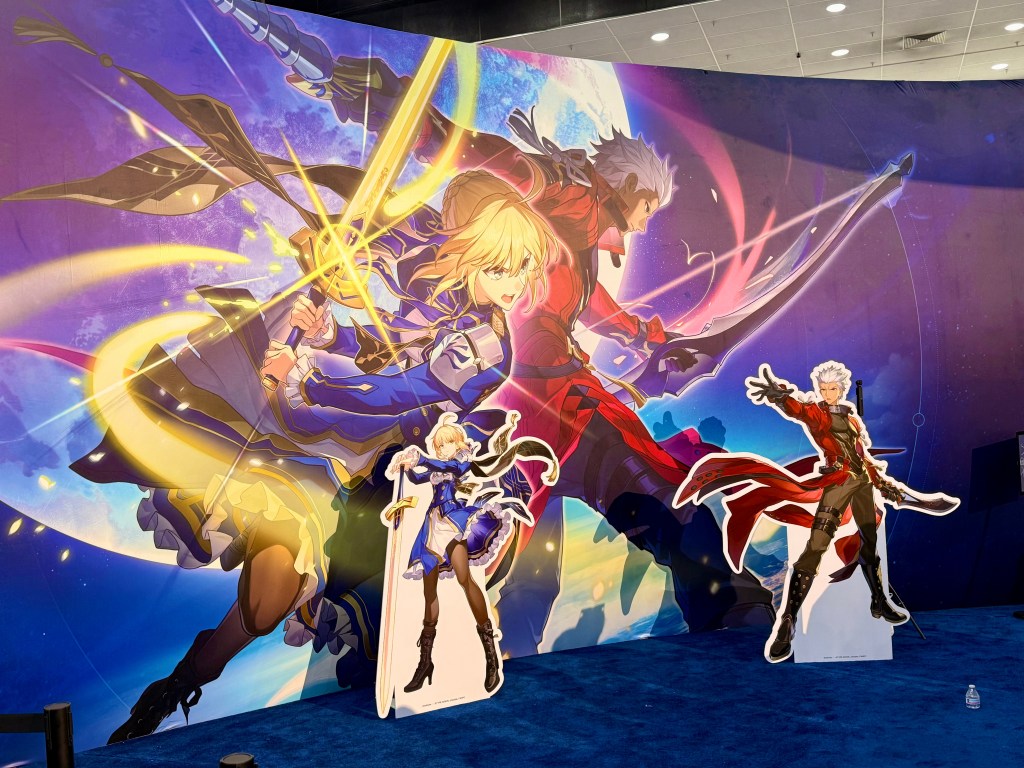


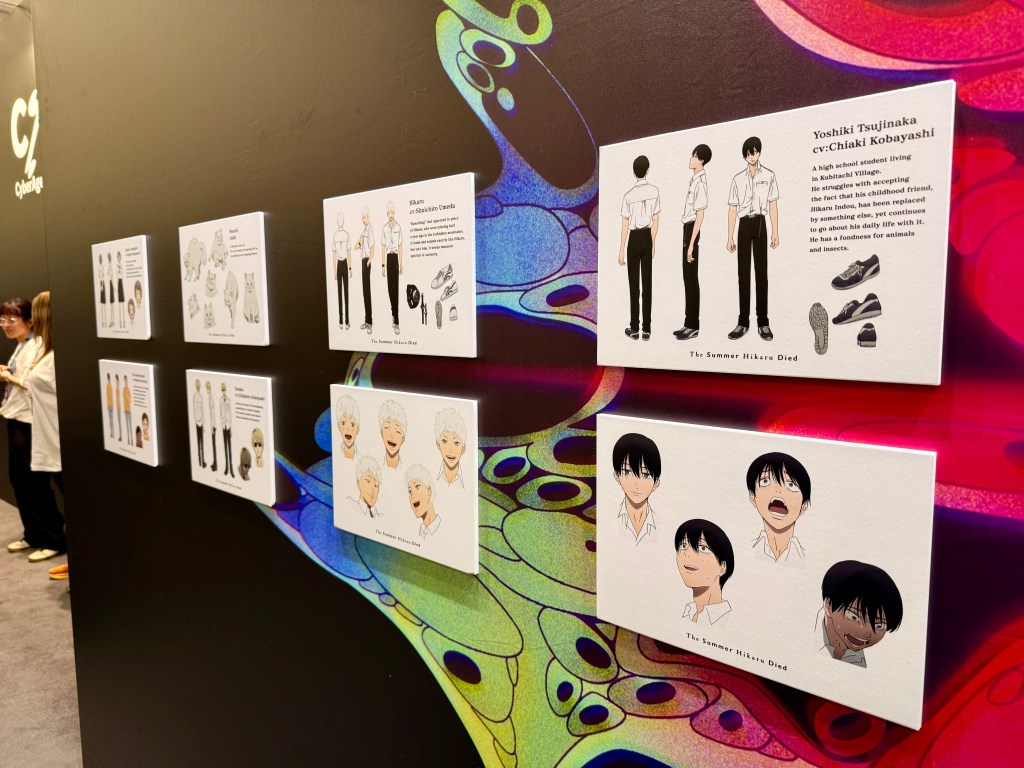


*The featured image is adapted from a Fancy Frontier 39 photograph owned by Wei-Te Wong (source)


[…] season is in full swing! On the back of our coverage of all the madness and fun at Anime Expo 2025, we’re on the road again—this time to […]