Time is a funny thing: There is a certain vertigo to it. Sometimes, a carved stone older than civilization pops up in the river of my city—a city with a wall built by a Roman legion, Renaissance palaces, and Visigoth churches once ransacked by Napoleon’s soldiers.
As the years go by, these backgrounds become landmarks of my own life, its own dizzying array of facts, stories, and references. I am connected to that past. I got married in a white cathedral that was built when the city was the capital of a medieval kingdom with knights and jousts. As it was being completed, fallen heir Hōjō Tokiyuki lived, fought, and died ten thousand miles away.
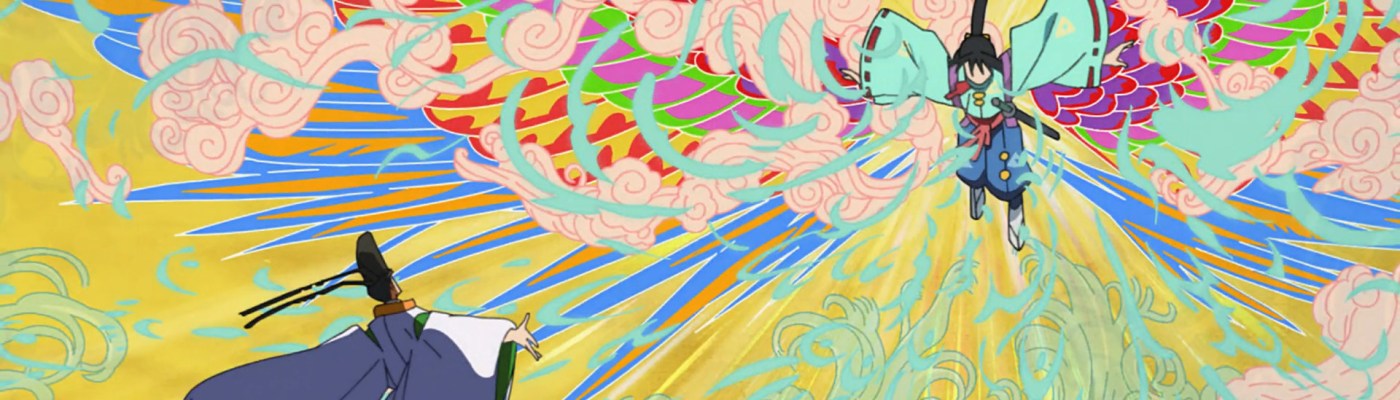
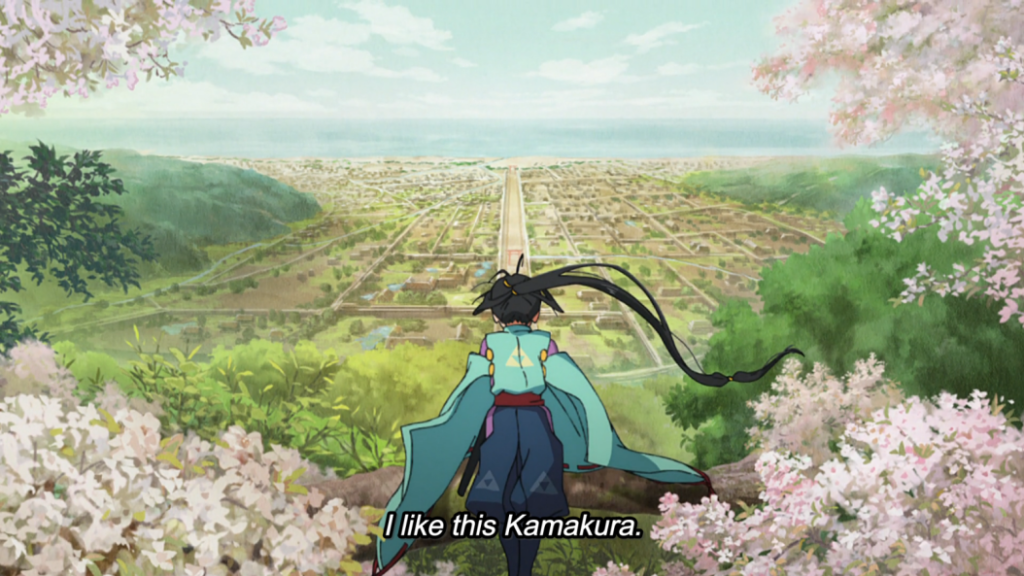
The Elusive Samurai, CloverWorks’ 2024 anime about the life of Tokiyuki, makes his journey and my own feel connected: Modern music with the occasional traditional instrument, anime designs with callbacks to classical Japanese art, and the story itself. Within the very first seconds, after a kaleidoscope of abstract symbols, vibrant colors, and colorful characters, we witness a hyper-fast countdown from 2024 to the era of the samurai, when honor was linked to battle and death.
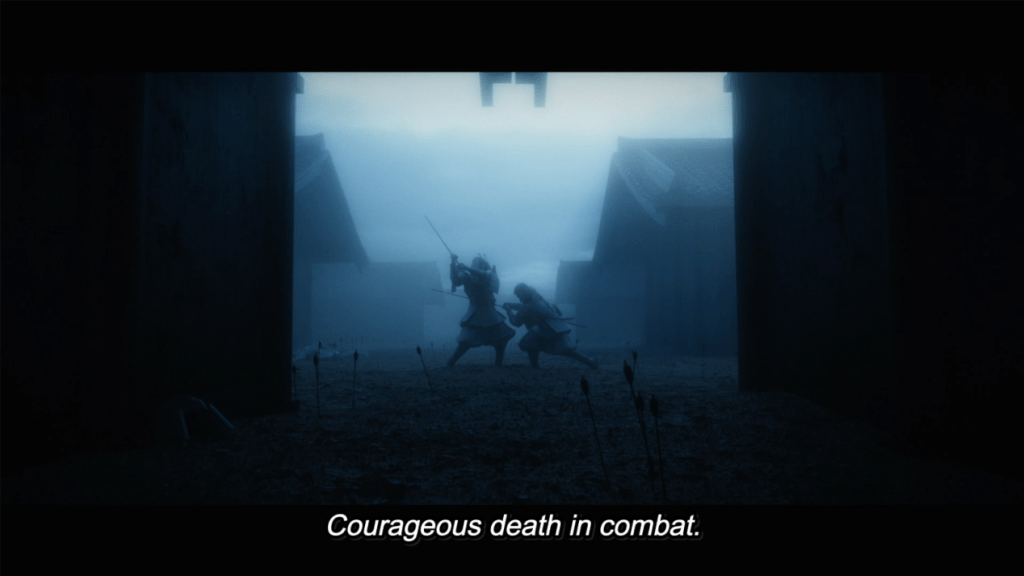
As Tokiyuki accepts the call to find a different way and become the “Samurai Who Lives,” each of the seven main characters of the show opens up a different dimension of this newfound reality. Part historical epic, part Buddhist parable, part cheeky comedy full of contemporary references, and part fast-paced shōnen, TES captures a joyful, disorienting experience: that of seeing your world disappear and starting to live a hidden life.
The show is full of curveballs, fast-paced, rich in ideas, and visually striking. As a stylized comedy-drama that does not fit neatly in any genre, it is probably not for everyone. But there is a lot to love here. Tokiyuki’s journey bears the mark of an invisible providence, redeems a past that is lost, and is guided by flashes of an unseen future. It involves a new community of followers and friends and is ultimately founded upon a new kind of heroism.
It also reminds me of how, in the whirlwind of time, I’ve also found a hidden life of grace with its own heroism and its own landmarks—the seven sacraments, visible signs of invisible realities, calling me to a new form of heroism. In the journey of Tokiyuki, I see the features of my own. And this feeling of history becoming present is, after all, what the show tries to achieve. It is probably not for everyone, but for me, TES is a triumph. Let’s see why.
Tokiyuki: The Boy Who Escapes
Every story needs an inciting incident, a first spark. Then again, some incidents are more dramatic than others. Some sparks ignite devastating fires that devour everything. When people talk about a “baptism of fire,” they normally mean the first contact with battle or some other life-shattering experience that forces us to redefine ourselves and reconsider everything we think we know. And the world around us is full of apocalypses we do not normally think about.
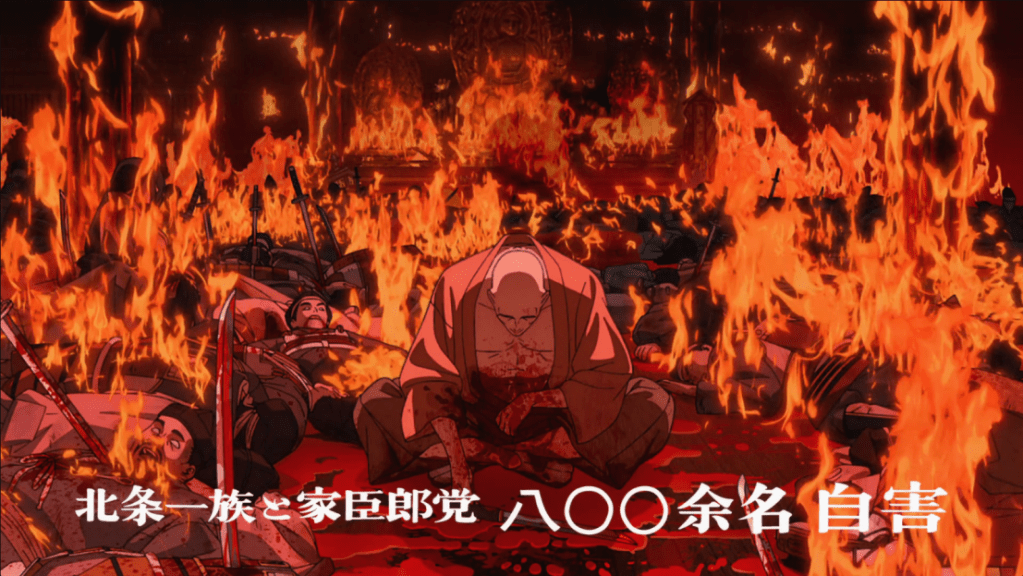
The fall of the Kamakura Shogunate is one such incident. For most Japanese students, it is nothing more than another date to memorize. But for the historical Tokiyuki and many others, it was the end of their world, written in blood and fire. Episode one of The Elusive Samurai (spoilers warning!) bridges the gap and turns history into a vivid, terrifying experience. The first person Tokiyuki needs to rediscover to live a new life is himself: who he is when everything is lost to the flames.
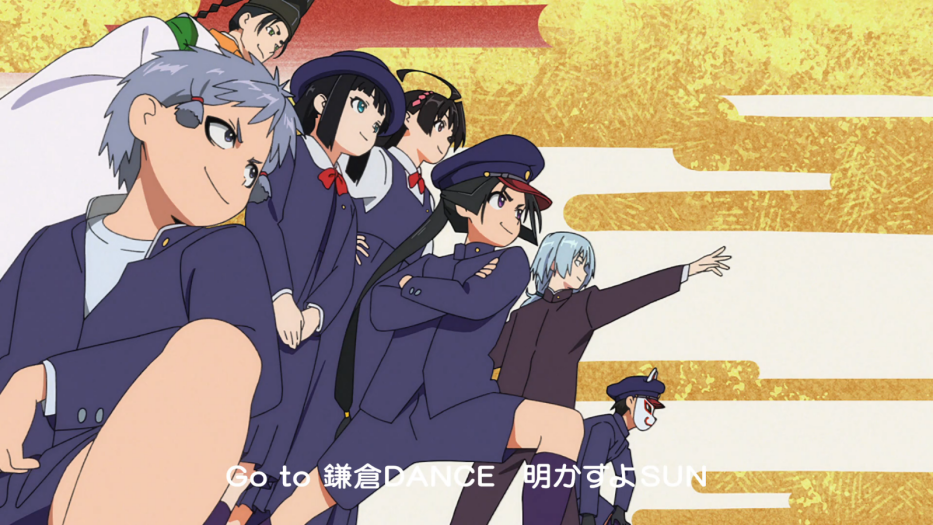
And who is Tokiyuki, then? Well, have you considered becoming a hero? No, really. Well? As we get older, we are more likely to become suspicious of anyone who tells us something like that: Two years before the fall of Kamakura, Tokiyuki literally runs away from the suggestion. That is his defining trait: hiding and escaping with nearly supernatural skill. “Kamakura Dance,” the ending song, shows us how, in our own time, Hōjō Tokiyuki could be a middle school kid like those who study the date of the fall, riding the bus in the morning and goofing around with friends. But this is not who he is.
Instead, Tokiyuki is the only legitimate son of Shogun Hōjō Takatoki. The weight of the Hojo clan, the Kamakura shogunate, and ultimately Japan lies on his shoulders, with the bittersweet consolation that his supposed “advisors” are in fact quite powerful. He will probably be a puppet ruler, like his father is.
TES is not aiming for historical realism, and it is not afraid of depicting anime superpowers or providential miracles, but the echoes of dates, names, and historical circumstances constrain the narrative. They create a sense that things are complex, determined, unstoppable. Heroism? Surely our lives are complicated enough, as is Tokiyuki’s. We are acutely conscious of our own flaws and of the invisible pressure we withstand every day, as he is.
Even more, we are conscious of the ambiguity of it all, of how easily we can deceive ourselves, of the way some of the heroes of this world are, in truth, puppets, being moved consciously or unconsciously by invisible strings we cannot leave behind. There is something to this angst that most of us, adults watching anime, can relate to.
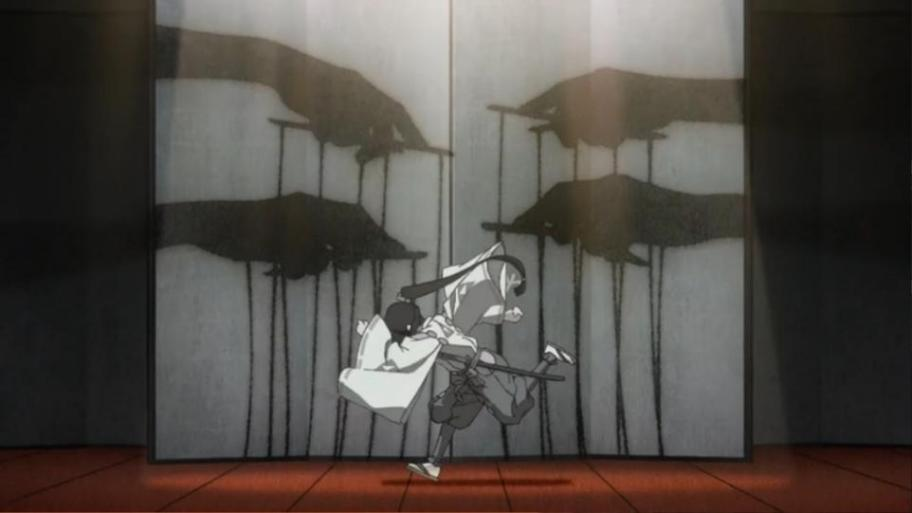
We get why Tokiyuki wants to escape. Doesn’t our inner kid want to escape sometimes too? The thing is that Tokiyuki escapes in a superpowered anime way, as none of us can. Some adults are worried about him, but most just laugh and let him goof around. This constant flight takes a toll on him, and he starts to think of himself as worthless and irresponsible.
But even if you’re not living up to the ideal, isn’t it enough to be one more of the people wandering around in your city? If they smile and life goes on, isn’t that enough? No, as it turns out. The seeds of destruction are already planted at the heart of his world, and the dream may suddenly turn into a nightmare. The weakness of the Kamakura Shogunate results in rebellion, conquest, and massacre.
The human worlds we inhabit are desperately fragile, flawed at their core, and their apocalypse is already coming. Time will become the fire in which they will burn. So is it for Kamakura.
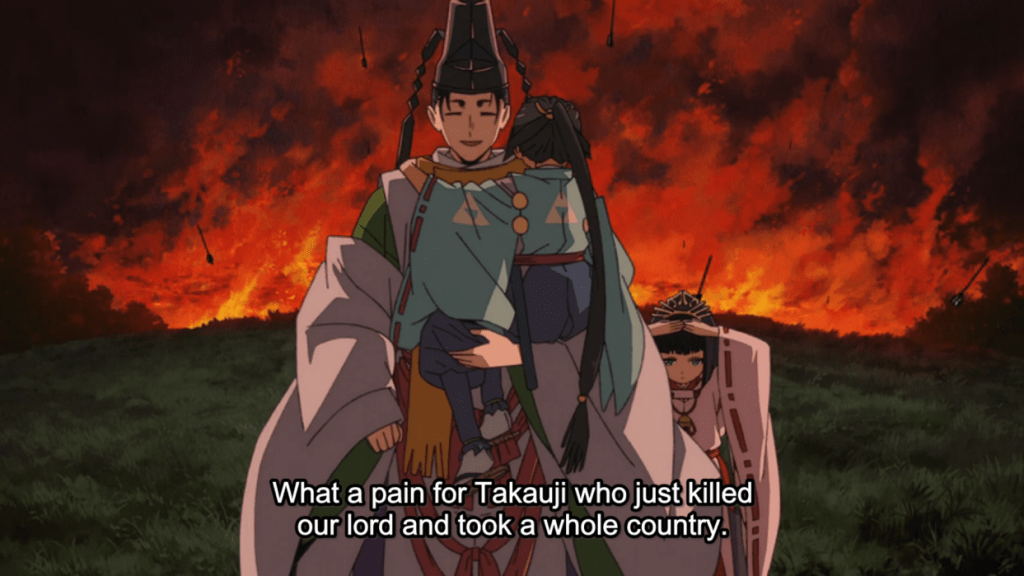
In the face of these destructive changes, some people become able to ride the waves—to read the world around them, destroy old structures, and make things go their way. Those who do so sometimes become leaders, icons, or winners. They often are the heroes of this world. The show has a great metaphor for this. One day, Ashikaga Takauji, the joyful warrior who is the hero of the clan (and who, if we open a history book, is destined to win and rule), hears a voice that tells him about his destiny and guides him on his path.
When we first meet Ashikaga, he is a celebrated leader and a kind man, and indeed, sometimes this heroism is positive. But the path Askikaga takes is a sadly familiar one. Those who chase success in the world face the temptation of letting it define them. Faced with triumph, many become worldly, attentive only to opportunity, to power, to win the game. They may come to think that they are special, different from others, destined for glory. Success often ignites a spark, a race to make that success even more absolute. And ultimately, to become like gods.
The triumph and tragedy of these false heroes come to resemble those of Lucifer, or of Adam and Eve: They extend their hand to become gods, only to find out that they have become monstrous. We cut from the face of Ashikaga to a statue of Buddha in flames.
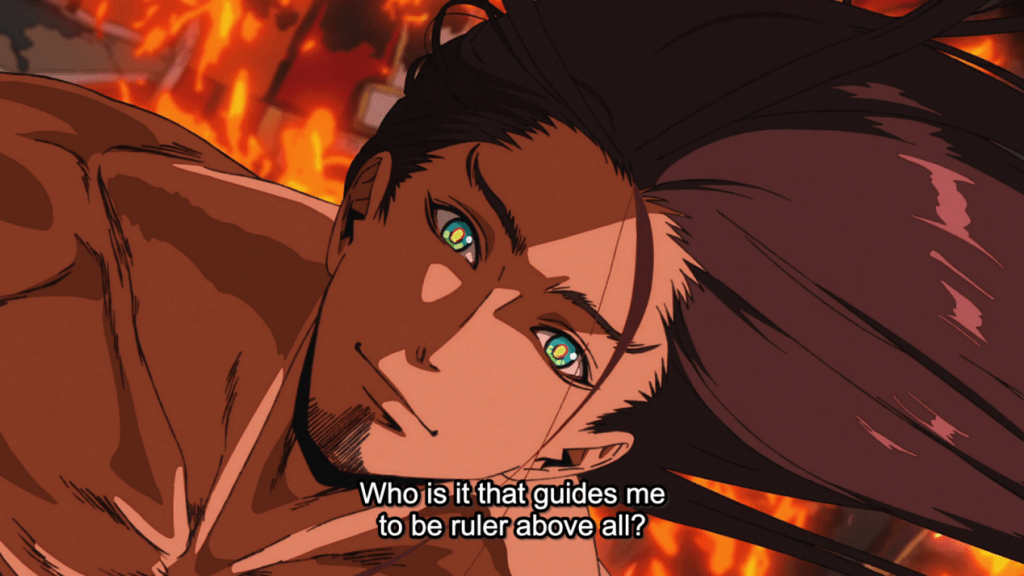
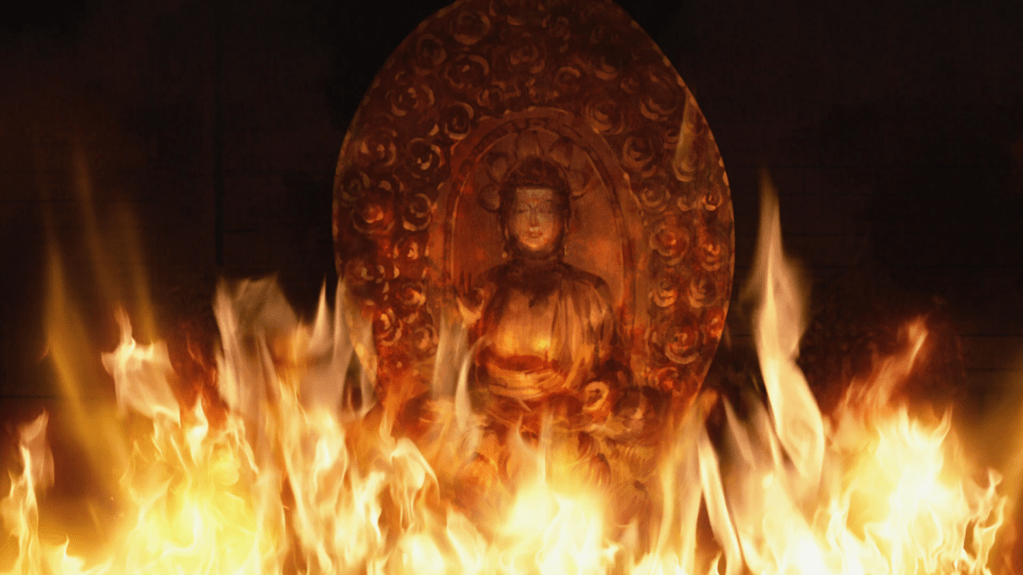
Ashikaga becomes a traitor and a destroyer, and rejoices with demonic glee at the destruction of all he once defended. His followers resemble demons, and the fire and the violence turn Kamakura into a vision of hell. But Tokiyuki survives. And, at his darkest hour, Buddhist priest Showa Yorishige and his daughter Shizuku, those who told him that he would be a hero, those he escaped from, come back on May 22nd, 1333.
The Monster Within Me
The heralds of Tokiyuki’s new life are known to him. Some years earlier, Shizuku told our protagonist: “You’re not lazy, nor a coward. Those are merely aspects of the monster within you.” Oddball Yorishige then told him about a mysterious force that can help him be a hero, that can help him survive even being thrown into the hell that is consuming his world. His power to escape has a providential meaning. And Tokikui, well, escaped.
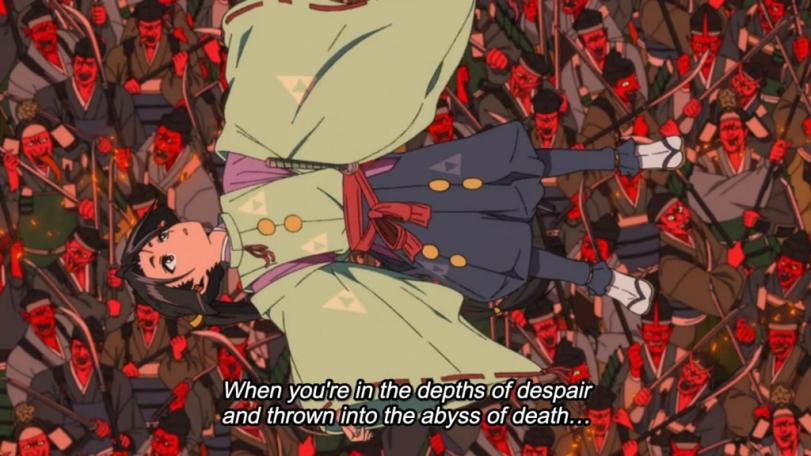
But now, Tokiyuki is able to listen. Instead of honorable suicide, in a world marked by the shadow of death, he is called to be a “samurai who lives.” And Tokiyuki is going to experience very vividly what that means: He is thrown into this hellish vision, and manages to escape. Instinctively, he jumps, turns, flies. We abandon realism completely. The abyss vomits him back. Imagine experiencing that.
I do not remember my own baptism: I was less than a month old. But I believe that at that time, June 19th, 1993, I shared the inner life of the One who experienced the abyss vomiting Him back. Why do I believe that? The phrase “baptism of fire” actually comes from the words of St. John the Baptist in the Gospel of Matthew: “I indeed baptize you with water unto repentance: but he that cometh after me is mightier than I, whose shoes I am not worthy to bear: he shall baptize you with the Holy Ghost, and with fire” (Matthew 3:11). St John was practicing a purification rite (a bath or “baptism”) as a symbol of repentance and renewal. The symbolism was clear: Just as water cleans the filth in our bodies, repentance and reform should clean the filth of the soul.
But John, like Yorishige the priest, could see some aspects of the future. He was what Israelites would call a prophet. He also foresaw a Hero that the abyss itself would vomit back, the One who could not be devoured by hell. The One Who Lives. This is Jesus of Nazareth, the Son of God. This Hero, John said, would transform this rite from symbol to reality, from an image into a life-changing infusion of grace. A baptism of Spirit and fire, that can make everything anew, under the visible appearance of water.
The Hero Within Me
So, do I think a physical rite done with water can produce true spiritual effects, create a new life in the soul? I do. TES has an odd way to depict this revitalization of Tokiyuki: He loses consciousness of where he is and wanders through the battlefield like a kid at play.
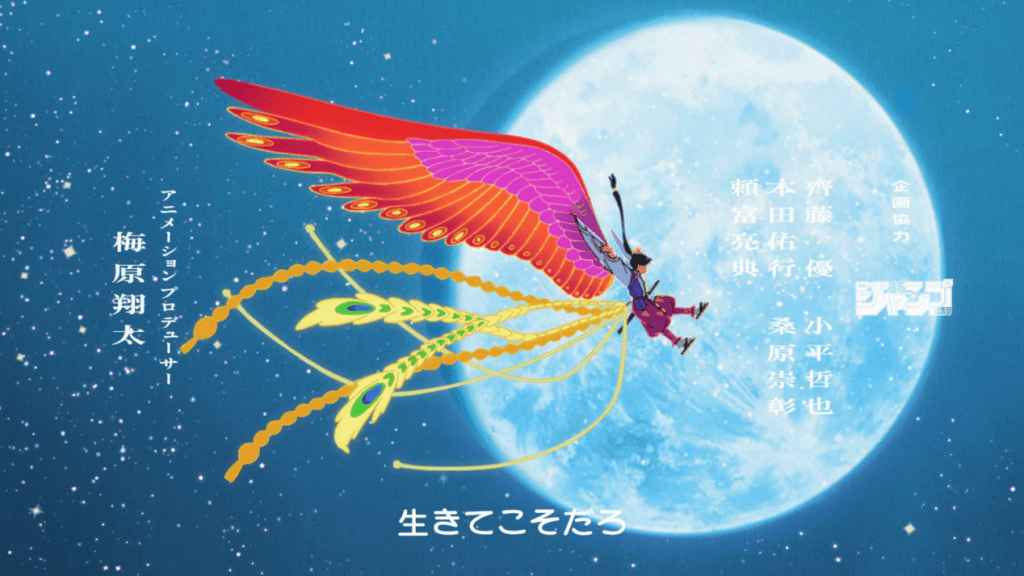
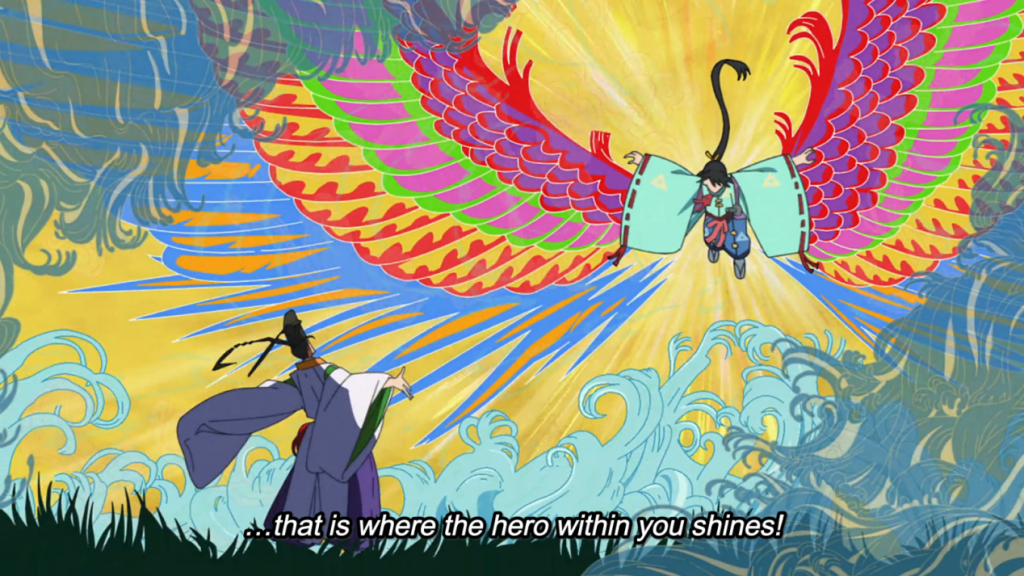
When he emerges from the pit, he is in a sort of ecstasy, his eyes bright, his forehead sweaty. But when he jumps, there is a vision: Colorful wings appear, and Yorishige knows for sure that he was not wrong. This prince is indeed the Samurai Who Lives, and his will to live is here again.
St. John also received his confirmation. The moment Jesus was baptized, those assembled there witnessed a prodigy that went beyond the symbolic. The Gospels of Mark, Matthew, and Luke tell us that the heavens opened, and a visible manifestation of the Spirit of God appeared. A voice thundered from Heaven, saying: “You are my beloved Son, in whom I am well pleased”” (Matthew 3:13–17; Mark 1:9–11; Luke 3:21–23). According to an old tradition, a bright light shone around the Lord. Something transcending this world took place there.
Before ascending into heaven, Jesus commanded his disciples to proclaim the Gospel to the whole world and to baptize all nations with these words: “All power in heaven and on earth has been given to me. Go therefore and teach all nations, baptizing them in the name of the Father, and of the Son, and of the Holy Spirit, teaching them to observe all that I have commanded you. And behold, I am with you always, until the end of the world” (Matthew 28:18-20).
We believe that the rite He went through, the pouring of water and the invocation of the Trinity, miraculously opens us up to the life of grace. The symbol becomes the reality. Though we will always be in this life sinners in need of repentance, though the baptized can stray from the way, the hero of the faith within us, aided by grace, comes to life and starts to act.
And why water? Ultimately, only Christ knows why he picked one thing and not another to become his life-giving miracle, but I can try to guess. Water is present in the life of every human being: It is necessary for all forms of life. Without it, our bodies become repugnant and eventually desiccated corpses. Every human being knows thirst. Thus, water symbolizes life.
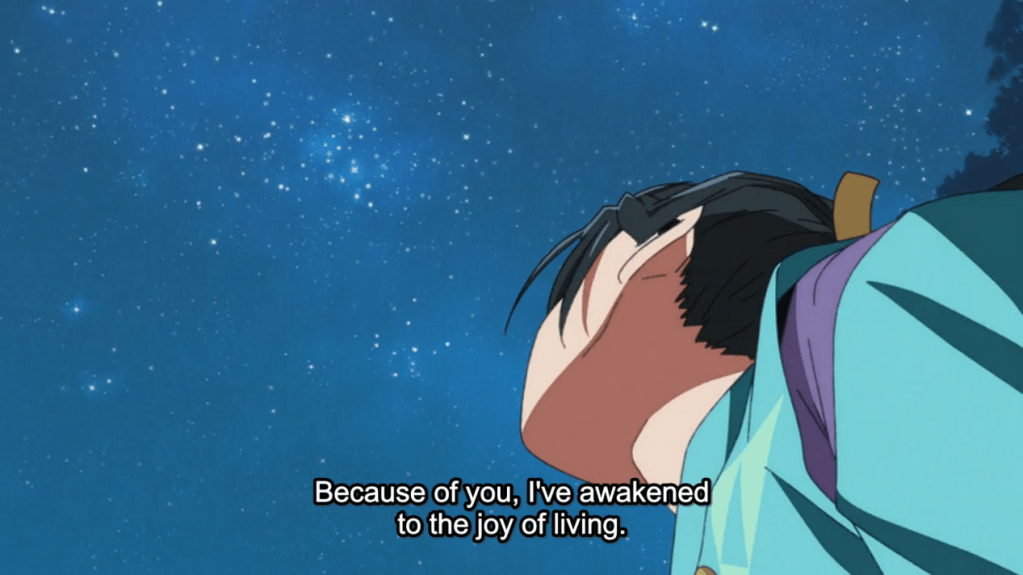
Nevertheless, we cannot survive for long when we are underwater: In some ways, it is a hostile environment that we are not adapted to. We drown. Water, then, is both death and life: the river that makes our harvests possible and the destructive flood. Like Tokiyuki, we have been submerged in death, yet we live. When we emerge from it, we are renewed. Like the “baptism of fire” of popular discourse, this sacrament allows us to potentially redefine ourselves and reconsider everything we think we know, in terms that transcend the limits of our world.
But what if someone never hears of this? One of my favorite teachings of the Second Vatican Council, Gaudium et Spes (Joy and Hope), expresses the belief of the Catholic Church that baptism is offered in some way to every human being, open or mysterious, during the course of his life. Sometimes, it is the visible baptism of water. Sometimes, it is a baptism of blood: giving your life for Christ before having a chance of being baptized.
And sometimes, it is a baptism of desire: an interior acceptance of the gift of baptism in a manner known to God, perhaps even without the clear conscience that that is what you’re accepting. That is how Abraham, Isaac, or King David accepted what God revealed to them: They implicitly received baptism before baptism of water even existed. And potentially, this is how some who never learn of Christ in their life, despite evangelization efforts, may be included in God’s plan of salvation.
“Such is the mystery of man,” says the Council, “and it is a great one, as seen by believers in the light of Christian revelation. Through Christ and in Christ, the riddles of sorrow and death grow meaningful. Apart from His Gospel, they overwhelm us. Christ has risen, destroying death by His death; He has lavished life upon us so that, as sons in the Son, we can cry out in the Spirit: Abba, Father.”
Have you considered becoming a hero? No, really. If so, you may need a baptism of Spirit and fire. In the whirlwind of time, many have received it. Perhaps one day, they will be able to enjoy the peace of God like children, playing in a time and place that seems like the way things should always have been. I hope I see you all there.
“Following Jomon, Yayoi, Kofun, Asuka, Nara, Heian periods, KA-MA-KU-RA / From Namboku-cho to Muromachi, then Azuchi Momoyama, Edo periods / Meiji, Taisho, Showa and then Heisei to RE-I-IWA / What future waits next? / We’re going to make it! Step tap, on the rhythm / Step up, be an adult / KAMAKURA STYLE!“
The Elusive Samurai can be streamed at Crunchyroll.

- The Elusive Samurai, I: Tokiyuki and the Baptism of Fire - 03.24.2026
- First Impression: Love Through a Prism - 01.17.2026
- First Impression: Oedo Fire Slayer -The Legend of Phoenix- - 01.12.2026
