
From ancient times, the boundless night sky and the numberless stars have captured the human imagination. For Aristotle, the birth of philosophy lay in the contemplation of the stars, while Plato wanted the wise to train themselves in astronomy, and Virgil and Seneca liken virtue to a “path to the stars.” Twenty-five centuries later, the skies above still fascinate us and make us reflect. Two anime that have dealt with this awe in beautiful ways are the similarly named, yet very different, Planetarian and Planetes.
Planetarian is a melancholy post-apocalyptic tale, while Planetes is a bold space comedy. Both deal with the contrast between the feelings the cosmos evokes in us and the realities that tend to crush these feelings, and both vindicate wonder, as they show their protagonists a message written in the skies—a message of wisdom, hope, and connection through wonder.
The Bible also points to the heavens and the wonder they instill to highlight God’s greatness: ”The heavens are telling the glory of God; and the firmament proclaims his handiwork” (Psalm 19:1). But also, interestingly, scripture uses the stars to represent the multitude of angels. Be it Lucifer in Isaiah 14:12 or the “war in the heavens” in Revelation 12:3-4, the stars are linked to God’s non-human messengers.
So, what is this feeling that stars evoke in us? And what is its role in these two shows? How do stars relate to angels? Can we really discuss sci-fi and angels in the same breath, or is the tonal whiplash too much to handle? Well, stay tuned!
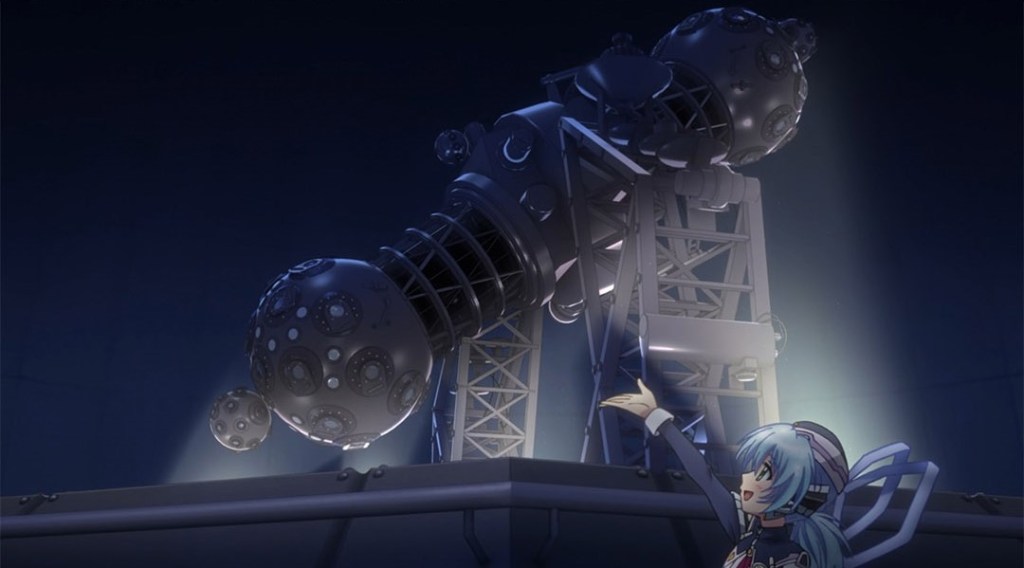
A message of cosmic wonder
Planetarian: The Reverie of a Little Planet started out as a Key visual novel, released between the moving Clannad and the likewise powerful Little Busters. If you’re a fan, you might want to check out the series of guest posts James did here back in 2014, highlighting the VNs’ theological themes, its callbacks to Christianity and its theme of sacrificial love, or its discussion on our own Tanglecast. The anime adaptation, though, deserves praise for its own sake: just five episodes long, beautifully rendered, and…available on Crunchyroll!
At its core, Planetarian powerfully conveys the limitless love that the robot host of a planetarium, Yumemi, has for humanity. Even in a post-apocalyptic wasteland, Yumemi cares for us to the point of (spoilers) giving up her electronic life, going out with a prayer to the God of Robots—a concept inspired by her knowledge of Greek mythology. She just wishes to serve humans for all eternity.
In the course of 168 hours, the robot’s boundless love for the stars and for the people who look up at them allows her to move the heart of the unnamed protagonist, a cynical scavenger surviving in a hostile and predatory world. Through Yumemi, Planetarian urges us to look to unchanging realities and find hope; to see beyond the struggles of today. This small reverie turns out to be more real than the chaos or the AI-ridden apocalypse that ended civilization.

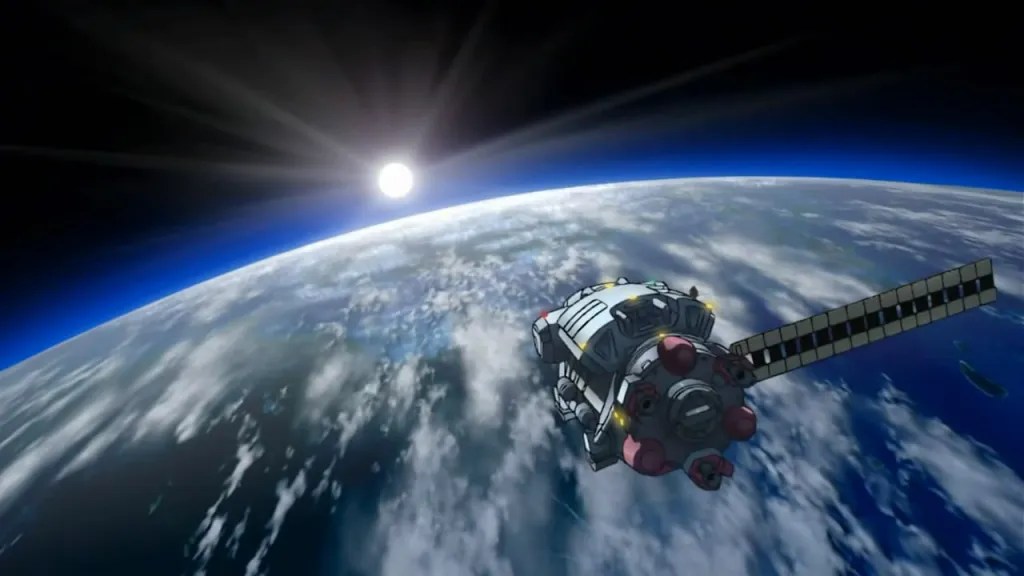
Planetes takes a very different route in introducing us to the wonder of space. The world it depicts is also soul-crushing, but instead of tragic, it is just hopelessly mundane. When the enthusiastic fresh recruit Ai Tanabe finally becomes an astronaut, she doesn’t expect to be relegated to the Second Division, Debris Section, picking space trash while surrounded by bureaucracy, disillusioned coworkers straight out of The Office, and disparaging words and looks from the other divisions, who call her team the “Half-Section”.
Our writer Josh, who loves this show with a passion, paints a vivid portrait of this chaotic setting in his post, highlighting how the story defends the dignity of humble work, and shows that everything is connected and everything is important. Planetes certainly does this, but it also does much more: from the pond of mundane dust, daily debris, and inane interactions, emerges a picture of cosmic wonder: the opposite of chaos, a cosmos full of order and wholeness.
Planetes illustrates this with (spoilers) an actual vision in which all the characters are united, forming a bridge of light across the stars, a vision that brings our depressed co-lead, “Hachimaki” Hoshino, back to Tanabe’s love and Tanabe’s dreams, convinced now, as she is, that “everything in the world is connected to space.” Human hearts are connected to the unchanging, to the limitless, to wonder, and a dream like this can even bring hope, order, and peace to a restless heart.


Hachimaki’s vision brings to mind Jacob, the patriarch God would name “Israel”, and his dream, narrated in Genesis 28:10–19. Finding himself far away from his home, a fugitive in a heartless world, Jacob lays down to sleep on the ground. “And he dreamed, and behold a ladder set up on the earth, and the top of it reached to heaven; and behold the angels of God ascending and descending on it. And, behold, the LORD stood beside him, and said: ‘I am the LORD, the God of Abraham thy father, and the God of Isaac…”
After the apparition has concluded, Jacob/Israel says to himself: “How full of awe is this place! this is none other than the house of God, and this is the gate of heaven.” This unwelcoming spot in the middle of nowhere is now full of meaning, and eventually becomes a home of prophets, judges, and even God’s Ark of the Covenant, as He continues to meet “Israel”, now a big nation, there.
God made Israel wonder at the connection between heaven and earth. Both Planetarian and Planetes also bring us to a moment of universal connection, showing us the vision of the vastness and wonder of the cosmos and the deep love it might instill in the human heart. At first, Hachi and our unnamed survivor have more pressing concerns than the vastness of the stars. But they ultimately look up and find above a vision that brings them (and us) peace.
The shows achieve this by acknowledging the protagonists’ causes for despair—the harshness of life, the abyss between reality and our dreams—but then leading these characters beyond, to the infinite, to the beauty that transcends time. But how? Well, they reach their characters through messengers.


Ai and Yumemi as angelic figures
Planetarian uses angelic imagery for Yumemi, giving her wing-like luminous ribbons and long hair that also resembles wings. Similarly, in Planetes, Ai is nicknamed “Angel” by her friends. This is because they bring angels, the wise spirits who act as God’s messengers, to mind. In their own way, Ai and Yumemi are wise visionaries who read in the stars this great message of cosmic wonder and fight to bring it to others.
Both of these “messengers” are crushed in different ways by an indifferent world. Nevertheless, their vision survives and ultimately inspires their co-protagonists (and us) to contemplate the wonders above and find hope in that vision. God’s wondrous messengers, the angels, can do this for us too: the Book of Job, the story of a crushed man finding God’s wonder, beautifully says that the “cornerstone of the Earth” was laid “when the morning stars sang together, and all the sons of God shouted for joy,” (Job 38:7).
And yet, in our world today, the message of wonder is constantly downplayed and termed lame or silly. Christians might be tempted to discard or downplay the angelic, too. We might link angels to the curiosity they inspire in the superstitious or the lovers of the occult, a danger already noted by St. Paul (Col. 2:18). Or we might think that angels are unscientific, kind of sappy, and definitively superfluous, and be tempted to explain them away to keep the focus on more essential things.
The first key point about angels that we must address, then, is that they are real and important, just as the stars are real and important. We have mentioned how the wisdom, the message of Ai and Yumemi, is born of the contemplation of the stars, and also how the stars are one of the main metaphors the Bible uses for angels. But where is the link?

Wonder calls to wonder, joy calls to joy, connection calls to connection. I think that’s why the Bible uses this analogy: the angels are a multitude of heavenly beings, invisible like the stars by day, yet wondrous like the stars by night. They are myriads of individuals who are great and complex beyond anything we could conceive, yet they exist in a harmonious cosmos, under God. Thinking about them instills in us an even deeper wonder about the universe. Wonder calls to wonder—and we might also think about our interior cosmos.
As it happens, thinking about angels is an actual branch of biblical theology, and St. Thomas Aquinas was very interested in this topic. His reflections elaborate on the biblical mentions of angels, especially those in the Pauline epistles, and are rooted in “cosmological” argumentation, trying to depict “a beautifully balanced celestial framework dictating the presence of angelic beings,” as this article puts it.
St. Thomas tells us that God has lovingly and fittingly created the immaterial beings we call angels (from the Greek word meaning “messenger”) so that they can interact with the physical universe, and that they play a central role in our salvation, both in their interactions with the people of the Old Covenant, and with their presence in our lives. I will try to use the insights of Planetes and Planetarian, and their wise approach to cosmic wonder, to evoke this feeling for the marvels of these other members of God’s great family.

St. Thomas tells us that angels are indeed not “necessary” to God. But neither are we! God creates for the good and happiness of the created, and He helps them love and serve to fulfill His will, which is rather like the prayer of Yumemi: that we be one people, one Church, and a multitude of siblings, all different, even from various species, yet loving and helping each other. The lesson Hachi learns is also a lesson for us: knowing everyone, loving everyone, serving everyone under God, makes us love God more.
What God showed Jacob, he shows us. What He reveals, He reveals for a reason. His family is our family, and thus He wants us to make room in our minds and our hearts for beings like the angels, knowing that they are also part of God’s family, and not anything else. We will have to go beyond the tame, well-intentioned but less-than-wondrous artistic representations of angels from the Renaissance and Victorian eras. As our writer reminds us, biblical angels are striking and strange and usually have to tell humans “Fear not!” when they meet them (Luke 1:30, Luke 2:10-11).
An angel’s presence is the presence of a powerful spirit beyond human understanding. They adopt human form on occasion (sometimes adding a flaming sword, as in Numbers 22:22-35), but also manifest themselves as many-winged beings (Isaiah 6:1–4), pillars of fire (Exodus 13:17), or enormous, interconnected wheels (Ezekiel 1:4-21).

So angels are real, but what are they? There is a key moment in Planetarian where the scavenger starts considering Yumemi to be a person. In this sense, angels are people, too. A parallel can be made between the android’s robotic intellect, containing in itself much of the order of the known universe, and the powerful angelic intellect, which is to the intellect of a human what a galaxy is to our solar system, since pure spirits do not need the gradual mode of knowledge acquisition required by bodily perception.
In that as in everything, angels are beyond the need of a body, letting their presence be felt where they want and appearing before the eyes of men in the guise they choose. Being immaterial doesn’t equate to being less real, or less capable, though. Angels are powerful, more than the mythical Greek gods Yumemi knows everything about. Not afflicted by passions, according to St. Thomas, every angel is capable of powerful, immediate, non-discursive intuitions, of instant, mind-to-mind communication, and of moving all sorts of bodies without regard for their size or weight with their native power.
Furthermore, angels were endowed with free will, which they used in a single, defining act, contemplating all its consequences and transforming themselves with it in a way we can only achieve with successive choices during our entire lifetime. This is why there cannot ever be change or redemption for Lucifer and those who followed him into rebellion. Infinitely determined for good or for ill, angels also resemble Yumemi in their unwavering commitment. But they are capable of true understanding and love. One day, we might speak to them and get to know them. And right here, right now, we’re already connected.
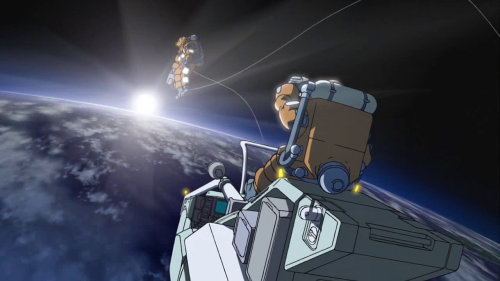
Everyone is connected
Connection is an aspect where the insights of Planetes come into play. According to St. Thomas, angels are intensely connected. They are part of a society, the Church, ordered and hierarchical in various ranks and subgroups, but every group, every individual, has specific gifts for the whole. This hierarchy is the hierarchy of service Christ showcased by washing the Apostles’ feet. The angels love and serve one another and also us, in our nations, like Israel (Daniel 12:1), our community churches like Smyrna (Revelation 2: 8-11) or Laodicea (Revelation 3:14-22), and…us individually!
Every human, from the cradle to the grave, is guarded by a Prince of Heaven who helps him or her by enlightening the mind, aiding against temptation, and sometimes, by exercising their native powers in ways big and small. This invisible care goes unnoticed, like the care the despised Debris Section provides, but unseen disasters are averted through it. Christ says that the angels of the little ones “always behold the face of the Father which is in heaven” (Matthew 18:10): no person is ever considered worthless.
When the Apostles discussed their rank in the Kingdom of Heaven, Christ took a young child and put him at the center among them (Matthew 18, 1-5.10). In the Kingdom, the smallest is the most important: God identifies with him. We can learn from this: from the quarks to the galaxies, from the astronaut to the janitor, from the seer to the priest, from the angel to the ant, everything in the Church, in society, in creation, is connected and serves as an integral part of God’s family, of God’s cosmos.

Lastly, angels are also described as a legion or army (2 Kings 6), battling against evil on the side of God, facing it the way Yumemi faces the rogue crab robot or Ai faces the terrorists. The choice between self-sacrificial love and pride unto self-adoration is what separated angels and demons, a battle depicted in Revelation 12:7–10. But this distinction is also shown in Christ’s temptation in the desert, where the angels serve him (Matthew 4:11), the angelic presence in Christmas, Gethsemane, and Easter, as well as the vivid descriptions of various saints. Its main battlefield is the human heart.
Hearts are transformed both in Planetarian and Planetes. We see how Yumemi’s theological imagination, formed through the Greek mythology she uses to explain the names of the constellations, leads her to love God and neighbor unto death in a deeply moving way. Ai also believes that love is the center of everything, a belief that ultimately helps her inspire others and stop a terrorist attack. The victory in this war is not in any worldly conquest, but in the flame of sacrificial, godly love—more powerful than any other force of the universe—growing stronger and stronger in each human heart.
In the words of St. John Chrysostom, a bishop and preacher from the early Church, “mounting as it were by steps, let us get to heaven by Jacob’s ladder.” Jacob saw a path to Heaven, the one Christ inaugurates and walks symbolically in His Ascension, visibly going upwards until a cloud takes Him out of sight (Luke 24:51). Then, angels talk to the Apostles, the younger members of the Church, and reassure them: just as Christ has gone to the Father, He will return (Acts 1:1–9). And the Apostles go back to Jerusalem filled with a mysterious joy.


Like Hachimaki and the scavenger, we might come to perceive the universe as chaotic and predatory, or as meaningless, random, and banal, with many experiences and deceptions piling up to support these feelings. But the contemplation of the stars shows us that we live in a reality of spheres and circles, of life and balance, of systems within systems: a cosmos, not a chaotic, hollow universe. And if there is order outside, why wouldn’t there be an order inside?
In the age of robots and astronauts, the scientific explanations we find don’t conflict with angelic participation in the order of the universe and inside ourselves. The very fact that there are rational answers to the questions that nature puts in front of us shows us the wisdom inherent in the workings of the universe. And in finding such wisdom, wonder is not a silly response: it is courageous and brave, and it allows us to live through our lack of control or even understanding, finding cause for celebration and for walking beyond.
Wonder challenges our objectivity, bringing us beyond our limits, but it also challenges our subjectivity, inviting us to go beyond ourselves. Outward marvels help us to find the way out of our inward darkness. It does this for Hachimaki, who was sinking into depression. It does this for the unnamed scavenger, lost in the fight for survival. The true beauty of the cosmos allows us to increasingly see our true selves, but also to see above and beyond, to see others, to see God. And in coming closer to Him, to share our joy with a great, mind-bending family.
Planetarian can be streamed at Crunchyroll, while Planetes is rumored to be receiving a North American Blu-Ray release in November.


[…] that helps raise them, a firm and unchanging world where justice always has the last word, a Cosmos aiding their development. We cultivate our moral sense by imitating examples and following […]
[…] makes a completely faithful approach impossible, nor would the format allow it: if Gabriel was an incorporeal being who decided everything in a single, defining act, the show presumably wouldn’t be a lot […]