
Tearmoon Empire has one of the best opening episodes in recent years when it comes to showcasing the gospel. And this is no surprise, given that the author of the original light novel, Nozomu Mochitsuki, is himself a Christian. I was so taken with the premiere episode that I wrote two posts when it aired! But what about the rest of the season? Did it live up to the hype that I and many of the folks at Beneath the Tangles were feeling after that first episode? The short answer is…no. As the show progressed, it seemed to get further and further from that gospel-filled opener as themes of grace, mercy and the power of prayer faded away and were replaced instead with a central gag. It was a great gag, but still. Bit of a letdown.
At least, that’s what I thought at the time. But I was wrong. What I didn’t see until later is that the central gag itself is actually the most profound gospel message of all: about the ongoing nature of grace. So, let’s dive in and see what a fluffy reincarnation comedy about a self-centered princess has to show us about our new life in Christ.
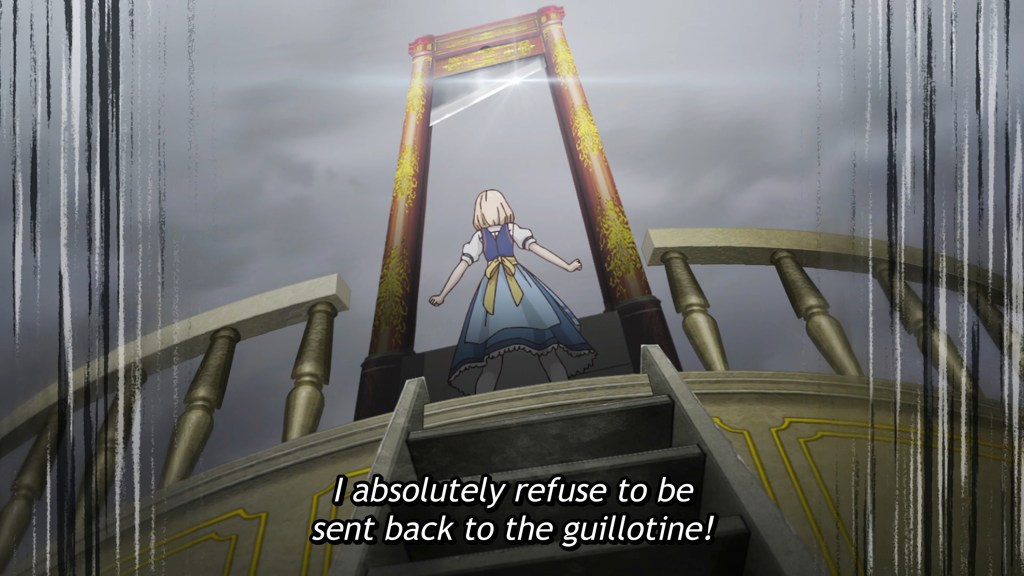

The central gag I’m talking about here is this: each episode, Princess Mia, haunted by memories of her bloody execution in the previous run-through of her life (after which point she reincarnated as her 12-year-old self), makes a pivotal decision of some sort with the aim of warding off her future deadly demise. And each time, those around her misinterpret her actions to her credit, viewing her rulings as the epitome of wisdom and magnanimity. There’s the time she donates her costly hairpin to help crowdfund a new hospital, knowing that the jeweled accessory would be stolen in the future anyhow, and inadvertently earns a reputation for benevolence; the time she (grudgingly) rescues someone from bullying in order to maintain the trust of her loyal retainer, her maid Anne, and wins a number of key political allies (and friends) as a result; and the time she gets in front of a potential diplomatic disaster (that could lead eventually to her execution) and gains herself the undying friendship of Princess Rafina and standing as a merciful leader. Before she knows it, Mia is being heralded as The Wisdom of Tearmoon Empire, which has a bit of a halo effect among the people when it comes to interpreting their future sovereign’s every word and deed. We viewers know the truth—that Mia’s just trying to save her skin!—but everyone else sees her through rose-colored glasses. It’s all pretty hilarious and sweet.

Fluff, right? Wholesome silliness.
And yet, there are two things going on here that have a direct parallel to our own rebirth into the new life of faith. The first is the struggle we often have to fully grasp grace; and the second is the fact that grace continues to flow in and through and around us regardless of our lack of understanding. Let’s unpack these parallels.
When Mia awakens as a 12-year-old with her head still attached, she is elated—and very, very grateful for the redo. We know this because from that moment on, she’s a changed young woman. But she’s also a frightened one. And it’s this fear of death that shapes much of her thinking and doing throughout the season. For Mia, the miraculous grace and mercy of being reborn is a one-off, and it’s now up to her to work hard at ensuring she is able to live out her days, neck intact. She has to get things right this time.
And it’s not just Mia. This same idea is woven into the fabric of the entire isekai/reincarnation genre, where death is a gateway for MCs to leave behind a broken life and broken world (where companies work their employees to death and truck drivers pay no attention whatsoever to pedestrians) for a second chance in a new one. Reborn protagonists often find that they’ve gained a special ability, a power dwelling inside them, or discover that their expertise from their previous life essentially serves as a special ability, an otherworldly wisdom (Holy Spirit parallels, anyone?), but even so, there’s this pressure on the isekai’d MCs to get things right this time, and not make the same mistakes that ushered them to an early grave on Earth. The most intense example of this pressure would be in Re:Zero, where Subaru continues to die painfully every time he gets it wrong, paying an extreme physical and psychological price over and over again. Even at the other end of the spectrum, chill isekai, there’s usually a heavy cloud or edge of urgency (e.g. in the form of hazy flashbacks) on the MC to max out the relaxation in order to avoid repeating the pain of the past. Across the board, rebirth in anime comes with the need to make good on the do-over the protagonist has been given. And Princess Mia is feeling this pressure.
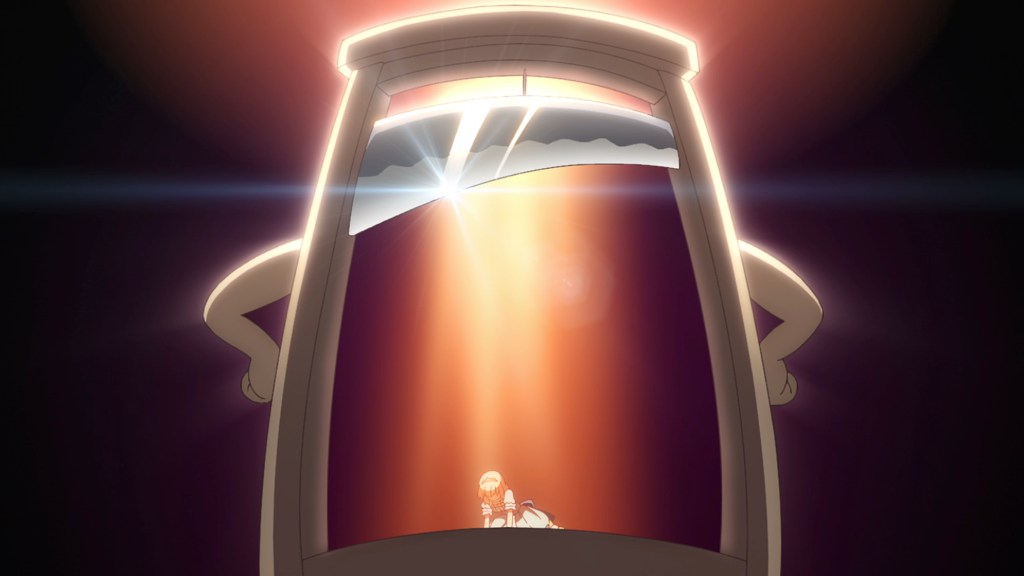
We feel this pressure too sometimes, don’t we? Like we need to prove to God, ourselves, and others that we’ve learned the lessons of our old life and spiritual death, like an isekai MC. That we have overcome the sin, temptation, and brokenness of our past; that we can get it right now. And like Mia, the fear that we can’t live up to the second chance we’ve been given can pervade our thinking and doing, though often we don’t realize it. We can find ourselves trying to retroactively earn the grace that’s already been given to us, and keeping God at arm’s length until we do.
The problem with this, and with how rebirth plays out in isekai/reincarnation anime in general, is that it treats grace like a doorman: there to get us over the threshold and into the Kingdom of God, but then leaving us on our own to figure out how to stay in. But grace is not a doorkeeper. It’s not a one-off shot at a redo. It’s not even an infinite number of shots at a redo, like for poor Subaru. In fact, grace is not a redo at all. It’s an already done that redefines our entire life irrevocably and for good. It’s the atmosphere that we now live our new life in, it’s our new context. Grace is the isekai!
And that’s exactly what the central gag of Tearmoon Empire is revealing, each and every episode. Mia cannot get away from the grace that swept into her life when she repented and was born again in that first episode. This is why everyone around her misinterprets her motives: they are seeing her through the lens of grace that now surrounds her, and they credit her with a wisdom and righteousness that are not her own. Sound familiar?
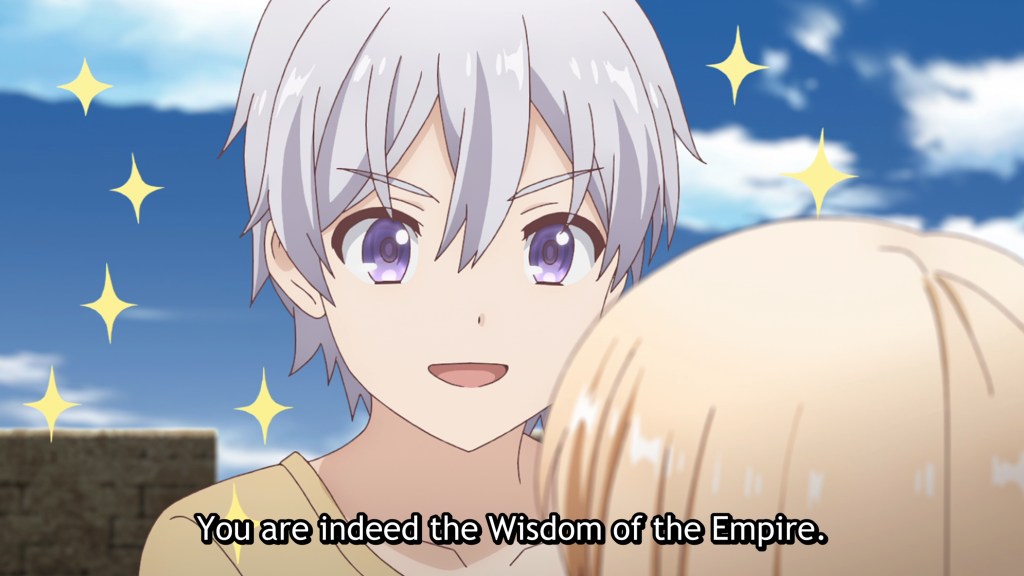
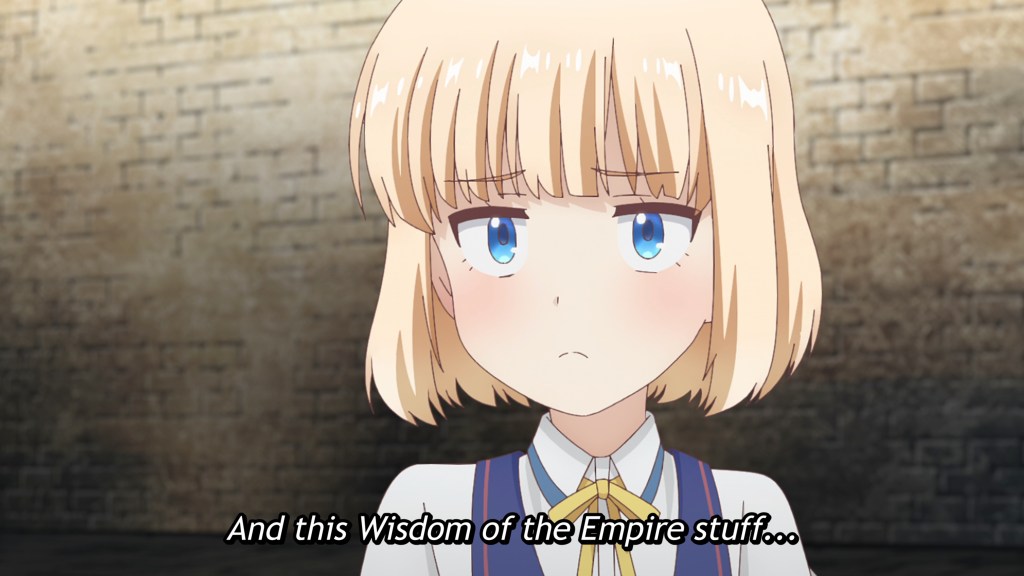
Isaiah 61:10 tells us that God clothes us in his own righteousness. Just think about that for a moment: being dressed by God completely transforms how we’re perceived. And more than that, it’s a well-known phenomenon that changing how we dress changes our own physical and mental posture too: it influences how we behave and move around in the world, and how we see ourselves too. We can see the impact of being clothed in righteousness in Hebrews 11, when the author, inspired by the Holy Spirit, reframes the compromised, sinful lives of a whole number of biblical figures and describes them instead as being faith-filled and righteous. Incredible! And it’s not just that chapter, either. Even a completely unheroic guy like Judah, who, after repenting still continued to make decisions with mixed motives and, much like Mia, was primarily concerned with saving his own skin—even he is credited with righteousness! Though he never once did anything grand for God, God still moved the heart of Judah’s father, Jacob, to skip over the unrepentant firstborn sons and give the double blessing to Judah instead. Later, God even chose the descendants of Judah as the caretakers for the city where he would dwell, Jerusalem. Now that is grace in action! God rewrote Judah’s entire legacy, not just his life, through the lens of righteousness. And he does the same for us.
Unlike Mia, we aren’t surrounded by a population of adoring supporters who see the best in us, even when it’s barely on show. (And we fail to do so for those around us, too.) But we do each have an audience of three who unwaveringly see us through the eyes of a love and grace so radical that it erases our sin and foibles and invades our weaknesses to strengthen us and rewrite our stories permanently. The three-in-one, Father, Son and Holy Spirit. We live in the middle of their love, caught up in their gracious gaze. And here’s the best part: nothing can change this, ever. Not even our ignorance of the fullness of the grace that has given us new life.
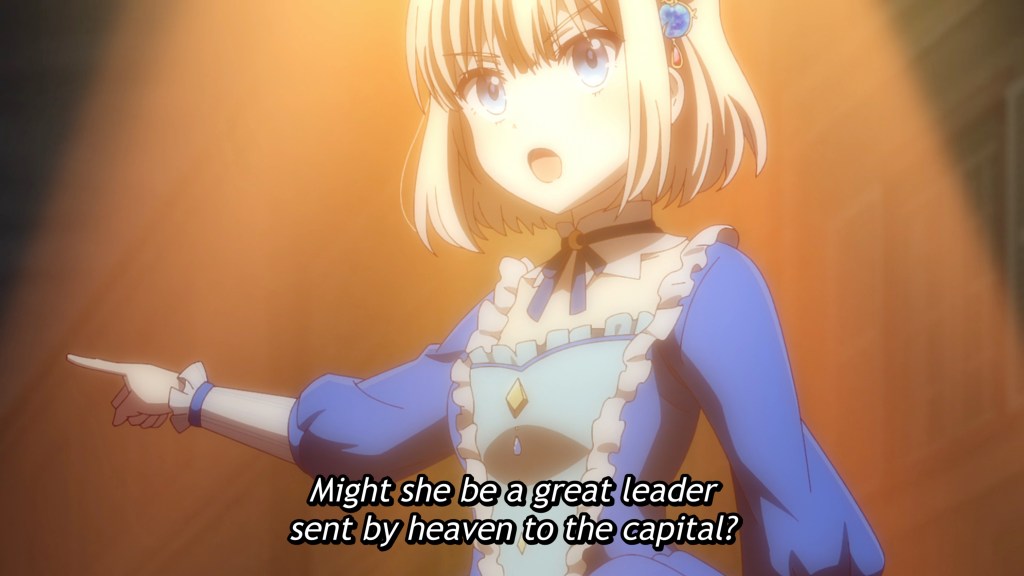
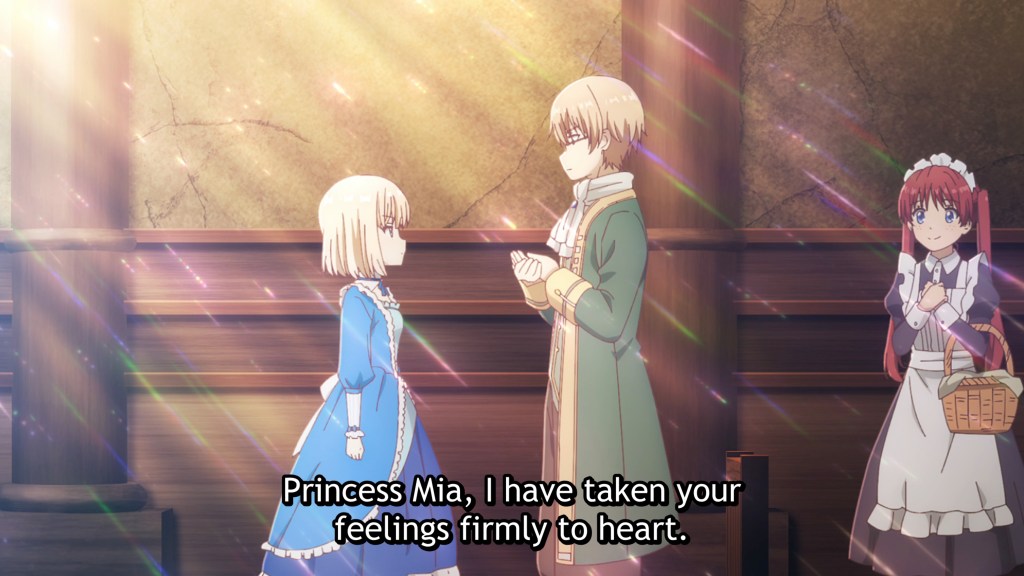
This too is on display in Tearmoon Empire. It’s no accident that Mia keeps stumbling into righteousness; that her decisions keep transforming the world around her for the better and demonstrating how she herself has been transformed. She may not be aware of it, but the unnamed deity who saved her that day is working through Mia, giving her wisdom and solutions and a kindness that eventually blossoms into genuine love for others, as we see by the end of the series. Mia doesn’t transform herself, and she doesn’t ever manage to earn that second chance she was given; but by the end of the series, she’s fully living her new life; she’s living more generously and joyfully than she ever could have managed on her own. She’s living under grace.
How much better to partner intentionally with that grace, though! To ask the One who has extended it to us to help us to grasp more fully what he has done and what that now means for our new life in him. And more to the point, what it doesn’t mean, and all the fears and pressures and striving we can let go of. After all, grace was not a mere event in our lives any more than it was for Mia; it’s a new way of living—living under grace, perpetually, inescapably. So let us learn from Tearmoon Empire all that Mia herself has yet to grasp: that grace does away with the need to get it right, and that instead, the ability to live rightly, to be wise and kind and courageous, flows into us through grace. Let’s open the doors of our hearts, letting the fear out and the grace ever more fully in.

- Film Review: All You Need Is Kill - 01.15.2026
- First Impression: Kaya-chan isn’t Scary - 01.11.2026
- First Impression: Dead Account - 01.10.2026

[…] We know that grace saves us, but then, gradually, perniciously, we find ourselves behaving as if we now need to keep the rules in order to remain in God’s favor. We have our lists of things that we will not do, say, watch, […]