
In the 21 years since Peter Jackson’s monumental trilogy of masterpieces, The Lord of the Rings content has been a mixed bag. But when news broke out that The Lord of the Rings was getting an anime prequel movie canon to Peter Jackson’s trilogy, I couldn’t help but get excited.
The Lord of the Rings: The War of the Rohirrim is the largest global premiere of an anime feature film in history. It is directed by anime veteran Kenji Kamiyama (Jin-Roh: The Wolf Brigade, Ghost In The Shell: Stand Alone Complex) and stars Brian Cox, Gaia Wise, and Miranda Otto reprising her role as Eowyn in the form of narrator. The film is set 183 years before The Fellowship of the Ring and tells the tale of the house of Helm Hammerhand (Brian Cox), the legendary king of Rohan, for whom Helm’s Deep in The Two Towers is named. After Freca (Shaun Dooley), the lord of the Dunlendings, approaches Helm with a proposal of marriage between his son Wulf (Luca Pasqualino) and Helm’s daughter Hera (Gaia Wise), Helm kills Freca, leaving Wulf an enemy of Helm’s house in search of revenge. Wulf’s war of vengeance leads Helm and the people of Rohan to make a last stand in the stronghold of the Hornburg as Hera leads the resistance against Wulf and his army.
So is The War of the Rohirrim worthy of the Peter Jackson trilogy’s legacy? Yes… mostly.

Making this film directly canon with three of the greatest pieces of cinematic history is a double-edged sword. From Eowyn’s opening narration, accompanied by musical cues from Howard Shore’s soundtrack, I was immediately swept up into the world of Middle-Earth. There are just enough callbacks to the original trilogy to make it fun for fans, without an over-reliance on nostalgia. Some of these callbacks come in the form of narrative similarities. Hera, like Eowyn in The Two Towers, is a shield maiden of Rohan, a woman with a warrior’s spirit and the courage to lead and defend her country, yet surrounded by men who see her less as an equal and more as someone to stay behind in days of battle. Many movies have tackled this warrior-woman concept over the years. While the criticism that this story is familiar could be valid, the story being narrated by Eowyn herself gives meaning to the trope. As her opening narration says, you will not find a mention of Hera “in the old songs.” This is a bit of a fourth wall break, as Hera is never given a name in Tolkien’s appendices. While the fictional histories of Tolkien’s work are tales of men told by men, Eowyn’s presence as the narrator shows that The War of the Rohirrim is like a tale of oral tradition passed down by the women of Rohan from one generation to the next, inspiring future generations of women to take up arms as shield maidens.
Make no mistake—though Hera is mentioned, yet never named, by Tolkien, this is Hera’s film through and through. Though not the only standout character, Hera commands attention every second of her screen time and meets what has perhaps been the most glaring need in Tolkienian lore for over 70 years: a strong and compelling female lead. The Lord of the Rings has several strong female characters, but none who could lead their own movie. While very strong and courageous, Hera is not a one-dimensional tomboy protagonist. She has genuine love and affection for her headstrong and imperfect father and her two brothers. When Wulf first arrives, you can tell she has a conflict of emotions within herself, and that there is the possibility that they could have married under different circumstances. They were once inseparable childhood friends, and that emotional connection is felt in the subtle animation of Hera and Wulf’s faces and eyes. But it is only when she sees that this marriage proposal is being used to seize her father’s throne that any possibility of this union is dashed. This is crucial to show that Hera is not just a girl who would rather brawl with the boys than marry one; instead, she’s a real woman with real human emotions, and one who doesn’t want to be used as a political pawn in a patriarchal power grab.

While some may wonder why this story was told not only through the medium of animation, but specifically in the style of Japanese anime rather than live action, Hera’s story proves to be one that benefits from the story-telling strengths of anime. Rather than seeming like a knock-off of Eowyn, Hera draws more inspiration from Studio Ghibli princesses like Nausicca and Princess Mononoke. Evoking the legacy of strong Japanese female protagonists allows Hera to stand on her own in The Lord of the Rings universe, and to become a believable figure that a known character like Eowyn could have looked up to for inspiration.
Hera’s father Helm Hammerhand is the other main beneficiary of the 2D anime medium. Helm’s punches are so powerful that he kills men with a single blow. This would be harder to believe with a live-action adaptation, but in traditional 2D animation, the force and velocity of his punch is felt so strongly that you really can believe that a man could be killed in a single blow (insert obligatory One Punch Man joke here). And while Helm is a headstrong and stubborn ruler and warrior, we are also treated to a genuine moment between Helm and Hera that solidifies Helm as one of the best anime dads around. While his mistakes are seen earlier in the film, Helm is portrayed as both an imperfect man and a good father.

The War of the Rohirrim also shines in its art direction and craft. Character designs and backgrounds are all beautifully developed, with many shots feeling truly cinematic and worthy of being seen on the big screen. Voice acting was all around very good, as was the score by composer Stephen Gallagher. It was truly a treat to see Middle-Earth brought to life in anime form, and I can only hope that Warner Bros Animation green-lights more anime adaptions of Tolkien’s work.
So what makes this a mixed successor of Peter Jackson’s The Lord of the Rings? Unfortunately for this animated movie, it is the animation.
Don’t get me wrong, the art of this film is simply marvelous, and you can tell that the animators put their heart and soul into this movie. But the film makes the decision to blend 3D animation in backgrounds and specific environmental objects with the 2D animated characters, which sometimes can look nice, but other times really does not. This has been an unfortunate trend within Warner Bros Animation for the past 15 years and can be seen a lot in their DC Animated content. Beautiful 2D animation will be on full display only for a 3D object to appear and break the spell of the animation. These 3D objects appear weightless compared to the 2D elements and make it painfully obvious that you are looking at a 3D model rather than something that really feels like it lives in the world of the movie. It is especially jarring considering the 3D animation seems to be rendered at a much higher frame rate than the character animation. Watching two different frame rates on the different layers creates the feeling that the characters are moving in slow motion, which then breaks the verisimilitude by reminding you that you are watching animation that doesn’t quite seem finished.
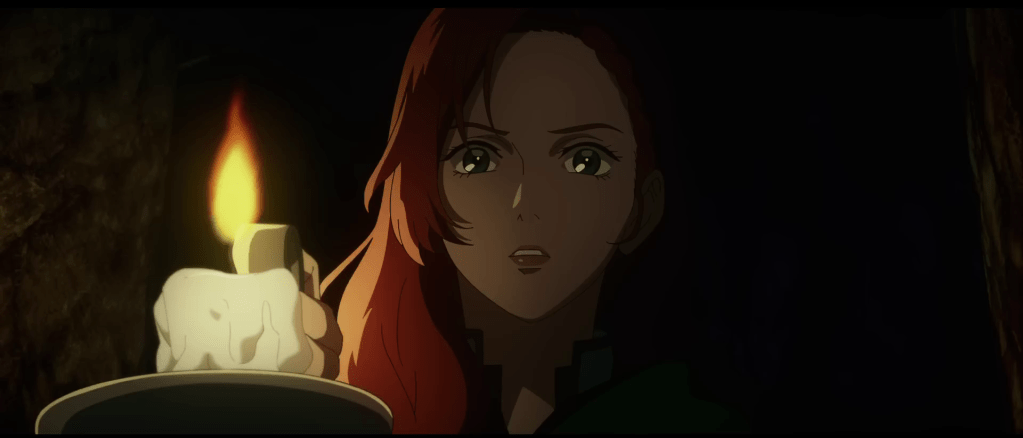
To be fair, I have seen far worse examples of blending 2D and 3D animation, but there have also been much better examples. If it were clear that this blending was an intentional artistic choice, then it wouldn’t be distracting. The unfortunate truth is that this blend feels more out of necessity than artistic vision, probably due to either budget or time constraints. And this is where the legacy of Peter Jackson’s trilogy hurts it the worst: It is easy to forget in light of the massive success of The Lord of the Rings movies that Peter Jackson’s production was pretty scrappy. He was a smaller director known for horror movies who had mastered the art of realizing his directorial vision through practical sets with practical live-action effects, enhanced in post-production with inventive special effects. It was all done intentionally, and it resulted in something that was more than the sum of its parts. The War of the Rohirrim, on the other hand, comes across not as a fully realized breath-taking directorial vision, but as a very good animated movie that is held back from its full potential.
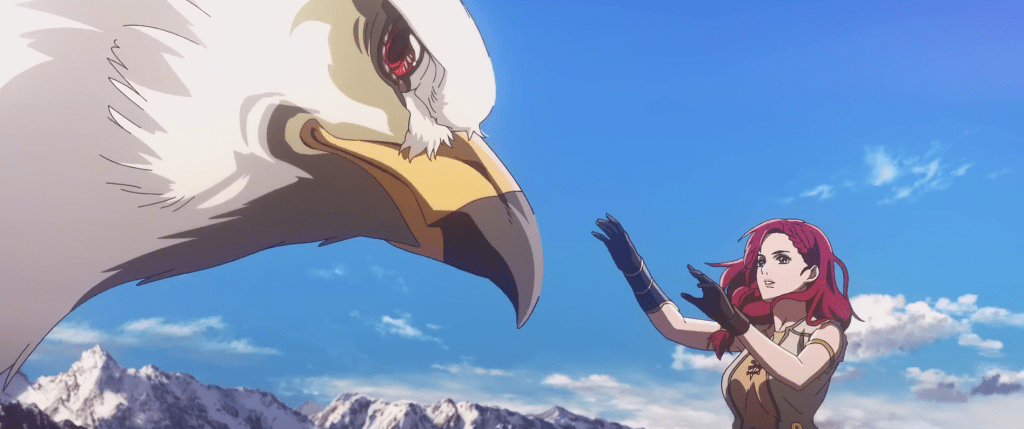
Despite some issues with the 3D aspects of the animation, other sequences absolutely soar high above the rest. The use of rotoscoping is exceptional, and a sword fight between Hera and Wulf really showcases the excellent animation that could have been present in more of the film if they had the time and money to make it happen.
Overall, The Lord of the Rings: The War of the Rohirrim is a very solid movie that had this Lord of the Rings fan very happy with what was on screen. I had a great time watching it, as did the group I saw it with, and I will certainly return to the theater for repeat viewings. If you like The Lord of the Rings, or if you just like good anime storytelling, do not sleep on this film. And if you like both of those things, I’d say you’re in for one heck of a treat.
The Lord of the Rings: The War of the Rohirrim is now playing in theaters.
- First Impression: Needy Girl Overdose - 04.05.2026
- First Impression: Mobile Suit Gundam GQuuuuuuX – Beginning - 03.08.2025
- First Impression: Yu-Gi-Oh! Go Rush!! - 01.11.2025
Unlike you, a lot of other people hated the film. Especially since everyone in the film artificially inflates Hera, even though she’s nothing special nor does she have much of a personality. Also, her shieldmaiden guard holds off the besieging army and even wins?! Sorry, but this girl-boss I’m happy to ignore. Also, I don’t believe Tolkien ever imagined generations of shield-maidens within the culture of Rohan!
Wow, you either didn’t actually see the film, or the moment you realized it had a woman as the central character you checked out to catch up on Tate crying in court. Her shieldmaiden defeated several people, but lots of the army ran past her. Wins? more like survives. Capt Marvel was a girl-boss, you apparently think any woman to try and stand up for herself is one. Hera is clever, and wins several conflicts by out thinking her foes and relying on the help of others-which comes across as very real. She has one climactic battle in the end that she does fight and win against an opponent we have already been shown she has beaten in the past. So when it comes to ignoring, I almost ignored your review but it seemed like some might take it seriously. Tolkien’s imagination notwithstanding, he did put them into his lore, and no reason to think we can’t expand on it. This is a heroine who won on the merits. Sad you can’t see them.
No, I can’t agree, and watching it, confirms for me, this is a boring, more subtle girl boss film. Yes, Hera isn’t insufferable, but she also doesn’t have an ounce of personality. I’ve seen much better women characters than Hera, anime and live. She always is right, and whenever men ignore her, they pay the price, usually with their lives. She’s special with seeing Great Eagles up close and gets one to help her somehow (even it is most ridiculous and eye-rolling), she upstages everyone, and as a result, the film suffers a lot. It’s funny how Eowyn says in the narration, “don’t look for Hera in the old songs” yet somehow she knows of this story. Also, all the Gondor subplot nonsense made no lick of sense, if one knows the true story of Gondor and Rohan’s alliance, namely the Oath of Eorl and Cirion! None of this Gondor’s fear of Rohan nonsense, or not asking Gondor for help: in the books, Gondor, after stopping the invasion on their borders, sends an army to Rohan’s aid, and Frealaf is the one to kill Wulf, *at Edoras in a desperate raid with his own men.*
It’s funny how everyone says this is faithful to Tolkien, but everyone ignores the feminist and frankly cringe bit how Hera doesn’t want to be wed to any man, and at the duel, she proudly says to Wulf, she’s wed to Death! Also, more than Helm, I and others note Hera’s overweening pride, and everyone’s continuing inflation of it, even though it is most unwarranted! And Hera’s abdication of the throne makes no sense in real medieval history or Tolkien’s history: each person had a duty and those who ignore or deny it usually go astray.
I will also add the animation was also feeling cheap, compared to other anime movies: it felt like a filler TV anime episode!
To each one’s own, I guess. But thankfully, for me, the box office returns are disappointing! It just shows, at least to me, people would rather see a much more faithful adaptation of Tolkien’s story. Heck, I would have liked to have seen more of Helm and his sons, rather than this limp female character.
As a long-time enthusiast of Tolkien’s legendarium, I truly appreciate your thoughtful and insightful review. Not only does it highlight the artistic strengths and minor flaws of *The Lord of the Rings: The War of the Rohirrim*, but it also captures the spirit of what makes Tolkien’s works so enduring. Your praise for Hera, the film’s central female protagonist, really resonated with me. As you write, “Make no mistake—though Hera is mentioned, yet never named, by Tolkien, this is Hera’s film through and through.” This observation is particularly meaningful, as it acknowledges the creative fidelity of the filmmakers. Rather than betraying the core of Tolkien’s source material, they’ve delved into the appendices and given us a character who feels both authentic and integral to Rohan’s storied past.
Tolkien himself saw Middle-earth as a vast tapestry of myth, open to new interpretations and retellings. In a letter to Milton Waldman, he described his goal as creating “a body of more or less connected legend” that could be enriched by subsequent generations. This film, with its original yet lore-consistent figure of Hera, genuinely respects that tradition. It is, as you suggest, “like a tale of oral tradition passed down by the women of Rohan,” filling in quiet spaces that Tolkien left for future voices to inhabit. One can imagine these stories whispered around hearth-fires in the Riddermark, inspiring young shield-maidens yet to come.
Your positive remarks about Hera’s character development underscore an important point: she isn’t just an added female figure to appease modern sensibilities, but rather a fully realized individual who “commands attention every second of her screen time.” Hers is a story not of forced empowerment, but of a woman who grows into her strength, building on the cultural and moral foundations that Tolkien laid down. Like Éowyn, whose courage and spirit Tolkien immortalized, Hera is nuanced—a woman who loves her family, wrestles with her emotions, and ultimately comes into her own as a leader. The film’s choice to narrate her tale through Éowyn, a canonical female hero who once declared herself “no man,” reinforces that lineage of strength. Your observation that “As her opening narration says, you will not find a mention of Hera ‘in the old songs’” testifies to the film’s conscious effort to enrich the lore rather than contradict it. She stands gracefully alongside Éowyn, the canonical shieldmaiden whose courage and defiance of patriarchal norms were originally considered so groundbreaking. In this way, Hera is both familiar and fresh—a timeless figure who embodies the Rohirric spirit.
From a technical standpoint, I appreciate your balanced critique of the film’s animation style. Tolkien admired craft and authenticity in all forms of art, and while “the decision to blend 3D animation…with the 2D animated characters” occasionally jars, you were fair in noting that the result is still predominantly beautiful. Your review gives credit where it’s due: the rotoscoping, the finely wrought character designs, and the “excellent animation” in sequences like the Hera vs. Wulf duel.
Thank you for your thoughtful appraisal. As a Tolkien devotee who treasures the integrity of Middle-earth’s lore, your review has convinced me that *The War of the Rohirrim* is “a very solid movie” that not only complements Peter Jackson’s legacy but also offers new textures and threads to the tapestry Tolkien began. I look forward to experiencing this inspired adaptation for myself.
[…] of the Rings: The War of the Rohirrim, a movie that unfortunately sunk at the box office despite being very good. It has pages for seemingly every single character, location, group of people, and creature, […]