
Christmas happens in the second season of Log Horizon, but it’s just an incidental part of a multi-episode arc (or maybe it’s two parallel arcs, depending on how you look at it). These are “Christmas episodes” only in the sense that the holiday is a background detail—lights twinkle and vendors dressed like Santa hawk strawberry shortcake. But, even if unintentionally, there’s a plot thread in this arc that is legitimately relevant to the Christmas season: death and resurrection.
Yes, Christmas and the resurrection really do go together! Of course, the death and resurrection of Jesus is more strongly associated with Easter, but it’s also central to Christmas, because it’s the very foundation of Christianity. The path from the manger leads directly to the cross, the empty tomb, and the throne of heaven itself. Surprising though it may be, the way that Log Horizon juxtaposes Christmas with an exploration of death and resurrection actually illustrates this connection.
But first, if you’re not familiar with it, Log Horizon is an outstanding entry in the isekai’d-into-a-world-based-on-a-game genre. Most of the main characters are players from our world who find themselves transported to a world resembling the MMO they played, and are transformed into their game characters. Besides these adventurers (that is, the former players who have been isekai’d), there are the People of the Land—basically, people who were NPCs back in the game of our world but are now real people.

We pick up in the fifth episode of the second season. It’s Christmas Eve, and a serial killer is going around the fantasy world’s version of Akihabara, murdering adventurers, which is odd since they automatically come back to life. Some characters try to track down this mysterious assailant. Meanwhile, Shiroe, the guild master of Log Horizon (the guild that is the namesake of the series), is absent; he’s commanding a dungeon raid with a bunch of other characters. That night, Akatsuki—an assassin who’s a member of Log Horizon—faces the serial killer and dies. It’s also strongly hinted that Shiroe and his group experience a total party kill, but the details are left ambiguous for now.
That brings us to the next episode and to Christmas Day. Akatsuki is revived at the local cathedral, and a bunch of people greet her. By the end of episode 6, it’s night on Christmas Day, so technically the “Christmas” part of the story is over (except not quite), but we aren’t even halfway done. Next comes a training episode; it covers the week after Christmas, during which everybody in Akihabara prepares to take down the serial killer. On New Year’s Eve (episode 8), Akatsuki—with everyone’s help and some timely power-ups—ultimately defeats the serial killer. As everyone celebrates victory and the new year, Shiroe lets Akatsuki know that his team is about to go up against the raid boss who defeated them.
Episode 9 jumps back a week to Christmas Eve when Shiroe and his raiding party first faced a big dungeon boss. Midway through the fight, two more raid bosses join the battle, something that was impossible in the game. Result: total party kill. The following episode (the tenth) takes place on Christmas Day and is about Shiroe’s raiding group reviving and mustering the courage to face the seemingly impossible battle once more. Fast forward until it’s New Year’s Eve and they’re about to challenge the trio of bosses again. After this, the arc wraps up with a couple more episodes in which the dungeon raid reaches a victorious conclusion, but that’s beyond the scope of this piece.
The first interesting mention of death and resurrection comes from a conversation in episode 5 involving Touya, a young member of the guild Log Horizon, and the older and wiser cat-man, Nyanta. Touya expresses a desire to fight the serial killer and says he doesn’t fear death. He can be so blithe about it because adventurers don’t suffer permadeath; after dying they automatically respawn at certain locations. Nyanta admonishes Touya thus: “Just the fact that you revive means that, essentially, you’re getting special treatment. By getting used to that, thinking of it as normal, it seems to me that you lose something in exchange.” Nyanta’s point holds true for the Christian doctrine of resurrection too. We do indeed hope for “special treatment,” but we should never take the Lord’s “precious and magnificent promises” of resurrection for granted. This is what Paul was getting at when he rhetorically asked “What shall we say then? Are we to continue in sin so that grace may increase? May it never be! How shall we who died to sin still live in it?”
Nyanta is also correct that cheating death has a price—the scriptures tell us quite explicitly “you have been bought with a price.” But herein lies a key difference between Log Horizon’s player revival and the resurrection Christians undergo: who pays this price? In the anime, players lose a fragment of their memories when they return from death, but we aren’t the ones who lost something for our resurrection. The church of God was “purchased with his own blood.” And in the words of the apostle Peter, “you were not redeemed with perishable things like silver or gold from your futile way of life inherited from your forefathers, but with precious blood, as of a lamb unblemished and spotless, the blood of Christ.” The life of God himself is the payment for our resurrection. That’s incomprehensibly more valuable than merely forgetting the name of your cat or a local ramen shop. This high price drives home just how valuable resurrection is, and motivates us to live differently “post-resurrection.” But more on that in a bit.
Log Horizon’s resurrection and Christian resurrection differ in terms of the price paid, but also in terms of the effects. This is seen in the parallel visions experienced by Akatsuki and Shiroe in episodes 6 and 9. Let’s start with Shiroe’s side. After dying, he finds himself in a black-and-white version of his hometown, where he sees a younger version of himself and laments his past failures—the many mistakes he made. “They were all small failures, but ones that I couldn’t fix. And each time, I came here and cried. I swore I’d never do it again, but I always did.” He realizes that he’s here now in this metaphysical space because he failed yet again and died. It’s a dark moment for him.

The anime’s gamelike resurrection can only revive Shiroe physically. However, Christian resurrection has the crucial advantage of being tied to the hope of personal change. We don’t just hope to come back to life. We hope to come back different and better, as God works in us. From a Christian perspective, Shiroe’s attempts to do better were missing something: the presence of Christ and the Holy Spirit in his life. We Christians don’t raise ourselves. Growth happens and failures are overcome when we stop relying on ourselves and look to God’s power to change us.
Akatsuki’s parallel story in episode 6 starts out similar to Shiroe’s, but it ends on a more explicitly hopeful note. In the episode, Christmas Day has dawned and Akatsuki, who just died, awakens in a surreal, black-and-white version of IRL Shibuya, looking like her pre-isekai self. “Where am I heading?” she asks as she’s jostled by the crowd. Suddenly, she sinks into the ground, and then she finds herself running up an endless staircase. “Where am I trying to go? I may not have a destination.” Akatsuki is, as the episode’s title puts it, “A Lost Child at Dawn.” This part of the vision ends and she finds herself on a beach on the moon. She’s back to her isekai’d game character form. Shiroe is there, since he died too. The beach is swirling with something that looks like snow but is actually the fragments of memories adventurers have left behind when they were revived. Akatsuki loses one herself. But when she awakens in the cathedral where adventurers revive, she finds that she’s also gained something through this experience: “I feel like I found something, like I understand something. So there’s something I should do… Something I must do.” She exits the cathedral with a new sense of purpose and determination, ready to challenge the serial killer again.
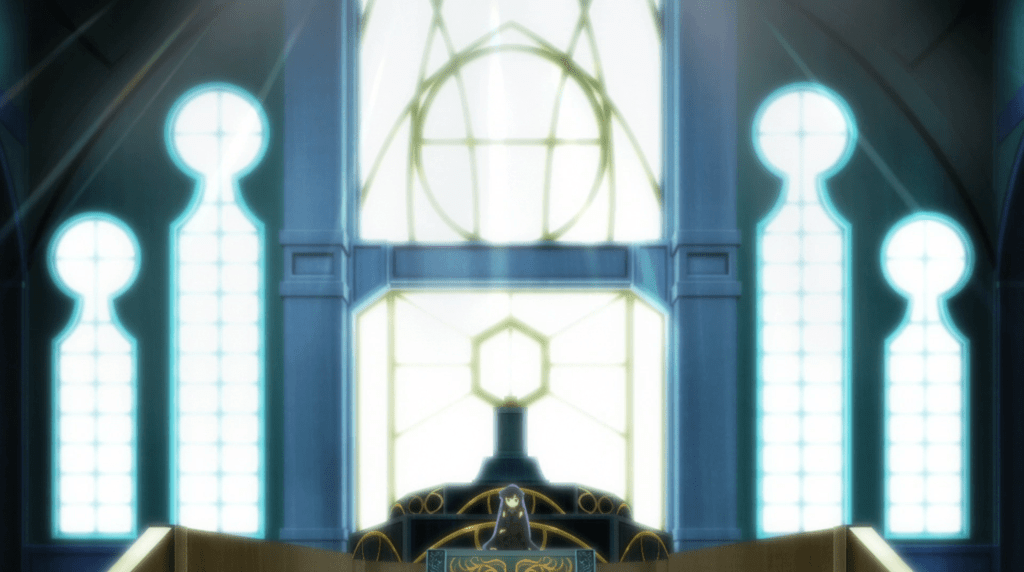
In all this, she very much reflects how Christianity talks about spiritual resurrection. Like Akatsuki, before resurrection, we must first question how we’ve lived and recognize that we are lost and vainly struggling, just as Akatsuki does when realizing that she doesn’t know where she’s going. It is after we realize we’re each the one trying to climb an endless stairway that we can humble ourselves before God, repent, and accept the grace he offers. On the beach, Akatsuki acknowledges how she got there: her defeat and death.
There’s an interesting detail in Log Horizon that usually comes off as a minor character trait, but here takes on added meaning. Specifically, it’s the way Akatsuki always addresses Shiroe as “my lord.” She doesn’t mean it in a religious sense; it’s more like she’s roleplaying as a ninja serving a feudal noble. But thanks to that little detail, from a certain point of view, we can say that in this story a “lord” and his vassal both undergo death and resurrection—kind of like Christians and our Lord and king, Jesus.
Shiroe may not have the power to resurrect Akatsuki, but he does offer her this encouragement: “You may have fallen. But you haven’t lost yet, have you?” This hopeful note harmonizes nicely with the themes of Christmas. Yes, we’ve all sinned. We die both spiritually and physically. But all is not lost, and if we accept God’s gracious offer, we can also rise to live with new purpose.
Perhaps no scripture captures this process of spiritual death, resurrection, and life with new purpose more succinctly than Galatians 2:20: “I have been crucified with Christ; and it is no longer I who live, but Christ lives in me; and the life which I now live in the flesh I live by faith in the Son of God, who loved me and gave Himself up for me.” To put it another way, Christ “gave Himself for us to redeem us from every lawless deed, and to purify for Himself a people for His own possession, zealous for good deeds.” Resurrection changes us, just as the characters of Log Horizon return from death changed (albeit in a relatively minor way). Striving to live differently by pursuing good works is a necessary consequence of the new life—Christ’s life—in which we partake.
This spiritual death and resurrection is a foreshadowing of the bodily death and resurrection we’ll eventually experience, but even now, it’s more than just an abstraction or imaginative exercise. Through the sacrament of baptism, we can actually participate symbolically in dying and rising again like Christ to live a new life. As Paul wrote in Romans 6, “Do you not know that all of us who have been baptized into Christ Jesus have been baptized into His death? Therefore we have been buried with Him through baptism into death, so that as Christ was raised from the dead through the glory of the Father, so we too might walk in newness of life.” On a spiritual level, it is in the act of baptism that we can imitate the death and resurrection of Jesus, and respawn with a new mission.
There’s one more thing Log Horizon has to offer us in episode 10, which takes place on Christmas after most of Shiroe’s team has resurrected. The episode is mostly focused on William Massachusetts, leader of the guild Silver Sword. He reflects on his past failures and rallies his guild members, and while it’s not quite as thought-provoking as the death/resurrection visions of Akatsuki and Shiroe, it’s not entirely irrelevant to the matter at hand. In particular, William describes Shiroe’s establishment of a government for adventurers in Akihabara like this: “There was a raid that I thought was pointless, impossible, and unwinnable, but he… But Shiroe won it.” Fitting, isn’t it? If ever there was an impossible, unwinnable raid, it would be when Jesus Christ soloed sin and death. As with many comparisons between the mundane and spiritual, the parallel is a little silly, but it also rings true. This season reminds us that Jesus came to Earth and defeated the greatest of bosses, and thanks to that, we can face death and resurrection with hope. Whatever we may lose in spiritual death and resurrection, we gain far more.

This time of year, we remember Christ’s birth, but the manger is meaningless without the cross and the empty tomb, which makes Log Horizon’s association of Christmas with stories of death and resurrection so unexpectedly appropriate. As death forces Shiroe, Akatsuki, and William to acknowledge their mistakes, the gospel forces us to confront the fact that our past failures—in other words, our sins—have left us spiritually dead and in a position where resurrection is a necessity. And with Akatsuki in particular, we see echoes of how our deaths can be followed by resurrected life filled with a new sense of hope and resolve. Turns out this arc of Log Horizon is a lot more Christmassy than it first appears, huh?


[…] Log Horizon (Season 2, Eps. 5-10) – “Christmas Eve,” “A Lost Child at Dawn,” “The Suifū Maidens”(The Maidens of Watermaple),” “Akihabara Raid,” “The Changing Battlefield,” “Guild Master” [1] […]
Very insightful Post, good work.
I watched Log Horizon recently and as I said elsewhere that build up to Christmas is present from the start of season 2. But I still think the best Batman Returns of Anime is Nanoha A’s.
The most explicit reference to the Resurrection in the Nativity Chapters is in Zacharias’s Prophecy on the day John is Circumcized, the Dayspring reference I like to help justify the Day of the Week of the Resurrection being now associated with The Sun. That of course happened 6 months before Christmas, amusingly it wouldn’t be hard to tweak the traditional chronology to place it on Tanabata.