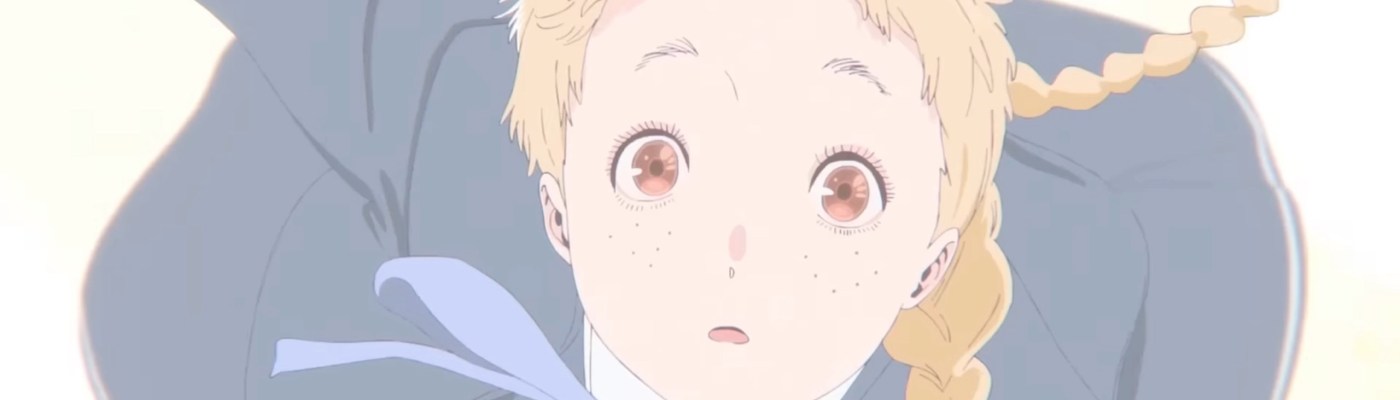
“God grant me the serenity to accept the things I cannot change…” From the very first moments of Naoko Yamada’s latest film, it is clear that Kimi no Iro/The Colors Within is something special—particularly for our community here at BtT. If The Heike Story was her exploration of Buddhism, The Colors Within is Yamada’s Christian film, complete with a Christianity consultant listed in the credits. The result is arguably the most holistic representation of Christians in Japanese anime, as Yamada brings her characteristic grace and eye for detail to bear on this original story. What’s more, it’s absolutely stunning!
Totsuko is a first-year student at a mission school in Nagasaki prefecture, where she is known as the girl who is always in the chapel. But what her schoolmates don’t know is why she is always there, as she struggles to find peace in praying the first line of the Serenity Prayer. For Totsuko, the thing she can neither accept nor change is herself, and specifically, her well-kept secret: she can see people’s colors. Part synesthesia, and part something a little more spiritual—for Totsuko, people simply have a color to them; everyone, that is, except herself.
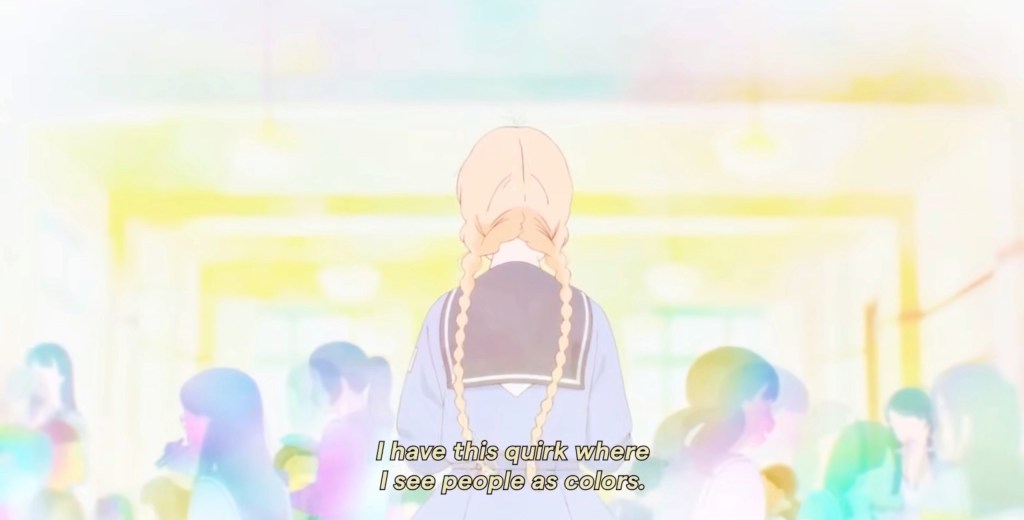
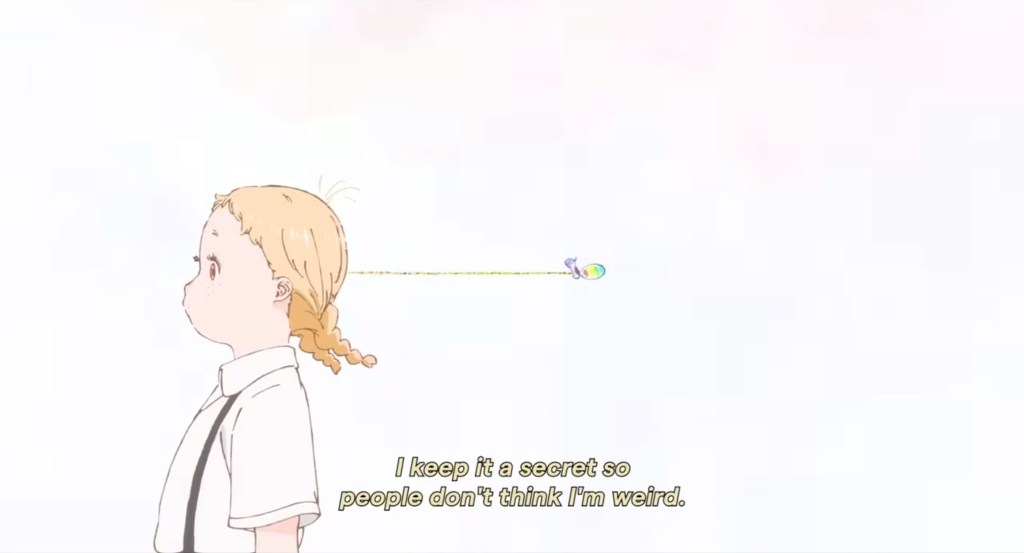
Totsuko’s unusual perception is what leads her to befriend her senpai Kimi, who is the embodiment of cool blue, and Rui, the boy whose warm green seems somehow to resonate with Kimi’s hue. In a charmingly awkward burst of extroversion, Totsuko proposes that the three of them—virtually strangers at that point—form a band, and to her surprise, they agree. What follows is a delicate study of humanity dressed up as a high school band story. The music is central, it’s true; but not in a way typical of the genre or of Yamada’s inaugural band series, the lighthearted comedy K-On! Instead, The Colors Within is more akin to Liz and the Blue Bird, where the music—both the experimental score by Kensuke Ushio, and the performance pieces by the teens of White Cat Hall—take on allegorical significance.
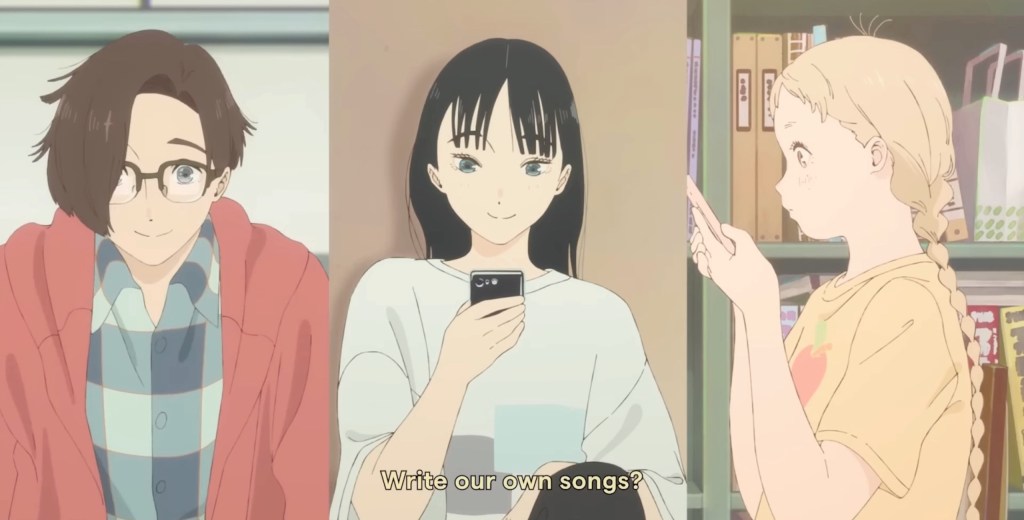
Over the course of the school year, the three young people work toward their school festival debut, leveling up with their instruments and throwing themselves headlong into songwriting. Yet, the plot is not really about their growth as a band, but rather, about each teen’s individual journey to find his or her voice through song, be it as a lyricist, like Kimi and Totsuko, or a composer, like Rui. The result is a concert of three distinct songs, with the band supporting the unique voices and experiences of each member, rather than merging their works into a single uniform sound. Totsuko, the main protagonist, composes a hymn, because her private struggle is a matter of faith and the balance between submission and agency that comprises it. Kimi writes an apology, because she has bridges she must mend and song equips her to speak up in a way she cannot manage in daily life. Rui’s composition is melancholy, as his sensitive soul responds to the pain of those around him, particularly Kimi; but it is also creative and intelligent, bringing together the competing desires of his heart—studying medicine and making music—into perfect harmony. In this sense, the band is a catalyst for each member’s growth, rather than the focus of it, and the site where their searches for peace intertwine. It is unlikely that the future holds any pursuit of fame or the Budokan stage for these three; that’s not what White Cat Hall—or The Colors Within—is all about.
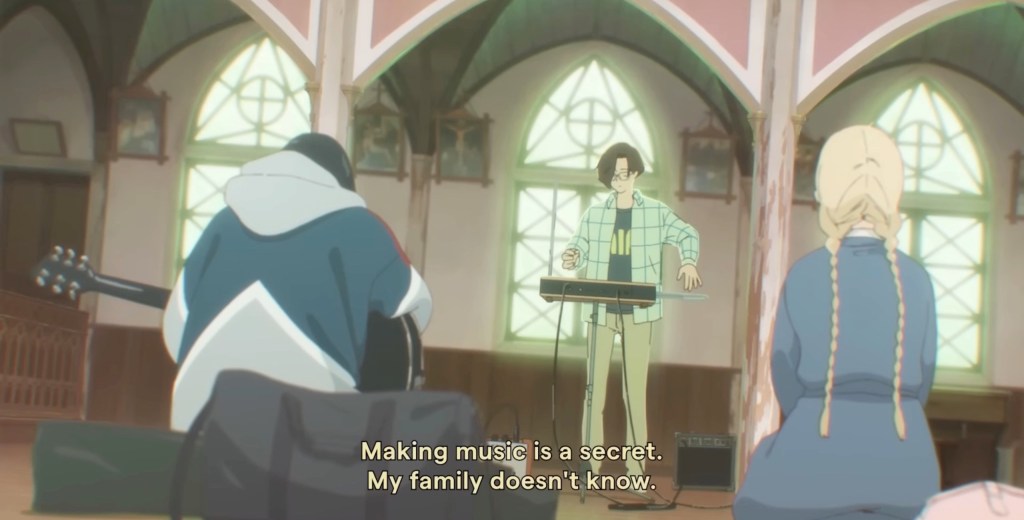
This unusual decentering of the band itself in the plot creates the breathing space for a compelling coming-of-age story to unfold, and one that applies to later life too. This isn’t a story arc with tidy answers or a climactic scene that resolves everyone’s problems. In fact, we never even really learn the full extent of what each character is dealing with. Their friendship is true, but it is also still very fresh and of the moment. They don’t share all that is on their hearts with one another—perhaps they are not even yet aware themselves—only enough to find fellowship with one another. They still have their secret, inner worlds; it’s just that now, there are points of overlap with the worlds of others, like a color wheel that has begun to bleed and blend. At the film’s screening in Scotland Loves Anime, Yamada explained that this lack of crisp, clear revelation and resolution was deliberate on her part: she wanted to handle these young people and their stories gently, because they were too kind for the world and had each been hurt by it. The gentleness of the film’s treatment of its protagonists is palpable, making The Colors Within Yamada’s kindest work yet.
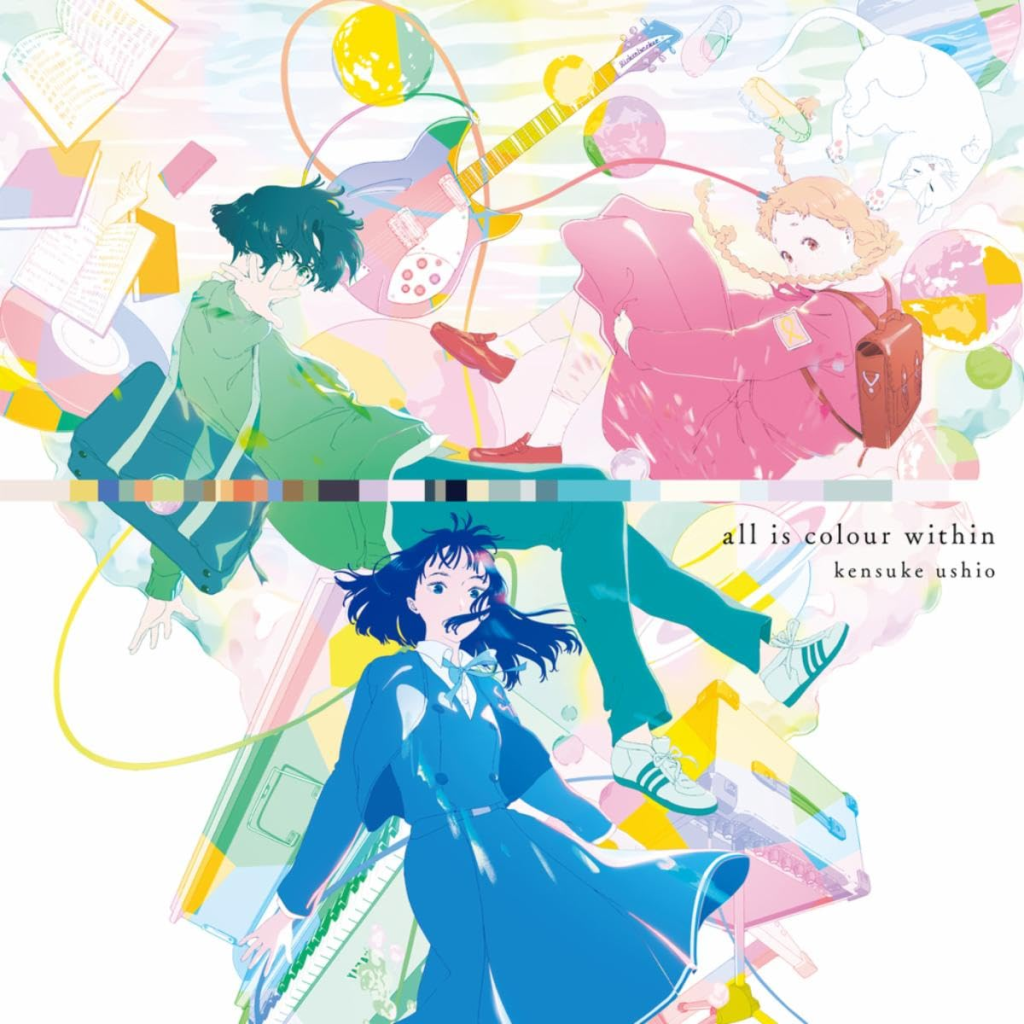
The subtlety of the storytelling is supported by the equally intentional, thoughtful soundtrack. White Cat Hall’s pieces represent quite the feat of composition for Yamada as lyricist and Ushio as songwriter, not to mention the recording artists of shironeko dou who capture the raw, unrehearsed energy of amateur talent in a way that is authentic and yet also well-produced. (It is not clear whether or not newcomer voice actresses Sayu Suzukawa, as Totsuko, and Akari Takaishi, as Kimi, sing as well, but their voice acting is superb, regardless.) Meanwhile, Ushio brings his trademark “sound otaku” sensibilities to the score, weaving location-based sound samples into his compositions to bring the sonic equivalent of added color to his tracks, as with, for instance, the particular sound of silence in a Nagasaki chapel on a snowy day that infuses a wintry “training camp” sequence. Use of the color metaphor here is quite appropriate, as the majority of Ushio’s track titles are in fact nine-digit RGB codes, creating a kind of synesthetic experience if you listen with the color before you. The titles correspond with the specific hues used in the color design of the film, which were, according to Yamada, chosen for their kindness. There are no jarring or enervating colors or contrasts to be found here. All is harmonious and welcoming, like a warm embrace.
This can very much be said of the film as a whole, as it weaves together with a light touch the lives of three lonely souls, while also inviting audiences to rest in the peace that the trio ultimately find. It’s the kind of film that compels repeat viewings, and rewards them too. So, dear reader, you can expect to hear more from us here at BtT about this beautiful, hope-filled film. Watch this space!
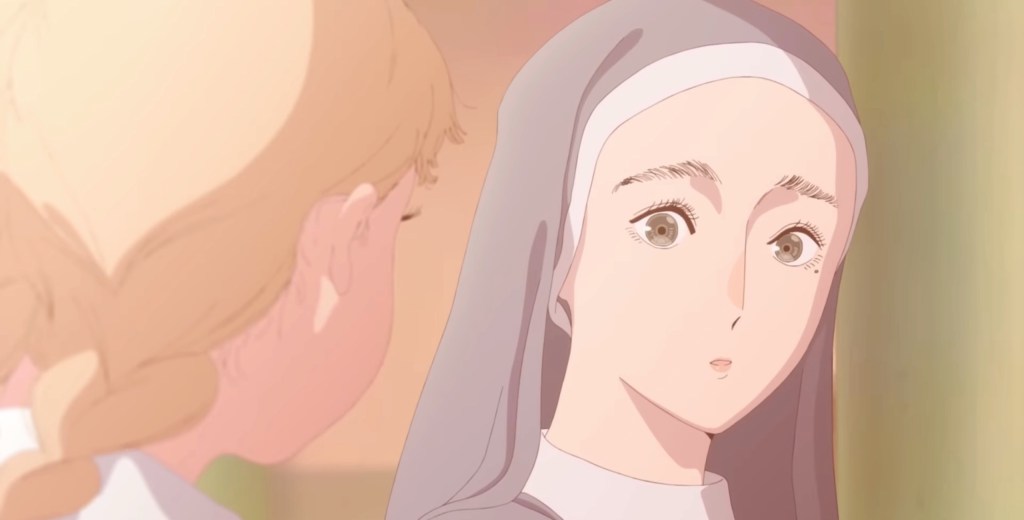
Also, Hiyoko-sensei is the best anime nun ever.
I was very fortunate to attend the world premiere of The Colors Within at the Annecy International Animation Film Festival in France in June 2024, and the Scottish premiere in Glasgow at Scotland Loves Anime in November. Yamada’s insights on her characters and Ushio’s work process were shared during talks at these screenings.
The Colors Within will be available for streaming on various platforms beginning April 1st. A BD + DVD combo, including a steelbook version, will be available for purchase starting May 27th.
All images taken from the official trailers.

[…] previous years, I simply wrote up reviews of some of the films I was able to see and posted them as the movies received international release […]