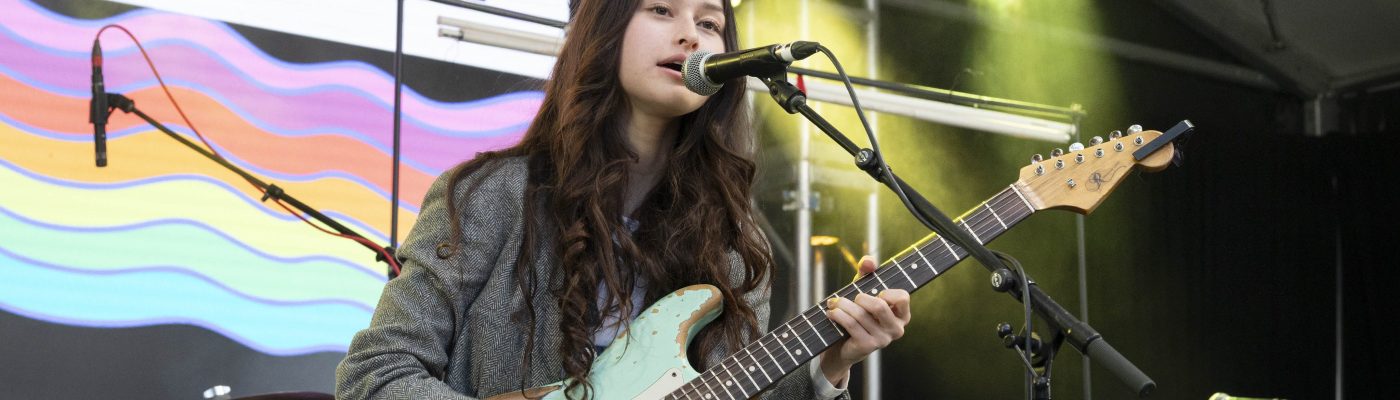
As the crowds began to assemble, finding seating on the field in front of the stage or lining up to buy food from vendors, I caught sight of a musician sitting cross-legged at the side of the festival stage, tuning her guitar. I immediately recognized this wispy, pretty young woman and wondered if others knew that she was about to go on stage and open the showcase. If they didn’t, they’d soon know her by her melodic tunes and powerful, precise voice.
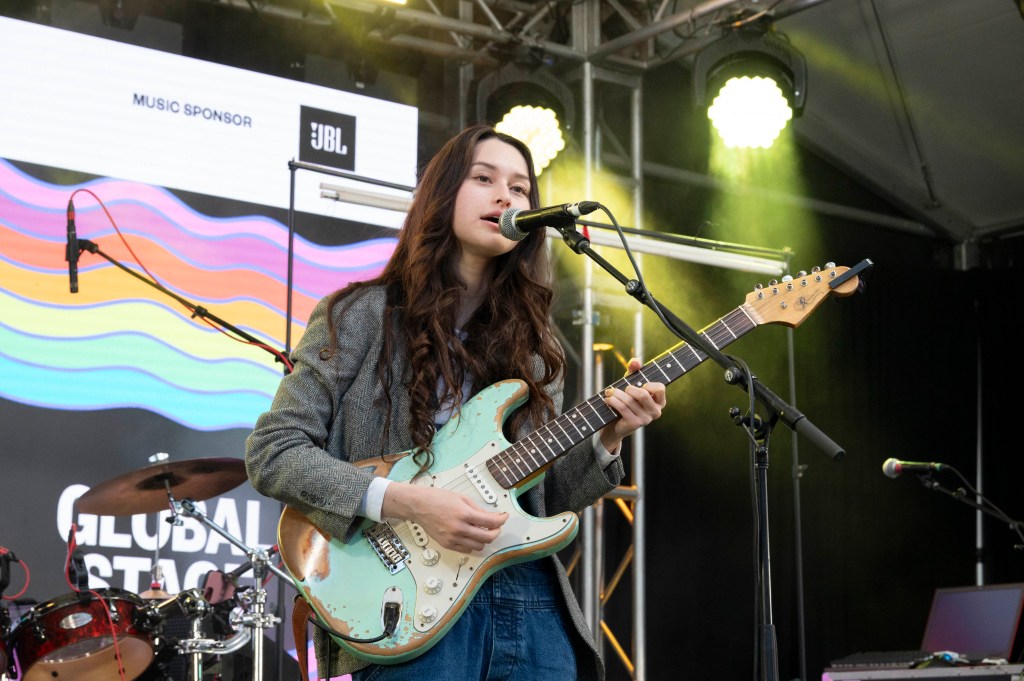
Indeed, when J-pop artist Rejay opened the TOKYO CALLING × INSPIRED BY TOKYO showcase during SXSW 2026, the venue still had that early-set energy—people wandering in and out, chatting with friends, scanning schedules, figuring out where they might head next. But as she began to sing, the dynamic shifted. Conversations faded. People who had been drifting around the space began turning toward the stage. Very quickly, people came to attention and cell phones went up, recording a dynamic performance.
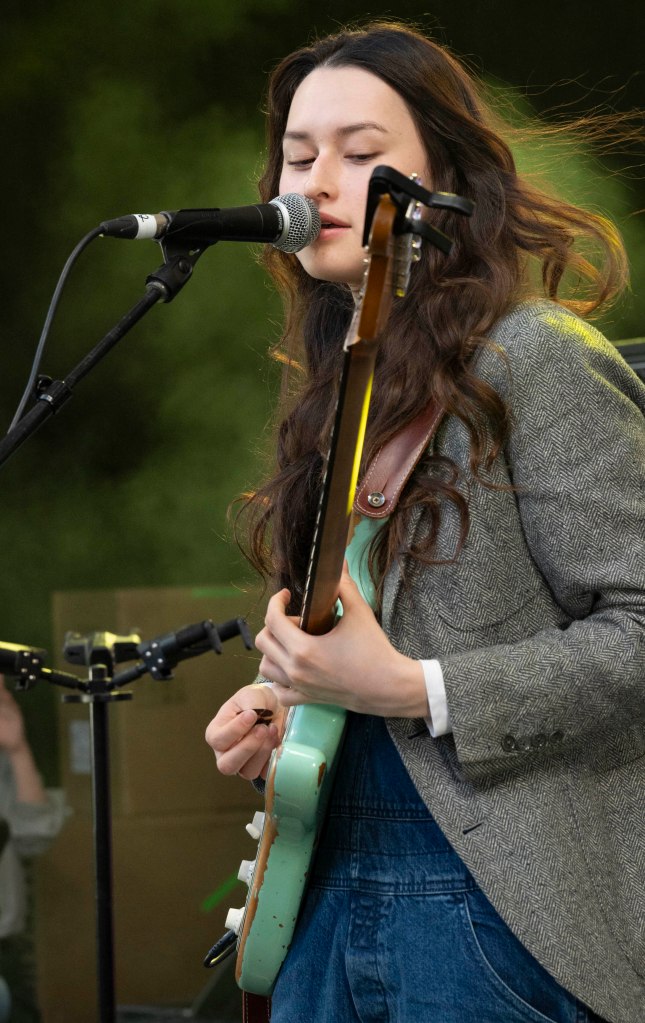
Rejay’s voice has that effect. It’s clear and expressive, full of warmth and emotion without ever feeling forced, and it carries a kind of sincerity that feels increasingly rare in live music. She is pitch-perfect and powerful—one of the best voices I’ve heard on a live stage. And hearing her perform reminded me of the first time I heard artists like Rie fu or even Jewel—singer-songwriters whose music balances vulnerability with melody and quiet confidence. Rejay’s sound feels very contemporary, sitting comfortably within today’s indie-pop landscape, but there’s also something timeless in the way she delivers a song.
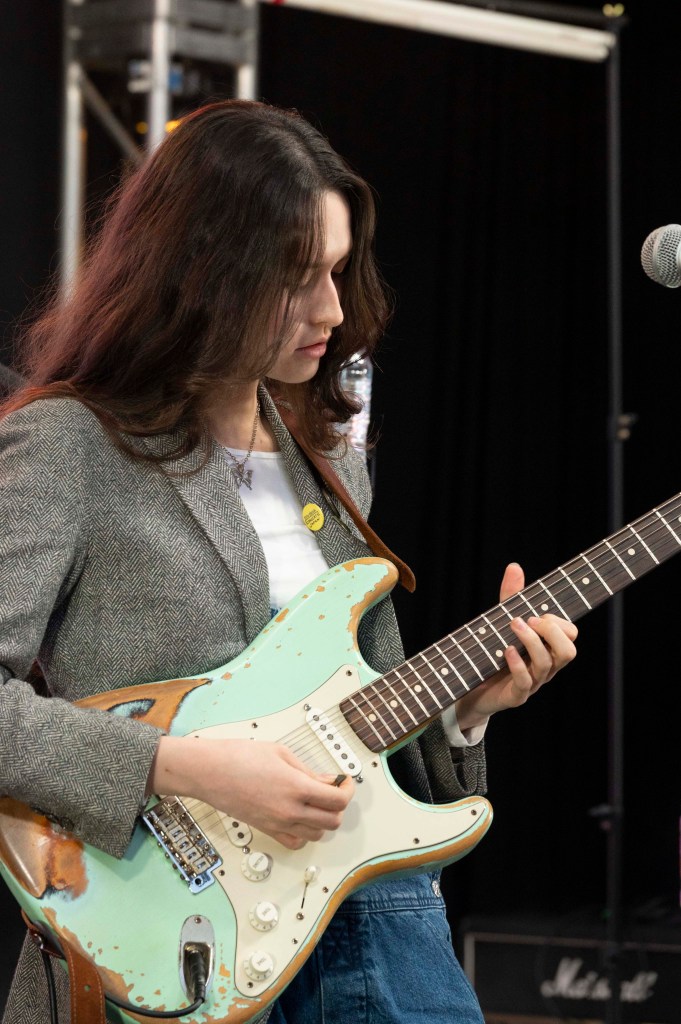
Rejay is also an instrumentalist; she played electric guitar throughout the set, moving easily between vocals and guitar lines with the relaxed assurance of someone who belongs onstage, even though I later learned she’d only picked up the instrument a couple of years ago.
The performance itself felt both intimate and expansive at the same time, the kind of set that gently pulls an audience into its orbit until suddenly everyone realizes they’ve been standing still for several songs, completely absorbed.
From Hokkaido to Tokyo to Austin
Although she was billed as part of Tokyo’s music set, Rejay’s journey into music began far from that city’s music scene. She grew up in the small town of Niseko on Japan’s northern island of Hokkaido, a quiet place surrounded by mountains and nature, and known internationally more for its ski slopes than for producing emerging pop artists.
When we spoke after the showcase, she described growing up in that country setting, one that shaped her creative instincts in ways she still feels today. Being surrounded by nature, she explained, influenced how she experiences emotion and how those emotions find their way into her songs.
She moved to Tokyo a couple of years ago to pursue music, though, and the transition opened new opportunities—collaborations, connections, the energy of a massive city filled with artists—but she admitted that living there can sometimes feel creatively constraining compared with the wide-open spaces she grew up with. When that feeling hits, she occasionally finds herself seeking out quiet places in the city, like sitting beside a nearby river to write lyrics, reconnecting in a small way with the natural environment that shaped her early life.
Discovering Music at Home
Music had always been present in her childhood home. Her father, who is Australian, played a wide range of artists around the house, exposing her to everything from The Beatles to Linkin Park to Sam Cooke. We laughed that her music is nothing like Linkin Park’s, but those early listening experiences nonetheless sparked her curiosity and encouraged her to explore music on her own, discovering artists she connected with and gradually developing her own taste.
Singing came first. She loved it from a young age, and it remained a constant presence in her life. Eventually, she picked up the acoustic guitar at age ten, and the combination of singing and guitar naturally led to songwriting. Over time, those elements blended together into the musical identity she continues to shape today.
Her current creative process often involves collaboration with a producer. Sometimes she brings in a demo she’s already created, and together they refine it and build out the arrangement. Other times, the process begins more organically in the studio, starting with a beat or a musical idea and slowly forming into something complete. The approach varies from song to song, but in each case, the goal remains the same—finding the best way to express the emotion at the heart of the music.
A Conversation After the Show
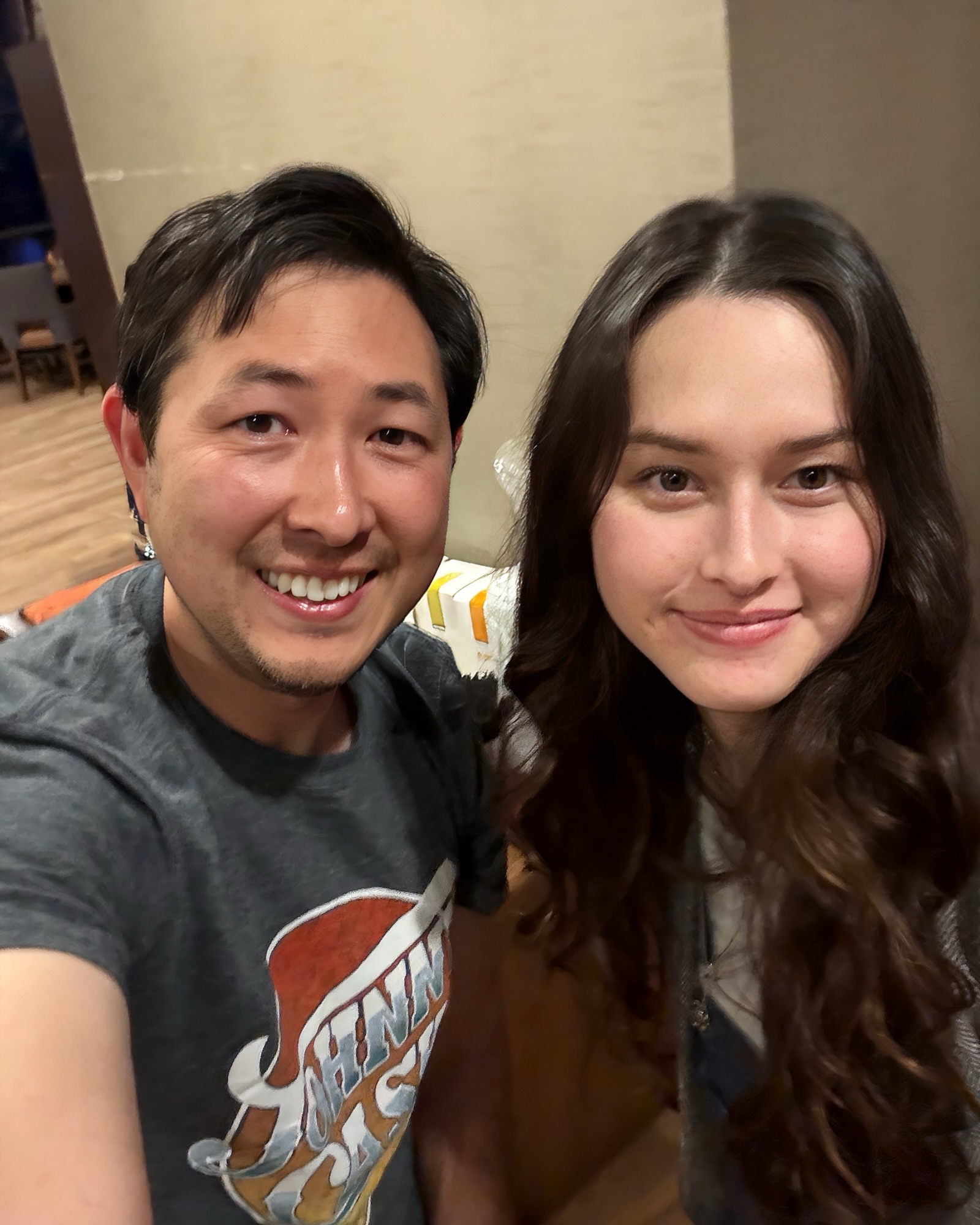
After the performance, Rejay sat down with me for an interview, and what stood out immediately was how open and warm she was throughout the conversation. SXSW can be a whirlwind for artists, with performances stacked between interviews and meetings, yet she spoke thoughtfully and patiently, answering questions with a mixture of humility and enthusiasm.
At one point, she even asked if I could help her navigate the SXSW app, handing over her phone so I could show her how to find something she was looking for. It was a small moment, but it said something meaningful about her personality. There was no sense of distance or guardedness—just an artist curious about the festival around her and happy to engage with the people she met.
Her English, incidentally, is excellent. Although she modestly insisted it isn’t perfect, she communicates comfortably and thoughtfully, moving easily between languages much the same way her music often blends Japanese and English lyrics far more than the typical J-pop artist’s does.
Reaching Beyond Japan
That bilingual approach is intentional. Rejay hopes her music will connect not only with Japanese audiences but also with listeners abroad, particularly in English-speaking countries. Achieving that balance isn’t always easy; audiences in Japan often prefer songs entirely in Japanese, while international listeners tend to gravitate toward English lyrics. Still, she believes artists like herself can help bridge that gap.
“It’s a challenge,” she said, reflecting on the effort to reach global audiences while remaining authentic to her roots. “But I feel like we will get there.”
Rejay noted that she’s not alone in this endeavor. There are other artists trending toward using more English lyrics, and that now may be “the time” for the transition for their music to be heard by English-speaking audiences to occur.
Songs and Performance That Define Her
When I asked which songs best represent her as an artist, she mentioned two immediately. The first was her debut track, “Too Late,” a low-fi indie-pop song that has become her most widely streamed and one that remains deeply meaningful to her. The other was “Meant to Be,” which she performed during the showcase and which captures much of what defines her sound: melodic, emotional, and quietly sincere.
Both songs offer a good entry point for anyone discovering her music for the first time. Incidentally, there’s a wonderful live version of “Meant to Be” on her YouTube channel that shows you how excellent she is live.
I noted to Rejay that she seems very comfortable on the stage. It’s almost surprising because while she shows a youth exuberance, she doesn’t express this wild personality that I saw more in the J-Rock acts. But as she noted to me, she feels quite at home performing for a crowd. If you get the chance to hear her live—and maybe SXSW will bring Rejay back next year—I encourage you to do so and see what I’m talking about.
An Artist I’m Rooting For
SXSW introduces audiences to hundreds of artists every year, and many of them leave a strong impression. Yet occasionally you encounter someone whose talent and personality combine in a way that makes you genuinely hope things work out for them.
That’s the feeling I had after meeting Rejay.
Her music is thoughtful and emotionally resonant, her live performance is compelling, and she carries herself with a humility and openness that makes it easy to want to see her succeed. More than anything, she seems driven by a simple goal: she wants her music to reach people and move them.
Listening to her perform, it’s hard not to think that goal is well within reach.
If Western audiences haven’t discovered Rejay yet, I suspect it’s only a matter of time. And when they do, they’ll find an artist whose voice—and whose sincerity—make her well worth paying attention to.
You can listen to Rejay on Spotify and Apple Music, subscribe to her YouTube, and follow her on Instagram and Twitter.

- First Impression: Botan Kamiina Fully Blossoms When Drunk - 04.10.2026
- First Impression: A Hundred Scenes of AWAJIMA - 04.09.2026
- First Impression: Eren the Southpaw - 04.08.2026