
Attack on Titan is a brutal show, not only because of the amount of gore on display, but because of the characters’ absolute faith in a leader who calls them to leave everything behind and join the war against the titans. Leaders of this cause, like Commander Erwin Smith and Captain Levi Ackerman, can be both inspiring and intimidating with their resolute courage and belief. Yet, it is in the story of these leaders that we can see a model for what a life of faith in Christ looks like: answering a challenging call with determination to follow the right leader without regrets.
One of the best examples of this is actually not in the main series, but in a two-part OAD called No Regrets, which shows us Captain Levi’s origin story. Spoilers ahead!

Captain Levi as we know him in Attack on Titan is the most feared and skillful member of the Survey Corps. He is a man of few words, seemingly cold and detached from the tragedy of death that surrounds him, ready to kill at a moment’s notice. But in No Regrets we see a younger Levi, an orphan living in an underground city, seeking the freedom to live above ground and stealing his way to the top. At this point in his life, Levi is clearly a criminal, though a sympathetic one who is shown to have hidden compassion for others, especially his two friends and partners in crime, Furlan and Isabel.
But Levi and his friends get in over their heads when they strike a bargain with a corrupt politician named Lobov, and agree to kill military Commander Erwin Smith in exchange for a life on the surface. Obviously, trusting a shady politician and conspiring to murder a military official is a terrible plan, but the three friends are desperate, and this fast track to the top seems to be their only option.
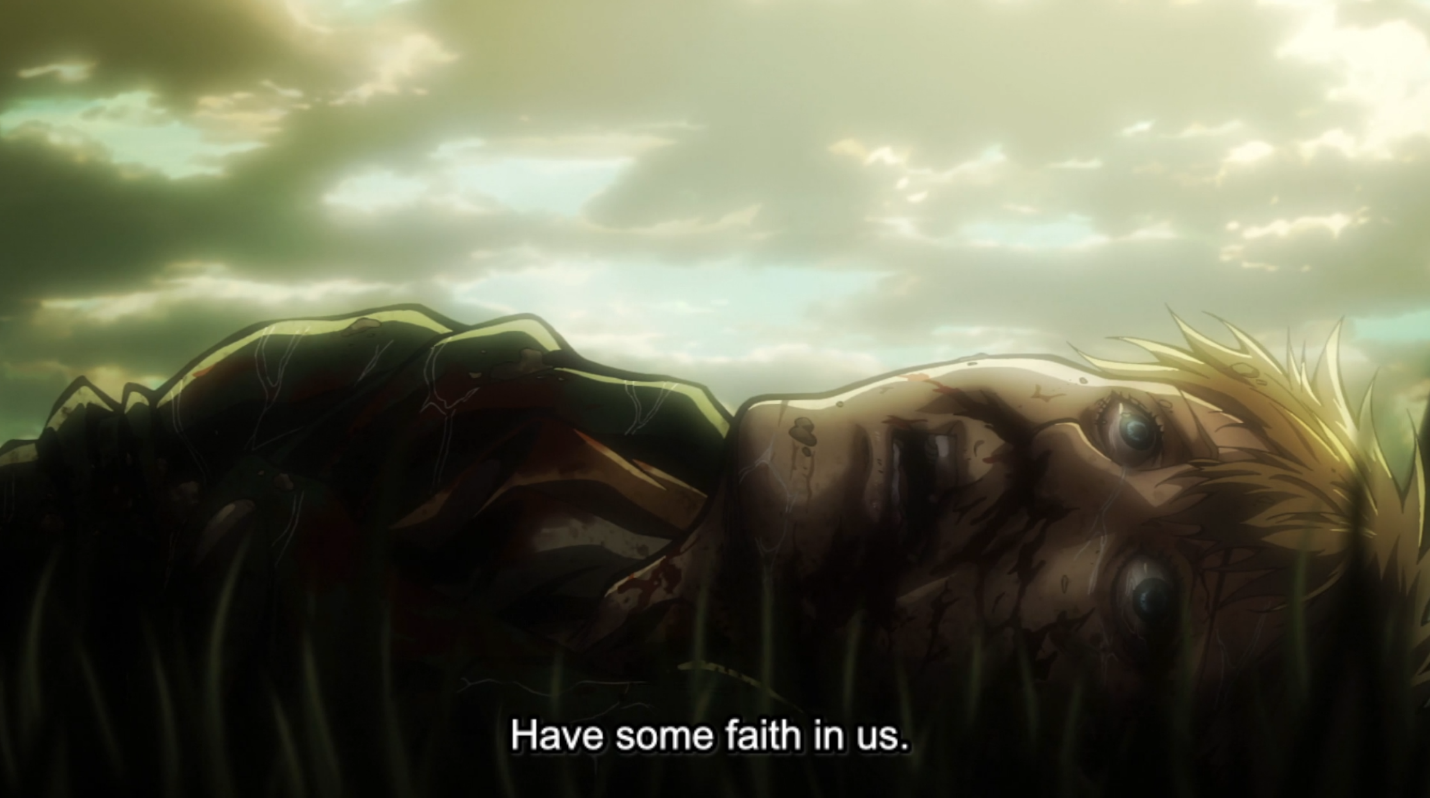
Levi and his friends accept the deal, but things quickly turn sour. After they join the Survey Corps to begin their undercover work, Levi sees how dangerous the situation is and tries to leave his friends behind on the mission to keep them safe and ensure that only he is risking his life while trying to kill Erwin. But Furlan and Isabel plead their case as to why Levi should let them help, asking him to have faith in them. He hears them out and agrees to have them join him on the mission.
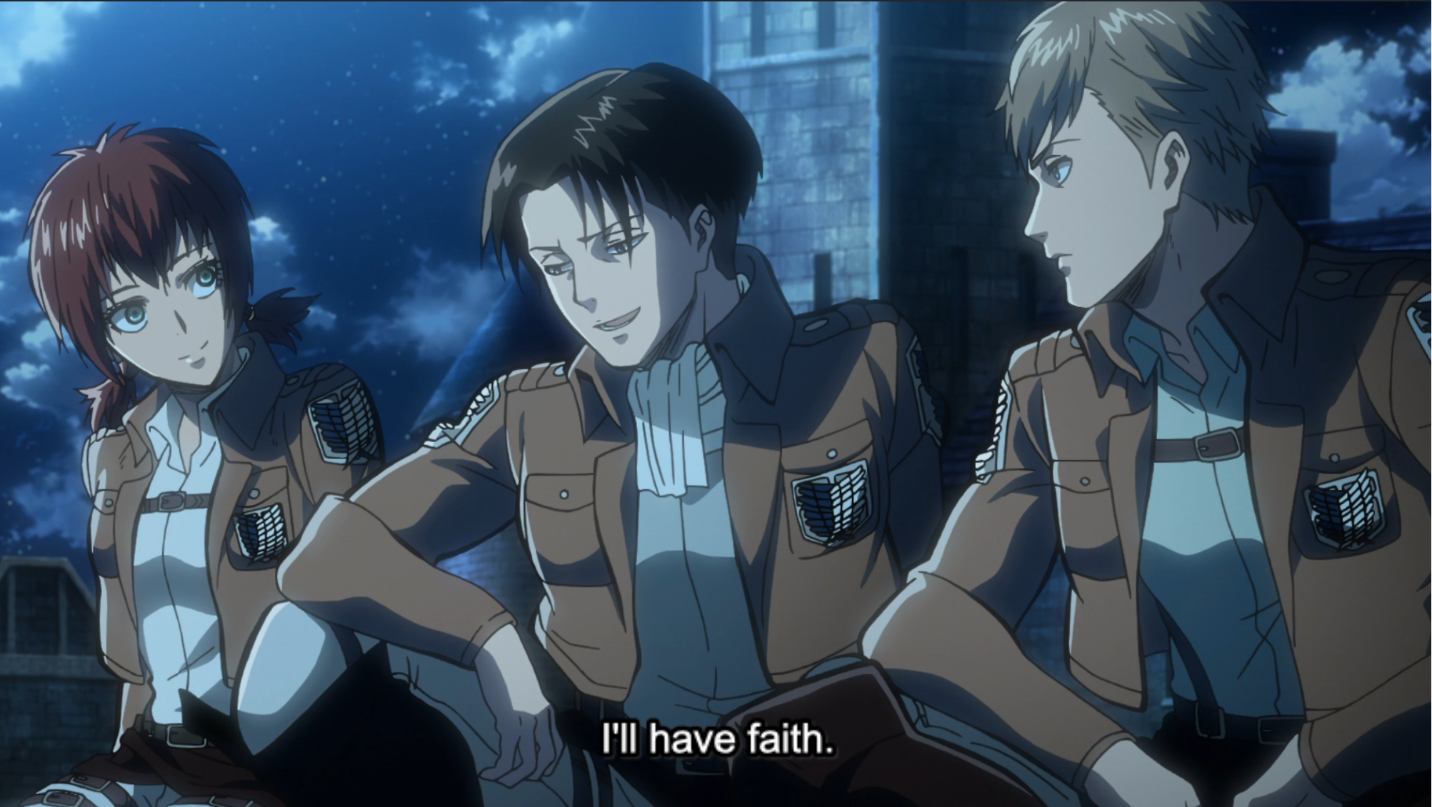
But things don’t go according to plan. They embark on their first Survey Corps mission with the hopes of killing Commander Erwin, but not long after an encounter with some titans, his two closest friends are killed in combat. To make matters worse, Erwin finds Levi on the battlefield and reveals to him that he knew of their plot all along. Levi falls to his knees in defeat, staring at the remains of his friends. Their cold, dead eyes haunt him as he thinks back with regret on their call for him to have faith in them.
With his only friends dead, and his dream of living free on the surface shattered, Levi begins to sink into himself. It is here, when Levi is at his lowest point, that Erwin intervenes. Rather than killing the would-be assassin, he instead keeps him from spiraling into despair by speaking directly into his situation. As he speaks, it is as if he knows exactly what is going on in Levi’s mind: “If you begin to regret, you’ll dull your future decisions and let others make your choices for you. All that’s left for you then is to die.”
Levi listens to Erwin’s words as he kneels among the dead bodies strewn across the battlefield. We may not know what Levi is thinking, but his face says it all. Levi had put his faith in his friends, believing that their plan would succeed and that they would stay together. But that faith was not rewarded, and both of his friends died. Levi was experiencing a crisis of faith.
But Erwin continues, “Nobody can foretell the outcome. Each decision you make holds meaning only by affecting your next decision.” He then turns and gives Levi a straightforward call: “We’re going to continue the expeditions. Levi, I expect you to come with me.”
With that, Erwin takes a look at the dead bodies on the ground, then rides on, leaving Levi to make his decision to follow him or not.

In the final scene of No Regrets, we flash forward as Levi, now a member of the Survey Corps, prepares to embark on another expedition. While acknowledging the unknown before him, Levi makes his resolve clear: “I don’t understand. I’ve never understood. Even if I believe in my own strength… Even if I believe in the decisions of my trusted friends… In the end, nobody…” Levi pauses as if still grappling with the loss of his friends at the hands of his misplaced faith. His incomplete thought leaves the audience hanging. In the end, nobody… what? Nobody understands? Nobody lives? Nobody can put their faith in anyone else? Perhaps Levi trails off here because he is still wrestling with his beliefs.
He then looks ahead at Erwin riding ahead of him, ready to lead the opening charge of their next expedition. Levi makes a resolution in this moment: “But this man is gazing up at something I can’t even see. Fine. I’ll follow you, Erwin Smith. I will never regret this decision for as long as I live.”
This scene is so emotional because Levi, as cold and detached as he may seem, has found something to believe in. You would think that someone as cynical as Levi wouldn’t decide to follow Erwin and continue as a member of the Survey Corps. It would be more likely that he would go his own way and live life like the lone wolf he appears to be.
Instead, he makes the choice to put his faith in Erwin and follow him.

Levi’s decision to answer the call and follow Erwin must not be understated. This choice changed his entire life, and there was a massive cost to it. But here’s the thing, the truth is that all of us have a similar decision to make: to put our faith in and follow the right person, and to weigh the cost of making that decision so that we have no regrets.
But how can we know if we are making the right decision? This is an especially difficult question when it comes to matters of belief. The cost of choosing which person or belief system to follow can be high, and this is exactly what Jesus spoke about when three prospective disciples played with the idea of following him in Luke 9:57-62. The imagery that Jesus used in his answers to them is actually on full display in No Regrets, and much like the episode, startled his audience and left people wondering if answering the call to follow Jesus was actually worth it. Let’s take a look at each of these three interactions.
In the first one, Jesus addresses the sacrifice of security inherent to the call. “As they were going along the road, someone said to Him, ‘I will follow you wherever you go.’ And Jesus said to him, ‘Foxes have holes, and birds of the air have nests, but the Son of Man has nowhere to lay His head.’” Pointing out that he is homeless, Jesus illustrates that following him means giving up the security that comes with a normal life and worldly possessions–even wild animals have more security than Jesus’s followers. If Jesus is trying to get lots of people to follow him, you wouldn’t think this would be his leading line!
In the second interaction, Jesus emphasizes the immediacy of the call. “To another, He said, ‘Follow me.’ But he said, ‘Lord, let me first go and bury my dead father.’ And Jesus said to him, ‘Leave the dead to bury their own dead. But as far as you, go and proclaim the Kingdom of God.’” This can be a challenging statement from Jesus. In the first century, it was normal for Jews to have two burials. In the first, the body was placed in a tomb or cave for about a year while the flesh decomposed. Once the flesh was all gone, the bones would be gathered and placed in a box called an ossuary for the second burial. It is likely that this person had already buried his father the first time, and was in the year-long process of waiting for his father’s second burial.
Jesus’s strong statement to let the dead bury their own dead is his way of saying, “Your father is already dead. Let the dead take care of him now. You have a much more important calling to answer.” Jesus’s statements are not arguing for insensitivity or disrespect of funerals or families, but they do make the cost of discipleship very clear: We can’t put off the call. We can’t procrastinate or come up with excuses. We can’t focus on the past with regret. We need to be focused on living out our calling here and now rather than missing out on what God wants for us by focusing on the dead. Just as Erwin called Levi to leave his dead friends behind and focus on the decision to follow him, so too does Jesus call us to leave our past behind us, look forward, and focus on Him.

Notice how the two swords make an X or cross shape. This is a visual representation that Erwin’s call is like Christ’s call to “pick up our cross and follow him.” It is a path of suffering that will lead to a future hope.
In the third interaction, Jesus illustrates the resolve needed for the call. “Yet another said, ‘I will follow you, Lord, but let me first say farewell to those at my home.’ Jesus said to him, ‘No one who puts his hand to the plow and looks back is fit for the Kingdom of God.’” This statement is layered with meaning. The idea of putting one’s hand to the plow speaks of committing to a task and beginning a new work. Jesus even uses the plow as a metaphor to align with several of his parables where He is depicted as a farmer bringing in the harvest. Like Erwin, Jesus teaches about regret, making our need for resolve clear: You can’t look back once you step forward. The decision must be made definitively and without regret. We must put our hands to the plow.
Interestingly, Levi Ackerman is linked to this verse through his name. Ackerman is a German last name which is a variation of “acre man” or farmer. Its original meaning is “plowman” or one who uses the plow. (Coincidence? I think NOT!)

Jesus’s call to follow Him is as brutal and hard-hitting as Attack on Titan’s discussions of death and regret. Like Erwin’s call to Levi, Jesus’s call to us is no walk in the park. It isn’t a promise that everything will be easy or that all of our dreams will come true. In fact, he promises hardship and tribulation in this world. As Dietrich Bonhoeffer once wrote, “When Christ calls a man, He bids him ‘come and die.’” This calling is not a popular one nor a socially acceptable one. And yet, he calls us.
When Erwin calls Levi to follow him, what does Levi do? He leaves the bodies of his friends on the battlefield. He leaves his old life as a criminal behind. He chooses to follow a man who he doesn’t even know, but who he can tell is gazing at something he can’t see. The call Erwin has given him is a difficult one. But Erwin has a hope that is founded in something real, and Levi determines that he will never regret his decision.

What if we had the same kind of resolve Levi had to follow after Jesus? Sometimes, we fall into regret because of difficult circumstances in life. Maybe we miss the security that comes with our old way of life and we begin to wish that we could live the way we used to–perhaps because it is easier or because we want to be just like the rest of the world. When this happens, as Erwin Smith says, we will dull our future decisions and let others make our choices for us. Then all that is left for us is death. But when we follow Jesus without regret, we can live life unmoved by the push and pull of outside influences and stand resolute in who Christ has called us to be and what Christ has called us to do. It is then that we can live out the words of the old hymn, “I have decided to follow Jesus. No turning back. Though none go with me, still I will follow. No turning back. The cross before me, the world behind me. No turning back.”
Levi’s interaction with Erwin shows us that it isn’t having faith or placing your trust in others that is the problem. The real problem is deciding who or what to put your faith in. Levi makes this decision several times in No Regrets. Putting his faith in the corrupt politician Lobov was the wrong decision. Putting his faith in his friends to steal and kill their way to the good life was the wrong decision. But putting his faith in Erwin was the right decision, and had a massive impact on his life.

So what makes Erwin so special? Lobov was deceptive. Isabel and Furlan made promises they couldn’t keep. But as Levi puts it, “This man is gazing up at something I can’t even see.” Erwin is a man who is driven by hope and purpose, and is not only able to share that hope and purpose, but is ultimately able to give Levi the new life of freedom he has been searching for. He believes in something that Levi hasn’t even begun to fully understand. But somehow, Levi knows this thing that Erwin is looking at is real. And it is on the basis of this faith that Levi makes the decision to follow him.
Like Levi, we are surrounded by many voices asking us to have faith in them. So how are we supposed to know the right call to follow? Some voices are out to intentionally trick us and take advantage of us, telling us what we want to hear and offering us happiness that is too good to be true, like Lobov. Other voices have great intentions but are nonetheless misleading, offering immoral shortcuts in order to gain happiness, like Furlan and Isabel. But there is one man, like Erwin Smith, whose words give us hope and purpose, and who is gazing up at something we can’t even see. Like Erwin, who gives Levi a new life above ground, this man is the one who can lead us into a new life of hope, purpose, and freedom. This is Jesus, the only man who is able to gaze up at the God we could not see, and make it possible for us to see Him (John 6:46).
So, when we look at the life of Levi Ackerman and then look at our own lives, it moves us to wonder: Are we willing to leave everything behind and follow Jesus, or are we holding onto our old life? Are we willing to no longer put our faith in things that will fail us and put our faith in Jesus instead? Just as Erwin Smith comes to a criminal like Levi and tells the broken young man to follow him, Jesus has come to us, people who are broken in sin, and says, “Follow me.” It is when we answer the call to follow Him that we are infused with the hope, purpose, and freedom that only Christ is able to give us, and as Levi puts it, we will never regret the decision as long as we live.

We are delighted to welcome new Guest Writer Jake Potter! Jake is the student pastor at Christ Fellowship in McKinney, TX and the vocalist of metal band Crucify The Flesh. He discovered a love for anime when God put missions in Japan on his heart. You can follow him on Instagram @the_jake_potter.
Attack on Titan: No Regrets can be streamed on Crunchyroll.
- First Impression: Mobile Suit Gundam GQuuuuuuX – Beginning - 03.08.2025
- First Impression: Yu-Gi-Oh! Go Rush!! - 01.11.2025
- First Impression: Übel Blatt - 01.10.2025

This was such a deeply moving article and have tears in my eyes. Thank you for writing and sharing this!
Thanks Laura! I’m glad that it was so moving!
Extremely well written and motivational Jake! Loved it! My favorite part…
But when we follow Jesus without regret, we can live life unmoved by the push and pull of outside influences and stand resolute in who Christ has called us to be and what Christ has called us to do. It is then that we can live out the words of the old hymn, “I have decided to follow Jesus. No turning back. Though none go with me, still I will follow. No turning back. The cross before me, the world behind me. No turning back.”
This is so interesting! I’m not a big AoT fan so far, but I feel I’ll be thinking about your words over and over, especially towards the end of the article. The way you describe the way of the Lord is very adventurous. Thank you so much, Jake!
I’ve looked at a lot of anime websites, but Satoru is among the greatest for watching anime! This is a good choice if you want to watch anime for free online. While trustworthy free anime websites are hard to come by, this one offers hassle-free HD anime viewing. Unquestionably a must-try for anyone looking for free anime websites or finding new anime websites online. I now use it to watch anime and browse the best free anime websites. I heartily recommend it to all anime fans!
This article offers such a fresh and thoughtful perspective on Levi’s journey—really resonated with how “discipleship” can be messy but meaningful. For fans inspired by AOT and seeking good anime content, I’ve been exploring sites like Satoru lately. It’s one of the better anime websites I’ve found to watch anime online, especially when looking for places to watch anime free with smooth performance. Posts like yours help us see anime in deeper ways—thanks for that!
Wow didn’t know Attack on Titan has such small references to being a Christ follower. I used to think this show was just fantasy and over the top violence but inside lay a small message to take up and sacrifice something not easy and could be missed.