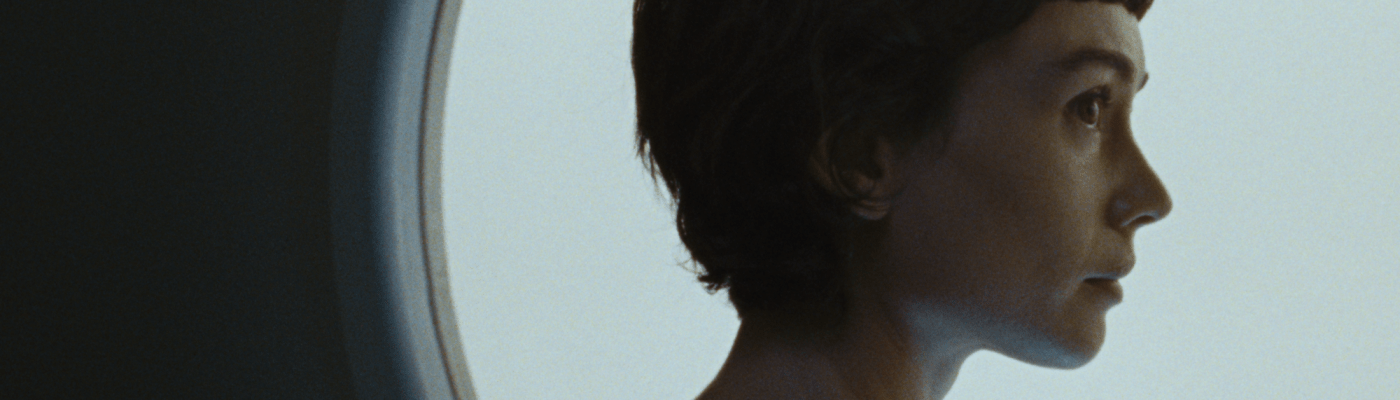
Anima, the narrative feature debut by director Brian Tetsuro Ivie, is described as a sci-fi comedy drama. It’s also a road movie. That’s a lot of labels for a 96-minute film to carry. And while Anima touches all those notes with an understated sincerity, it’s probably best described more simply: it’s a story about two hurting souls connecting over what matters in life (and what matters in death).
Those two souls are Paul, a Japanese button manufacturer with a terminal illness, and Beck, a young woman hired to drive him to Anima Technologies, where his consciousness will supposedly be preserved to “live forever.” The premise is unmistakably science fiction, but the film feels grounded in a future that’s only slightly beyond our own. The technology itself is unsettling. Through Beck’s introduction to the facility, we only glimpse how the process works and how loved ones might access the preserved consciousness of the dead. Is it real? Is it something else entirely?
Beck’s mother dismisses the company as a group of “death capitalists,” and Beck initially seems indifferent. Yet from the beginning, she asks questions that hint at deeper unease—like why Anima would select her specifically to drive Paul to the facility. Something about the arrangement doesn’t quite sit right with her.
Paul, meanwhile, appears almost too willing to accept Anima’s promises (after hearing about the company through a blog). His main concern during the journey is stopping along the way to visit certain people—perhaps to seek forgiveness or settle unfinished business. Stern, reserved, and often cantankerous, he initially seems like Beck’s opposite. But as the miles pass, the film gently suggests that the two may have more in common than either of them expects.
Road movies have a particular strength: Even as they take us to new places and occasionally absurd situations (there are a couple in this movie), they give us time to sit with their characters. The best of them allow us to watch people change—not through grand revelations, but through small, human interactions. Anima largely succeeds on this front. Ivie’s script feels authentic and refreshingly restrained, avoiding the kind of sentimentality that could easily overwhelm a story like this.
The performances help immensely. Sydney Chandler (Alien: Earth) has one of the most expressive faces in Hollywood right now. Much of Beck’s inner life is revealed through subtle shifts in her expression; her eyes often communicate more truth than her words, particularly in the early scenes when she’s still avoiding the deeper questions raised by the journey and her own demons.
Takehiro Hira (Shōgun) is even more compelling. Whether sitting in silence or sharply chastising Beck, he brings a quiet refinement and emotional depth to Paul that makes the character endlessly watchable. In fact, I think I could watch Hira act all day long in any movie and leave satisfied.
There’s also a surprising standout performance from Maximilian Lee Piazza, whom our viewers may recognize as the young Zoro in the live-action One Piece. Without spoiling his role, it’s safe to say that his presence becomes critical to the film in ways audiences may not expect—and he delivers it well.
Music plays an important role as well. The soundtrack moves between lovely J-pop, saxophone pieces, and other selections that weave gently through the narrative. The film’s first half occasionally feels a bit uneven in rhythm, but once music shifts from being a passing motif to a meaningful narrative device, the story finds a stronger emotional flow that carries through to its thoughtful conclusion.
It’s also worth noting that Ivie is a filmmaker of faith. I first became aware of his work through The Drop Box, his documentary about a Korean pastor who cares for abandoned infants. Anima never becomes preachy or overtly theological, but it carries a similar conviction beneath its story: that human life has meaning, that relationships matter, and that grace shapes the paths we walk.
In the end, the quiet strength of Anima lies in that restraint. Anchored by moving performances from Chandler and Hira—and supported by a thoughtful script that trusts the audience to sit with its questions —the film ultimately invites viewers to consider what life and death mean in the here and now.
Photo Credit: Kebrado

- First Impression: GHOST CONCERT : missing Songs - 04.05.2026
- He Is Risen! Happy Easter to the Doubters, the Failures, and the Thieves - 04.05.2026
- First Impression: Mao - 04.04.2026

[…] Read my full review here. […]